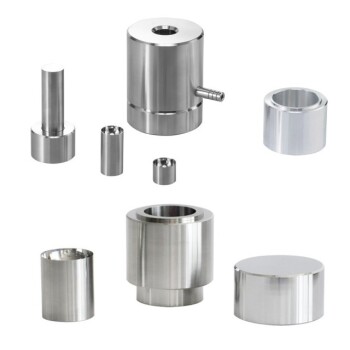
A laboratory press is the fundamental tool for structural densification. It transforms uniformly mixed phosphate composite electrolyte powder into high-density thin-film disks—typically 20 mm in diameter and 2 mm in thickness—by applying immense physical pressure within a mold. This mechanical compression is the primary driver for achieving the material properties required for operation at temperatures between 200°C and 300°C.
The laboratory press does more than shape the material; it fundamentally alters the electrolyte's microstructure. By eliminating internal voids and maximizing density, the press ensures the high ionic conductivity and mechanical strength required for reliable battery performance.
The Critical Role of High-Density Molding
To understand the press's contribution, one must look beyond the shape of the disk to the microscopic interaction of particles. The press acts as a bridge between raw powder and a functional ceramic component.
Maximizing Ionic Conductivity
The primary reference indicates that achieving high density is critical for performance. The press compacts loose powder to approach its theoretical density, which significantly reduces the contact resistance between individual particles.
By minimizing the space between grains, the press facilitates easier ion movement. This is vital for maintaining optimal conductivity, particularly when the electrolyte is subjected to high operating temperatures (200°C–300°C).
Eliminating Internal Voids
Raw electrolyte powder contains significant air gaps. The laboratory press applies sufficient force to collapse these voids, creating a continuous solid structure.
This reduction in porosity is not merely cosmetic; it directly dictates the mechanical strength of the electrolyte disks. A denser disk is less prone to fracturing under thermal or mechanical stress within a battery cell.
Advanced Pressure Control Mechanisms
While raw force creates density, the stability of that force determines the quality of the final sample. Modern laboratory presses utilize specific mechanisms to ensure uniformity.
Pressure Holding for Defect Prevention
Advanced presses feature an automatic pressure-holding function. This maintains a constant extrusion state, compensating for the natural rearrangement of particles or plastic deformation that occurs during compaction.
Improving Sample Yield
Stable pressure holding allows time for internal gases to escape the mold. This controlled process prevents lamination or layer cracking, which often occurs if pressure fluctuates or is released too rapidly.
By preventing these structural defects, the press significantly increases the yield of usable samples and ensures consistent performance across different batches.
Understanding the Trade-offs
While a standard laboratory press is essential, it is important to recognize the limitations of different pressing techniques to avoid common processing pitfalls.
Unidirectional vs. Isostatic Pressing
A standard hydraulic press typically applies unidirectional pressure. While effective for thin disks, this can sometimes create density gradients where the edges are denser than the center, or vice versa.
In contrast, a Cold Isostatic Press (CIP) applies uniform, omnidirectional pressure through a liquid medium. This eliminates internal stresses and density gradients, providing superior resistance against lithium dendrite penetration, though it requires more complex equipment.
Thermal-Mechanical Coupling
Standard pressing relies on mechanical force alone. However, some composite formulations benefit from heated pressing, where temperature softens the matrix (such as PEO) while pressure is applied.
If your phosphate composite includes polymer components, a press without temperature control may fail to achieve full penetration of the polymer into ceramic gaps, resulting in suboptimal interfacial compatibility.
Making the Right Choice for Your Goal
The specific configuration of your pressing process should be dictated by the performance metrics that matter most to your application.
- If your primary focus is Ionic Conductivity: Prioritize high pressure (up to 300 MPa) to maximize grain boundary contact and reduce internal resistance.
- If your primary focus is Structural Integrity: Utilize a press with an automatic pressure-holding function to allow gas release and prevent lamination cracks.
- If your primary focus is Large-Scale Homogeneity: Consider isostatic pressing (CIP) to eliminate density gradients and internal stresses that occur in larger samples.
The laboratory press is not just a molding tool; it is the gatekeeper of your electrolyte’s electrochemical efficiency.
Summary Table:
| Feature | Impact on Phosphate Composite Electrolytes | Key Benefit |
|---|---|---|
| High-Pressure Compaction | Minimizes grain boundary contact resistance | Maximizes ionic conductivity at 200°C–300°C |
| Void Elimination | Collapses internal air gaps and pores | Enhances mechanical strength and fracture resistance |
| Pressure Holding | Compensates for particle rearrangement | Prevents lamination, cracking, and structural defects |
| Isostatic Pressing | Applies uniform omnidirectional pressure | Eliminates density gradients and improves dendrite resistance |
| Heated Pressing | Softens polymer matrices during compression | Improves interfacial compatibility in ceramic-polymer composites |
Elevate Your Battery Research with KINTEK Precision
At KINTEK, we understand that the performance of your phosphate composite electrolytes depends on the precision of your molding process. Our comprehensive laboratory pressing solutions are designed to provide the exact pressure control and stability needed for high-performance battery materials.
Why Choose KINTEK?
- Versatile Range: From manual and automatic to heated and multifunctional models.
- Advanced Capabilities: Specialized glovebox-compatible designs and Cold/Warm Isostatic Presses (CIP/WIP).
- Optimized Results: Achieve theoretical density, minimize internal voids, and ensure consistent ionic conductivity across every sample.
Ready to transform your electrolyte powder into high-density, high-performance disks? Contact us today to find the perfect pressing solution for your lab!
References
- Shintaroh Nagaishi, Jun Kubota. Ammonia synthesis from nitrogen and steam using electrochemical cells with a hydrogen-permeable membrane and Ru/Cs<sup>+</sup>/C catalysts. DOI: 10.1039/d3se01527k
This article is also based on technical information from Kintek Solution Knowledge Base .
Related Products
- XRF KBR Plastic Ring Lab Powder Pellet Pressing Mold for FTIR
- Lab XRF Boric Acid Powder Pellet Pressing Mold for Laboratory Use
- Lab Round Bidirectional Press Mold
- XRF KBR Steel Ring Lab Powder Pellet Pressing Mold for FTIR
- Lab Polygon Press Mold
People Also Ask
- What is the purpose of making KBr pellets for FTIR? Achieve Precise Molecular Analysis with Solid Samples
- What factors should be considered when choosing a lab press for XRF pellet preparation? Ensure Accurate and Consistent Results
- Why are pellets used in XRF analysis, and what is their limitation? Boost Accuracy and Speed in Your Lab
- How are pellets prepared for XRF analysis and what is a potential drawback? Master XRF Sample Prep and Accuracy
- What checklist of factors should be considered when choosing an XRF pellet press? Ensure Accurate Sample Preparation