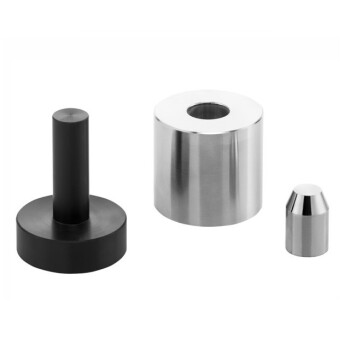
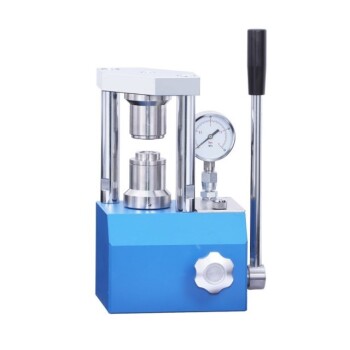
A precision laboratory press acts as the critical standardization tool in lithium battery research, directly determining the physical integrity of your electrode samples. By applying uniform and constant pressure to coated materials, it ensures tight physical contact between the active material layer and the current collector, which is the primary factor in reducing interfacial contact resistance.
Core Takeaway The accuracy of your testing results relies less on the chemistry itself and more on the geometric consistency of the electrode. A precision press eliminates variables by standardizing thickness, porosity, and contact density, ensuring that any variance in data is due to the material's properties, not preparation errors.
The Physical Foundation of Accuracy
Standardizing Electrode Geometry
The primary function of the press is to ensure high consistency in electrode layer thickness and porosity. Without precise control, variations in thickness lead to inconsistent volumetric energy density calculations.
Eliminating Interfacial Resistance
The press forces the active material layer into tight contact with the current collector (such as copper foil). This mechanical bonding significantly reduces interfacial contact resistance, which is often a hidden source of error in impedance measurements.
Enhancing Particle-to-Particle Contact
Beyond the current collector interface, the press compacts the active material, conductive agents, and binders. This compaction creates a robust electron transport network within the electrode itself, reducing internal ohmic resistance.
Impact on Electrochemical Performance
Stabilizing Cycle Capacity
Repeatable physical structure leads to repeatable chemical performance. By standardizing the porosity and density of the electrode, the press ensures that electrochemical performance tests are repeatable, improving the reliability of cycle capacity data.
Optimizing Ion Transport
For solid electrolytes or rare earth halides, the press facilitates "cold plastic deformation." This process is essential for forming continuous ion transport channels, which directly improves the battery's rate performance.
Preventing Dendrite Growth
In stack-type or coin cell assemblies, uniform pressure prevents uneven current distribution during high-current cycling. This uniformity inhibits the localized growth of lithium dendrites, effectively extending the predictable cycle life of the battery.
Understanding the Trade-offs
The Balance of Compaction Density
While pressure is vital, "more" is not always "better." You must achieve an appropriate compaction density that balances electronic conductivity with electrolyte wettability.
The Risk of Over-Densification
If the press applies too much pressure, the electrode becomes too dense, blocking the paths required for the electrolyte to wet the material. This creates a bottleneck in ion transport rates, even if the electron transport network is perfect.
The Risk of Under-Densification
Conversely, insufficient pressure leaves gaps between particles and the current collector. This results in high contact resistance and "hot spots" of non-uniform current, leading to inaccurate data regarding the material's true capability.
Making the Right Choice for Your Goal
To ensure your testing results reflect the true nature of your materials, align your pressing strategy with your specific objectives:
- If your primary focus is Cycle Life Stability: Prioritize uniform pressure distribution to prevent uneven current flows and dendrite formation.
- If your primary focus is High-Rate Performance: Focus on higher precision compaction to minimize interfacial resistance and maximize electron transport networks.
- If your primary focus is Solid-State Electrolytes: Ensure high pressure stability to maintain consistent pellet thickness and reduce measurement deviations caused by geometric irregularities.
Precision in preparation is the prerequisite for precision in data.
Summary Table:
| Parameter | Impact of Precision Pressing | Resulting Benefit |
|---|---|---|
| Electrode Geometry | Standardizes thickness and porosity | Accurate energy density calculations |
| Contact Resistance | Tightens bond with current collector | Lower ohmic resistance & cleaner data |
| Electron Transport | Compacts active materials & binders | Improved conductivity & rate performance |
| Ion Transport | Creates continuous pathways | Enhanced solid-state electrolyte performance |
| Current Distribution | Ensures uniform density | Inhibits dendrite growth & stabilizes cycle life |
Elevate Your Battery Research with KINTEK Precision
In the competitive field of battery development, preparation errors shouldn't compromise your data. KINTEK specializes in comprehensive laboratory pressing solutions designed specifically for the rigorous demands of battery research.
Whether you require manual, automatic, heated, multifunctional, or glovebox-compatible models, or specialized cold and warm isostatic presses, our equipment ensures the geometric consistency and compaction density your research deserves.
Ready to eliminate variables and achieve superior electrode integrity?
Contact KINTEK Today for a Tailored Solution
References
- Akzhan Bekzhanov, Damian M. Cupid. One‐Step Solid‐State Synthesis of Sandwich‐like, Porous C–SnS<sub>2</sub> Matrix Composites as Anode Materials for Rechargeable Lithium Ion Batteries. DOI: 10.1002/smsc.202500192
This article is also based on technical information from Kintek Solution Knowledge Base .
Related Products
- Button Battery Sealing Press Machine for Lab
- Lab Button Battery Tablet Press Sealing Mold
- Laboratory Hydraulic Press Lab Pellet Press Button Battery Press
- Lab Infrared Press Mold for Laboratory Applications
- Lab Cylindrical Press Mold for Laboratory Use
People Also Ask
- Why use standardized CR2032 components & high-precision presses? Ensure reliability in lithium metal battery research.
- Why is a laboratory battery sealing press essential for desolvation energy testing? Ensure Reliable Kinetic Data
- Why is a laboratory hydraulic press or battery sealing machine essential? Ensure Coin Cell Data Integrity
- How do laboratory battery sealing machines ensure performance consistency? Master Your Lithium and LFP Battery Assembly
- What role does a laboratory sealing press play in thermal analysis of solid dispersion films? Ensure Data Integrity