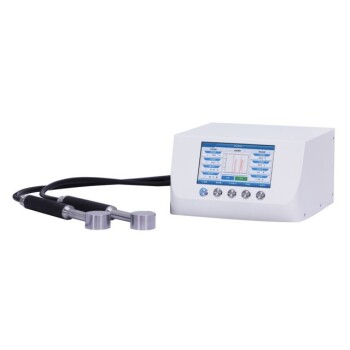
A precision temperature control system functions as a critical analytical tool by accurately regulating the thermal environment of Ga/Ta-doped LLZO samples while they are subjected to high mechanical pressure. By maintaining specific temperatures, such as 150 °C, this system enables the precise measurement of activation enthalpy, allowing researchers to isolate how thermal energy assists lithium ions in overcoming energy barriers within a compressed crystal lattice.
Core Takeaway The combination of precise heating and high pressure creates a "thermo-mechanical coupling environment" essential for calculating activation enthalpy. This data reveals the physical mechanisms behind ion migration, showing exactly how lithium ions navigate the energy landscape of a material under extreme stress.
The Science of Thermo-Mechanical Coupling
Creating a Controlled Testing Environment
A precision temperature control system does not operate in isolation; it works in tandem with high-pressure devices.
Its primary function is to apply and maintain exact heat levels—up to 150 °C in specific experiments—while the sample is simultaneously compressed.
This creates a thermo-mechanical coupling environment, where both thermal and mechanical variables are strictly controlled to ensure data reproducibility.
Measuring Activation Enthalpy
The most critical output of this system is the ability to measure activation enthalpy.
Conductivity is not static; it changes based on the energy available to the ions.
By fixing the pressure and precisely varying the temperature, researchers can calculate the specific energy barrier lithium ions must surmount to migrate through the material.
Deciphering Ion Migration Mechanisms
Analyzing Energy Barriers
To understand why a material becomes conductive, you must understand what stops it from conducting.
The temperature control system helps reveal the "height" of the energy barriers within the Ga/Ta-doped LLZO structure.
This analysis shows how thermal energy allows ions to "hop" from one site to another, even when the lattice is distorted by high pressure.
Correlating Structure and Performance
While pressure physically compresses the lattice—shortening the distance ions must jump—temperature provides the kinetic energy for the jump.
The control system allows researchers to observe the interplay between these two forces.
This reveals the physical mechanisms behind enhanced ion migration, distinguishing between improvements caused by lattice compression and those caused by thermal excitation.
Understanding the Trade-offs
The Necessity of Stability
The primary trade-off in these experiments is the absolute requirement for thermal stability.
If the temperature control system fluctuates, it introduces noise into the activation enthalpy calculations.
Inaccurate thermal data makes it impossible to distinguish whether a change in conductivity is due to pressure-induced lattice changes or simple thermal fluctuation.
Dependency on Sample Preparation
Even the most precise temperature control cannot compensate for a poorly prepared sample.
As noted in supplementary findings, the sample must be compressed into a pellet with uniform density to minimize pores and micro-cracks.
If the sample density is inconsistent, the thermal data will reflect structural defects rather than the intrinsic material properties of the Ga/Ta-doped LLZO.
Making the Right Choice for Your Goal
How to Apply This to Your Project
To extract meaningful data from high-pressure LLZO experiments, align your thermal strategy with your specific research objectives.
- If your primary focus is fundamental physics: Prioritize temperature stability to accurately calculate activation enthalpy and map the energy landscape of the ions.
- If your primary focus is material optimization: Use the system to simulate operating conditions (e.g., 150 °C) to see if high-pressure structural changes remain stable at elevated temperatures.
By rigorously controlling temperature alongside pressure, you transform raw conductivity data into a map of ionic behavior.
Summary Table:
| Feature | Role in LLZO Research | Key Research Outcome |
|---|---|---|
| Thermal Regulation | Maintains exact heat (e.g., 150 °C) during compression | Creates a stable thermo-mechanical coupling environment |
| Enthalpy Calculation | Measures energy barriers for lithium-ion hopping | Reveals physical mechanisms behind ion migration |
| System Stability | Eliminates thermal noise in conductivity data | Ensures accurate distinction between pressure and heat effects |
| Structural Correlation | Maps kinetic energy against lattice distortion | Identifies factors for enhanced ion conductivity |
Elevate Your Battery Research with KINTEK Precision Solutions
Are you looking to master the complex environment of thermo-mechanical coupling? KINTEK specializes in comprehensive laboratory pressing solutions, offering the precise equipment needed to analyze next-generation electrolytes like Ga/Ta-doped LLZO. From manual and automatic presses to heated, multifunctional, and glovebox-compatible models, our technology ensures your samples achieve the uniform density required for accurate activation enthalpy measurements.
Whether you are conducting fundamental physics research or optimizing material performance, KINTEK provides the cold and warm isostatic presses trusted by leading battery researchers worldwide.
Ready to transform your conductivity data into a clear map of ionic behavior?
Contact KINTEK Today for a Expert Consultation
References
- Jialiang Jiang, Cailong Liu. Improved electrical transport properties in Ga/Ta co-doped LLZO under high temperature and pressure. DOI: 10.1063/5.0264761
This article is also based on technical information from Kintek Solution Knowledge Base .
Related Products
- Infrared Heating Quantitative Flat Plate Mold for Precise Temperature Control
- Automatic High Temperature Heated Hydraulic Press Machine with Heated Plates for Lab
- Lab Polygon Press Mold
People Also Ask
- How do precision temperature-controlled heating plates function in electrolyte thermal stability storage experiments?
- What is the importance of a precision temperature-controlled heating module? Ensure Aluminum-Cadmium Thermal Stability
- How does heating platen precision affect rubber specimens? Achieve uniform density and reliable testing results.
- How are thin polymer films produced for spectroscopic analysis? Expert Guide to Heat and Low-Pressure Methods
- What accessories and field services can be used to optimize the capabilities of presses? Maximize Your Lab Performance