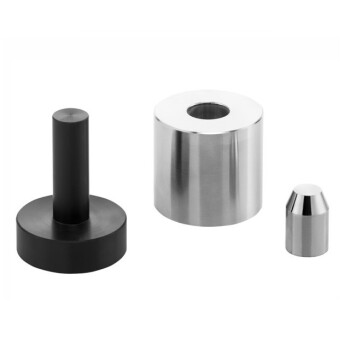
The transition from manual research to commercial manufacturing hinges on automation. An automatic laboratory press system facilitates large-scale production by integrating automatic feeding, precision pressure monitoring, and thickness detection. This automation eliminates the variability of manual operation, ensuring that the critical solid-state electrolyte layers are produced with the uniformity and speed required for mass-market viability.
Core Takeaway Commercializing solid-state batteries requires overcoming the inconsistencies inherent in manual fabrication. Automatic press systems solve this by standardizing the compression process, ensuring every battery cell achieves the precise solid-to-solid contact necessary for reliable performance while significantly increasing production throughput.
The Role of Automation in Scaling Production
Eliminating Human Variability
In manual laboratory settings, slight variations in operator technique can lead to inconsistent battery performance.
Automatic press systems replace this variability with programmable precision. By automating the feeding and pressing cycles, manufacturers ensure that every batch meets the exact same specifications.
Real-Time Quality Control
Mass production requires immediate feedback on product quality.
Integrated thickness detection systems allow for continuous monitoring of the electrolyte layer. This ensures that any deviation from the target thickness is detected immediately, preventing defective units from moving downstream.
Enhancing Throughput
Speed is a critical factor in commercial viability.
Automatic feeding mechanisms significantly reduce the cycle time between presses. This allows for a continuous workflow that far exceeds the output capabilities of manual loading and unloading.
Optimizing the Solid-Solid Interface
Eliminating Microscopic Voids
The fundamental challenge in solid-state batteries is the "solid-to-solid" contact problem. Unlike liquid electrolytes, solids do not naturally flow into pores.
The press applies controlled external pressure to force air out of the interfaces. This mechanical compression eliminates gaps and holes that would otherwise impede ion flow.
Reducing Interfacial Resistance
High performance depends on low resistance between layers.
By applying continuous and uniform pressure, the system forces the polymer or powder electrolyte to undergo microscopic deformation. This allows it to penetrate cathode pores, creating tight adhesion and minimizing interfacial charge transfer resistance.
Densification of Materials
To function correctly, solid electrolytes must be dense and free of internal porosity.
Uniaxial hydraulic presses apply high pressure (typically 40 to 250 MPa) to cold-press powders into dense pellets. This maximizes the ion conduction pathways within the material, which is essential for efficient battery cycling.
Understanding the Trade-offs
Batch vs. Continuous Processing
While automatic lab presses significantly improve speed over manual methods, they often remain batch-processing tools.
For true gigafactory-scale production, moving from a batch press to continuous roll-to-roll calendering may eventually be necessary. However, automatic presses are ideal for pilot lines and high-mix, low-volume manufacturing.
The Risk of Over-Pressurization
More pressure is not always better.
Thermodynamic analysis suggests that maintaining stack pressure at appropriate levels (often below 100 MPa) is crucial. Excessive pressure can induce unwanted material phase changes or crack propagation, degrading the battery rather than improving it.
Making the Right Choice for Your Goal
To leverage automatic press technology effectively, align the equipment capabilities with your specific production stage:
- If your primary focus is Pilot-Scale Production: Prioritize systems with automatic feeding and thickness detection to simulate mass-manufacturing consistency and throughput.
- If your primary focus is Material Optimization: Focus on heated press variants that promote thermoplastic deformation, ensuring better physical interlocking at the interface.
- If your primary focus is Cell Consistency: Ensure the system offers programmable pressure profiles to maintain precise stack pressure below critical thresholds (e.g., 100 MPa) to prevent degradation.
Success in solid-state battery commercialization relies not just on the chemistry, but on the mechanical precision used to assemble it.
Summary Table:
| Feature | Benefit for Large-Scale Production |
|---|---|
| Automatic Feeding | Reduces cycle times and increases throughput compared to manual loading. |
| Thickness Detection | Ensures real-time quality control and uniformity of the electrolyte layer. |
| Programmable Pressure | Eliminates human variability, ensuring consistent solid-to-solid contact. |
| Precision Monitoring | Prevents over-pressurization and material degradation during assembly. |
Scale Your Battery Research with KINTEK Precision
Transitioning from lab-scale research to commercial viability requires the precision and reliability of KINTEK’s advanced pressing technology. We specialize in comprehensive laboratory pressing solutions, including manual, automatic, heated, multifunctional, and glovebox-compatible models, as well as cold and warm isostatic presses designed specifically for high-performance battery research.
Our systems empower your team to eliminate interfacial resistance and achieve superior material densification. Ready to optimize your production workflow? Contact our experts today to find the perfect press for your pilot line or research facility.
References
- Swapnil Chandrakant Kalyankar, Pratyush Santosh Bhalerao. Comparative Study of Lithium-Ion and Solid-State Batteries for Electric Vehicles. DOI: 10.5281/zenodo.18108160
This article is also based on technical information from Kintek Solution Knowledge Base .
Related Products
- Warm Isostatic Press for Solid State Battery Research Warm Isostatic Press
- Laboratory Hydraulic Press Lab Pellet Press Button Battery Press
- Lab Infrared Press Mold for Laboratory Applications
- Button Battery Sealing Press Machine for Lab
- Carbide Lab Press Mold for Laboratory Sample Preparation
People Also Ask
- Why must composite cathodes be sealed in vacuum lamination bags for WIP? Ensure Battery Stability and Density
- What is the function of elastic molds in warm isostatic pressing? Achieve Uniform Density in Composite Particles
- How do sacrificial volume materials (SVM) maintain microchannels in isostatic pressing? Ensure Structural Integrity
- What is the significance of temperature control in Warm Isostatic Pressing? Unlock Uniform Densification and Process Stability
- What is the process involved in warm isostatic pressing? Mastering Uniform Density with WIP Technology