
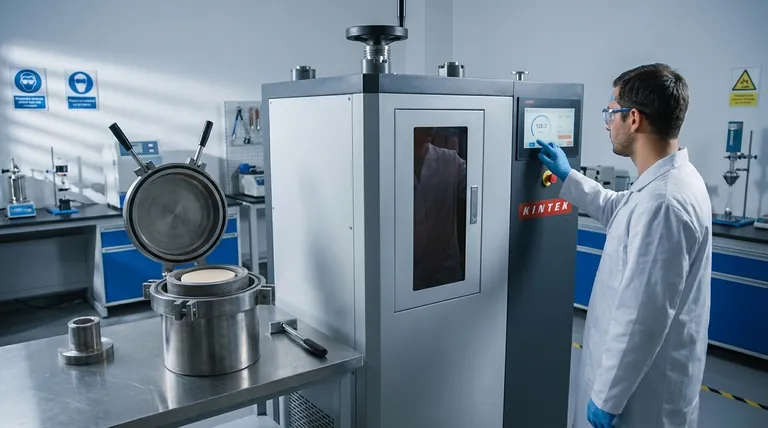
High-pressure compaction acts as the decisive densification step in the fabrication of solid electrolyte (SE) membranes. By utilizing equipment such as hydraulic presses to apply forces often ranging from 50 to 440 MPa, you physically transform loose powders or slurries into a unified, defect-free ceramic layer essential for battery function.
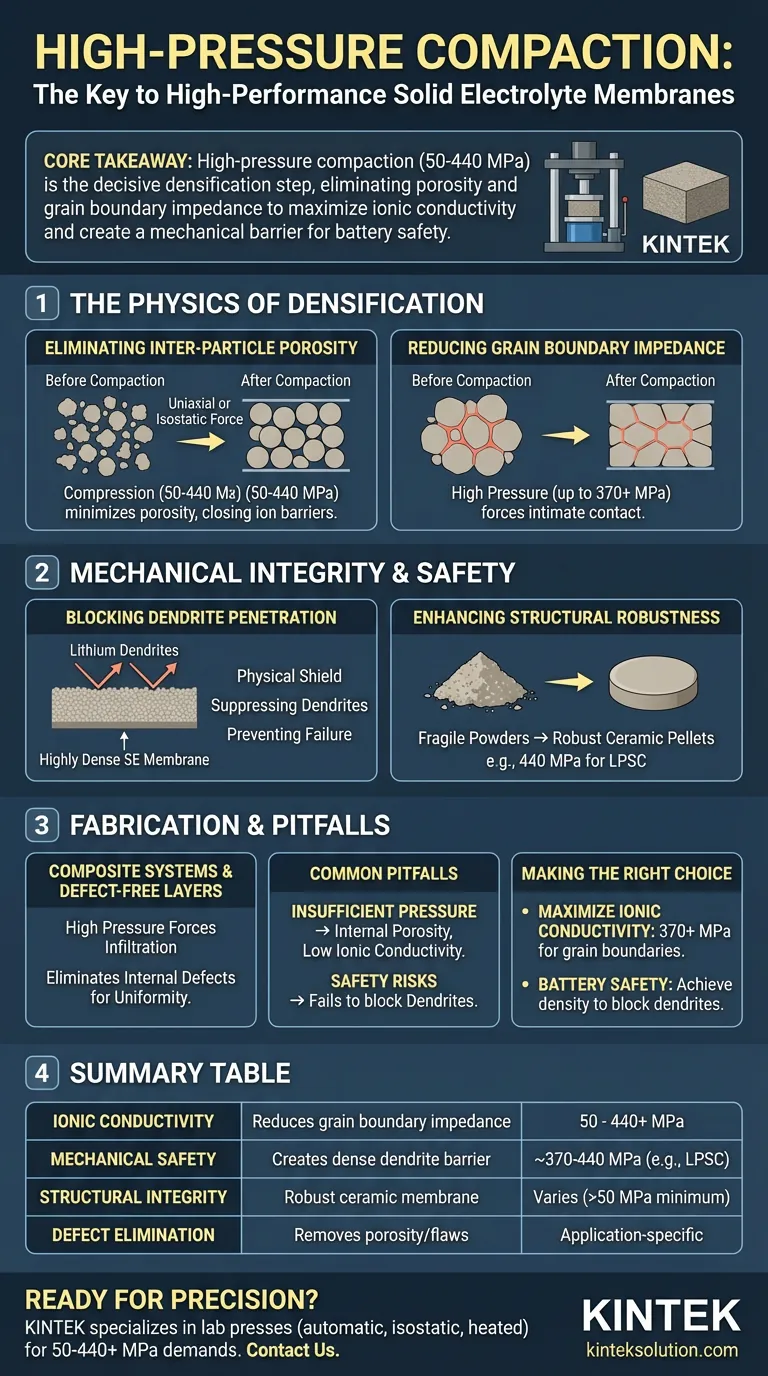
Core Takeaway The performance of a solid electrolyte is inextricably linked to its density. High-pressure compaction is the primary mechanism for eliminating porosity and grain boundary impedance, simultaneously maximizing ionic conductivity and creating a mechanical barrier strong enough to ensure battery safety.
The Physics of Densification
Eliminating Inter-Particle Porosity
The fundamental challenge in solid-state batteries is the natural spacing between material particles. High-pressure equipment utilizes uniaxial or isostatic force to mechanically compress SE powder.
This compression minimizes inter-particle porosity, effectively closing the gaps that would otherwise act as barriers to ion movement.
Reducing Grain Boundary Impedance
When particles are loosely packed, the "grain boundaries"—the interfaces where particles meet—create high resistance.
By applying pressures up to 370 MPa or higher, compaction forces these boundaries into intimate contact. This significantly reduces the grain boundary impedance, facilitating a smoother, faster pathway for ion conduction.
Mechanical Integrity and Safety Implications
Blocking Dendrite Penetration
A major failure mode in lithium batteries is the growth of dendrites—needle-like lithium formations that short-circuit the cell.
A highly dense SE membrane acts as a physical shield. The mechanical strength gained through high-pressure fabrication is a prerequisite for effectively suppressing these dendrites, thereby preventing catastrophic failure.
Enhancing Structural Robustness
Beyond electrochemical performance, the membrane must be handleable during assembly.
High-pressure processing turns fragile powders into mechanically robust ceramic pellets. For materials like Li₆PS₅Cl (LPSC), pressures around 440 MPa are specifically noted to achieve the necessary mechanical stability.
Fabrication of Composite Systems
Infiltration of Porous Substrates
For composite electrolyte systems, pressure does more than just compress; it drives material transport.
High pressure forces electrolyte slurries to completely infiltrate porous substrates. This ensures that all internal voids are filled, resulting in a dense, continuous composite structure.
Creating Defect-Free Layers
The application of significant force eliminates internal defects that could act as stress concentrators or current hotspots.
The result is a uniform, defect-free membrane that maintains consistent performance across its entire surface area.
Common Pitfalls in Pressure Application
The Cost of Insufficient Pressure
The most critical trade-off in this process is the non-negotiable need for high-spec equipment.
If the applied pressure falls below the required threshold (e.g., below 50 MPa for certain systems), the material retains internal porosity. This directly results in low ionic conductivity due to obstructed ion transport pathways.
Safety Risks of Low Density
Compromising on fabrication pressure does not just lower performance; it compromises safety.
A membrane that lacks sufficient density will fail to block lithium dendrites. Therefore, precise control of fabrication pressure is not merely an optimization variable but a safety requirement.
Making the Right Choice for Your Goal
To maximize the potential of your solid electrolyte, you must align your fabrication parameters with your performance targets.
- If your primary focus is Maximizing Ionic Conductivity: Prioritize pressures (often 370+ MPa) that aggressively minimize grain boundaries to lower total impedance.
- If your primary focus is Battery Safety and Longevity: Ensure your compaction process achieves the density thresholds required to mechanically physically block lithium dendrite penetration.
Fabricating a high-performance solid electrolyte is ultimately an exercise in density management, where applied pressure is the lever that controls both efficiency and safety.
Summary Table:
| Key Factor | Impact of High-Pressure Compaction | Typical Pressure Range |
|---|---|---|
| Ionic Conductivity | Reduces grain boundary impedance by forcing particle contact | 50 - 440+ MPa |
| Mechanical Safety | Creates dense barrier to block lithium dendrite penetration | ~370-440 MPa (e.g., for LPSC) |
| Structural Integrity | Transforms powder into robust, handleable ceramic membrane | Varies by material (e.g., >50 MPa minimum) |
| Defect Elimination | Removes porosity and internal flaws for uniform performance | Application-specific (e.g., slurry infiltration) |
Ready to fabricate high-performance solid electrolyte membranes with precision?
KINTEK specializes in lab press machines—including automatic lab presses, isostatic presses, and heated lab presses—designed to deliver the exact pressures (from 50 to 440+ MPa) your research demands. Whether you're maximizing ionic conductivity or ensuring dendrite-resistant safety, our equipment provides the controlled densification critical for reliable battery development.
Contact us today (#ContactForm) to explore how our presses can elevate your lab's capabilities and accelerate your solid-state battery innovations.
Visual Guide
Related Products
- Lab Polygon Press Mold
- Lab Round Bidirectional Press Mold
- Special Shape Lab Press Mold for Laboratory Applications
- Laboratory Hydraulic Press Lab Pellet Press Machine for Glove Box
- Automatic High Temperature Heated Hydraulic Press Machine with Heated Plates for Lab
People Also Ask
- What is the purpose of incorporating cartridge heaters into a lab press mold for MLCC block compression? Optimize Results
- How do the design and geometric precision of pressing molds and mandrels affect the quality of PTFE composite samples?
- What role do precision positioning and pressure molds play in single-lap joints? Ensure 100% Data Integrity
- What are the requirements for pressing molds when using SSCG? Key Materials for Complex Single Crystal Production
- How do industrial-grade pressure molds affect zinc metal pouch cells? Maximize Energy Density & Performance



















