
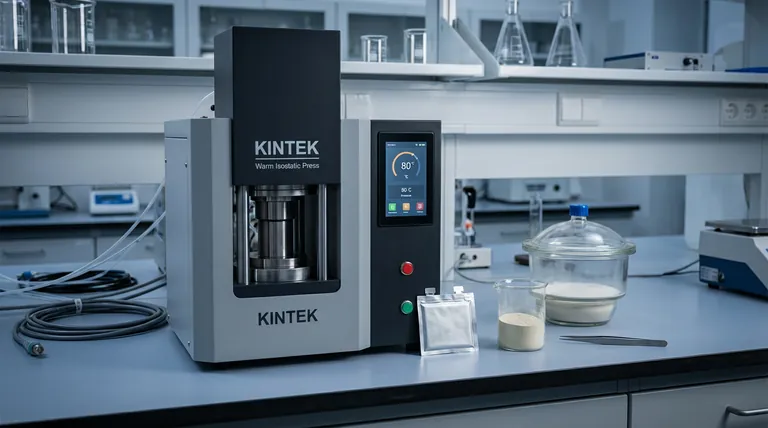
The primary function of a Warm Isostatic Press (WIP) in sulfide-based solid-state battery preparation is to eliminate microscopic voids and maximize physical contact between the solid electrolyte and electrode materials. By simultaneously applying uniform, omnidirectional pressure and gentle heating, the WIP process densifies the cell layers to minimize interfacial impedance, a critical factor for battery performance.
Core Insight: In solid-state batteries, ions must travel through solid materials rather than a liquid. Therefore, the performance of the cell is strictly limited by the physical quality of the contact points between particles. WIP is the definitive method for fusing these distinct solid layers into a cohesive, high-density unit.
The Engineering Challenge: Solid-Solid Interfaces
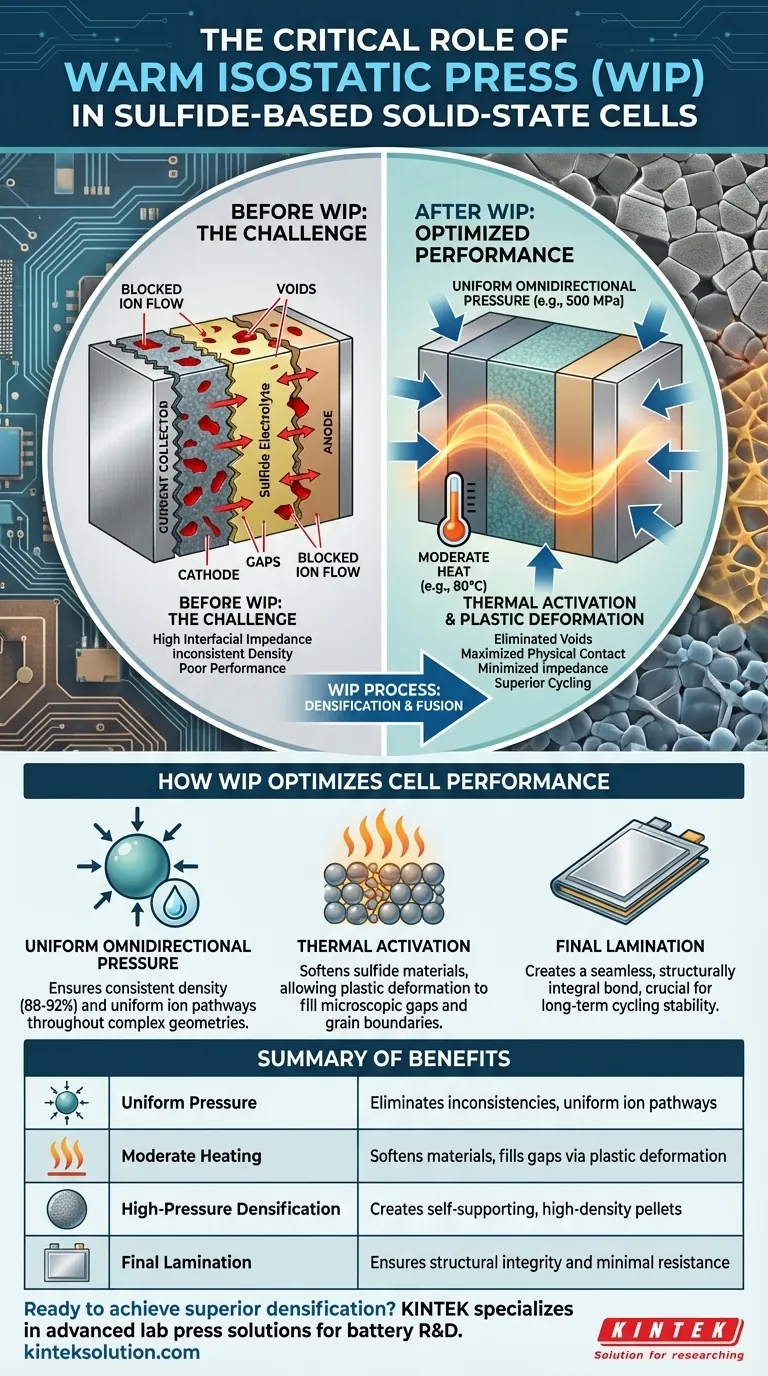
Eliminating Voids and Gaps
The fundamental hurdle in manufacturing sulfide-based cells is the presence of voids. Unlike liquid electrolytes that flow into gaps, solid electrolytes remain rigid.
Without sufficient processing, microscopic gaps exist between the sulfide electrolyte, the cathode particles, and the current collector. These voids block ion flow, leading to high resistance and poor cycling.
Surpassing Uniaxial Pressing
Traditional uniaxial pressing (pressing from top and bottom) often results in density inconsistencies.
Friction at the die walls can cause the edges of a pellet to be less dense than the center. This lack of uniformity creates "weak links" in the ion conduction path.
How WIP Optimizes Cell Performance
Uniform Omnidirectional Pressure
A Warm Isostatic Press uses a liquid or gas medium to apply pressure from every direction equally.
This isostatic approach ensures that the pressure is transmitted uniformly throughout the complex geometry of the cell. References indicate pressures as high as 500 MPa are used to compact the electrolyte powder into self-supporting pellets with relative densities of 88-92%.
The Role of Thermal Activation
Pressure alone is often insufficient for sulfide materials. WIP introduces moderate heat (e.g., 80°C) alongside the pressure.
This "warm" aspect softens the sulfide materials slightly, allowing them to deform plastically. This deformation fills interstitial spaces and grain boundaries that cold pressing cannot reach, ensuring an intimate, seamless interface.
Final Lamination for Pouch Cells
For pouch-type batteries, WIP is critical during the final lamination stage.
It creates a seamless bond between the cathode, solid electrolyte, and current collector. This structural integrity minimizes interfacial impedance, which is directly responsible for stable, long-term cycling and higher energy density.
Understanding the Operational Trade-offs
Complexity of Medium Management
WIP systems are more complex than standard presses because they utilize a fluid medium (liquid or gas) injected into a sealed cylinder.
Because the pressure is transmitted via this fluid, the battery cell must be meticulously sealed or protected. If the fluid contacts the sulfide electrolyte directly, it could degrade the material or compromise the cell chemistry.
Precision Temperature Control
While heating is beneficial, it requires precise management. The system uses heating elements on the cylinder and pre-heated fluids to maintain stability.
Excessive heat could degrade the battery components, while insufficient heat fails to achieve the necessary plasticity for densification. The balance between temperature and pressure must be calibrated exactly to the material properties of the specific sulfide compound used.
Making the Right Choice for Your Goal
To maximize the effectiveness of Warm Isostatic Pressing in your process:
- If your primary focus is decreasing internal resistance: Prioritize the combination of heat and pressure to deform the sulfide electrolyte, as this fills grain boundaries and maximizes the active contact area.
- If your primary focus is material characterization: Use WIP to create high-density pellets (88-92% density) to ensure that ionic conductivity measurements reflect the material's true properties, not just its porosity.
- If your primary focus is commercial scalability: Implement WIP as the final lamination step for pouch cells to ensure the structural integrity required for long-term cycling stability.
The Warm Isostatic Press is not just a compaction tool; it is the enabler of the dense, low-resistance interfaces required for viable solid-state battery performance.
Summary Table:
| Key Function | Benefit for Solid-State Cells |
|---|---|
| Uniform Omnidirectional Pressure | Eliminates density inconsistencies, ensures uniform ion pathways |
| Moderate Heating (e.g., 80°C) | Softens sulfide materials for plastic deformation, filling microscopic gaps |
| High-Pressure Densification (up to 500 MPa) | Creates self-supporting pellets with 88-92% relative density |
| Final Lamination for Pouch Cells | Creates seamless bond between layers, ensuring structural integrity |
Ready to achieve superior densification and minimize interfacial resistance in your solid-state battery research? KINTEK specializes in advanced laboratory press solutions, including Warm Isostatic Presses, designed to meet the precise demands of battery development. Our expertise ensures you get the uniform pressure and controlled heating necessary to create high-performance, long-lasting cells. Contact our experts today via our form to discuss how our lab press machines can accelerate your R&D!
Visual Guide
Related Products
- Warm Isostatic Press for Solid State Battery Research Warm Isostatic Press
- Electric Lab Cold Isostatic Press CIP Machine
- Automatic Lab Cold Isostatic Pressing CIP Machine
- Manual Cold Isostatic Pressing CIP Machine Pellet Press
- Electric Split Lab Cold Isostatic Pressing CIP Machine
People Also Ask
- Why must composite cathodes be sealed in vacuum lamination bags for WIP? Ensure Battery Stability and Density
- What is the function of elastic molds in warm isostatic pressing? Achieve Uniform Density in Composite Particles
- How do sacrificial volume materials (SVM) maintain microchannels in isostatic pressing? Ensure Structural Integrity
- What is the mechanism of a Warm Isostatic Press (WIP) on cheese? Master Cold Pasteurization for Superior Safety
- What is the significance of temperature control in Warm Isostatic Pressing? Unlock Uniform Densification and Process Stability



















