
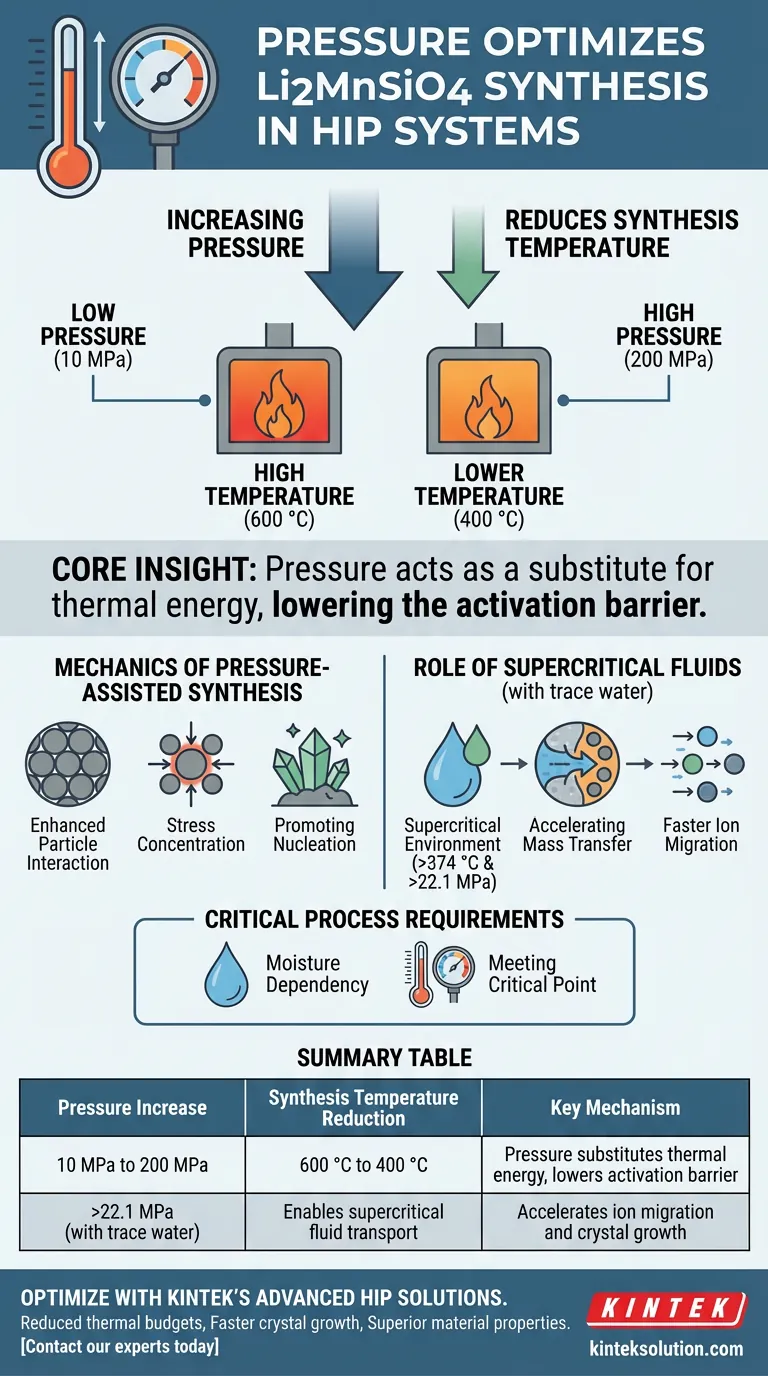
Increasing operational pressure significantly reduces the thermal energy required for Li2MnSiO4 synthesis. In a Hot Isostatic Pressing (HIP) environment, raising the pressure creates a thermodynamic environment where phase formation can occur at much lower temperatures. Specifically, increasing pressure from 10 MPa to 200 MPa allows the synthesis temperature to drop from 600 °C to 400 °C.
Core Insight: Pressure acts as a substitute for thermal energy. By increasing mechanical force, you lower the activation barrier for phase transformation, enabling material synthesis in regimes that would otherwise be thermodynamically inactive.
The Mechanics of Pressure-Assisted Synthesis
Enhanced Particle Interaction
At the micro-structural level, high pressure forces reactant particles into intimate contact. This physical compression significantly increases the effective surface area available for the reaction.
Stress Concentration
The pressure does not distribute perfectly evenly; it creates points of stress concentration where particles touch. These high-stress zones lower the energy barrier required for the new phase to form.
Promoting Nucleation
The combination of increased contact area and localized stress directly promotes the nucleation of the Li2MnSiO4 phase. This mechanical facilitation explains why a 200 MPa environment can achieve synthesis at 400 °C, a full 200 degrees lower than low-pressure methods.
The Role of Supercritical Fluids
Creating a Supercritical Environment
If your precursor material contains even trace amounts of residual water, the HIP process changes the reaction medium entirely. When the system surpasses 374 °C and 22.1 MPa, that residual water transforms into a supercritical fluid.
Accelerating Mass Transfer
Supercritical water acts as a highly effective solvent and mass transfer medium. It penetrates the material more effectively than liquid water or gas.
Faster Ion Migration
This fluid medium accelerates the migration of reactant ions. By improving how fast ions can move and react, the system promotes rapid growth of Li2MnSiO4 crystals without requiring excessive thermal input.
Critical Process Requirements
The Moisture Dependency
It is vital to recognize that the "solvent-assisted" growth mechanism relies on the presence of trace water. If your precursors are perfectly dry, you lose the benefits of supercritical fluid transport and rely solely on mechanical stress.
Meeting the Critical Point
To trigger the supercritical water mechanism, your process parameters must strictly exceed water's critical point (374 °C, 22.1 MPa). Operating below this pressure or temperature threshold prevents the water from acting as a supercritical transport medium.
Making the Right Choice for Your Goal
To optimize your Li2MnSiO4 synthesis, align your HIP parameters with your specific constraints:
- If your primary focus is minimizing thermal budget: Target a pressure of at least 200 MPa to enable synthesis at temperatures as low as 400 °C.
- If your primary focus is rapid crystal growth: Ensure trace residual water is present and maintain conditions above 374 °C and 22.1 MPa to leverage supercritical fluid transport.
High-pressure processing transforms pressure from a passive variable into an active tool for efficient low-temperature material synthesis.
Summary Table:
| Pressure Increase | Synthesis Temperature Reduction | Key Mechanism |
|---|---|---|
| 10 MPa to 200 MPa | 600 °C to 400 °C | Pressure substitutes thermal energy, lowers activation barrier |
| >22.1 MPa (with trace water) | Enables supercritical fluid transport | Accelerates ion migration and crystal growth |
Optimize Your Li2MnSiO4 Synthesis with KINTEK's Advanced HIP Solutions
Struggling with high synthesis temperatures or slow crystal growth? KINTEK specializes in laboratory isostatic press systems designed to leverage pressure for efficient low-temperature material synthesis. Our heated lab presses and HIP systems enable precise control over pressure and temperature, helping you achieve:
- Reduced thermal budgets by synthesizing materials at significantly lower temperatures
- Faster crystal growth through supercritical fluid-assisted transport
- Superior material properties with enhanced phase purity and microstructure
Whether you're researching battery materials like Li2MnSiO4 or developing advanced ceramics, KINTEK's lab press machines provide the precision and reliability your laboratory needs.
Contact our experts today to discuss how our HIP systems can transform your material synthesis process!
Visual Guide
Related Products
- Warm Isostatic Press for Solid State Battery Research Warm Isostatic Press
- Electric Lab Cold Isostatic Press CIP Machine
- Electric Split Lab Cold Isostatic Pressing CIP Machine
- Lab Isostatic Pressing Molds for Isostatic Molding
- Manual Cold Isostatic Pressing CIP Machine Pellet Press
People Also Ask
- Why must composite cathodes be sealed in vacuum lamination bags for WIP? Ensure Battery Stability and Density
- What is the function of elastic molds in warm isostatic pressing? Achieve Uniform Density in Composite Particles
- How do sacrificial volume materials (SVM) maintain microchannels in isostatic pressing? Ensure Structural Integrity
- What is the mechanism of a Warm Isostatic Press (WIP) on cheese? Master Cold Pasteurization for Superior Safety
- What is the significance of temperature control in Warm Isostatic Pressing? Unlock Uniform Densification and Process Stability



















