
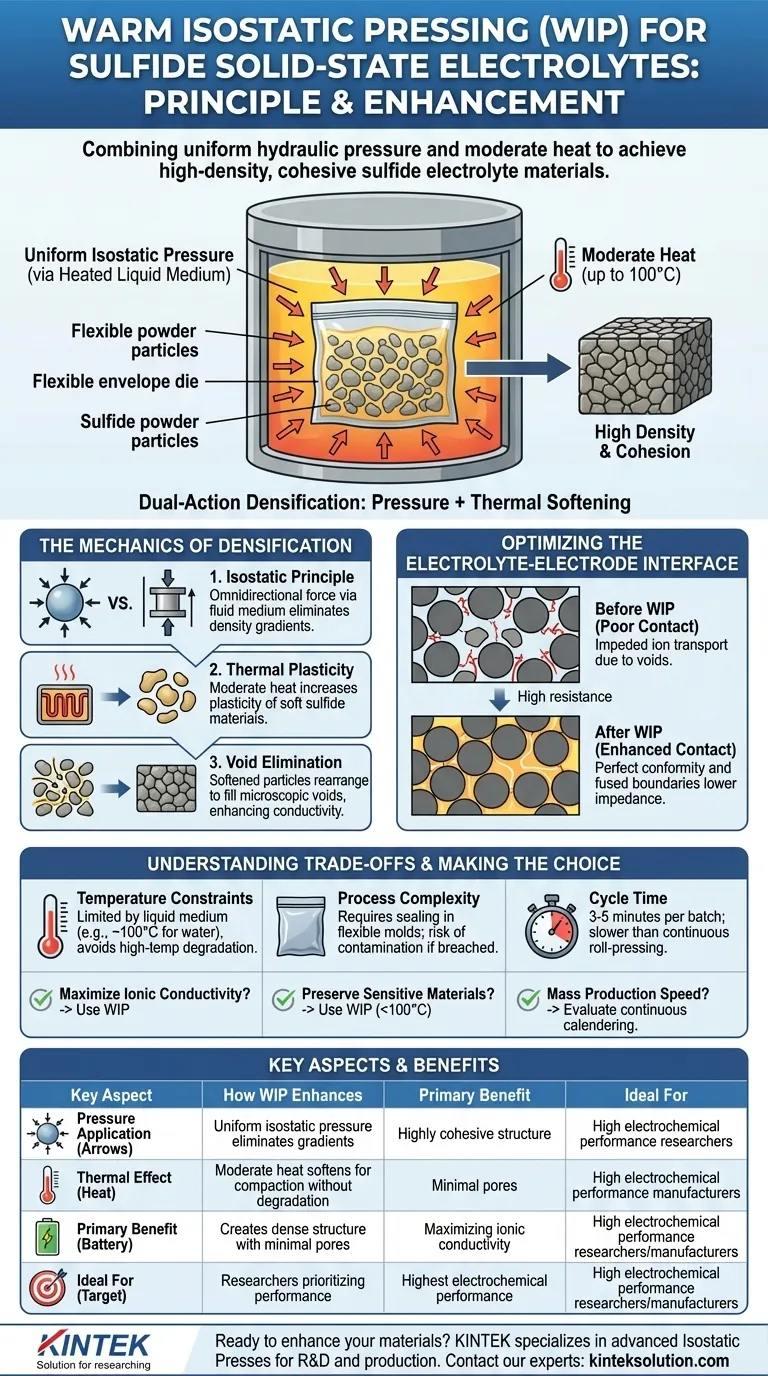
Warm Isostatic Pressing (WIP) functions by applying uniform hydraulic pressure via a heated liquid medium to densify powder materials. In the specific context of sulfide solid-state electrolytes, WIP combines high isostatic pressure with moderate heat (typically up to 100°C) to induce plastic deformation in the electrolyte particles. This dual-action approach eliminates internal voids and density gradients more effectively than pressure alone, resulting in a highly cohesive, conductive material.
The Core Insight Sulfide electrolytes are soft but prone to micro-structural defects that impede ion transport. WIP solves this by operating in a "sweet spot": it uses just enough heat to soften the material for perfect compaction, but remains cool enough to avoid the chemical degradation or high costs associated with high-temperature sintering.
The Mechanics of Densification
To understand how WIP enhances sulfide electrolytes, one must look beyond simple compression and examine the interaction between thermal softening and omnidirectional force.
The Isostatic Principle
Unlike traditional uniaxial pressing, which squeezes a sample from top to bottom, WIP utilizes a fluid medium to apply pressure.
Because the material is confined within a flexible membrane (the "envelope die") and submerged in a pressurized liquid, the force is applied equally from every direction.
This ensures uniform density throughout the sulfide pellet, eliminating the "density gradients" and brittle edges common in die-pressed pellets.
Thermal Plasticity
The defining feature of WIP, distinguishing it from Cold Isostatic Pressing (CIP), is the introduction of a heating element.
The liquid medium—often water or oil—is heated to a specific temperature below its boiling point (e.g., warm water).
Sulfide solid-state electrolytes possess a relatively low Young's modulus (they are somewhat soft). Even a mild elevation in temperature significantly increases their plasticity.
Void Elimination
When the warm, pressurized fluid squeezes the flexible mold, the softened sulfide particles rearrange and deform more easily.
This "flow" allows the material to fill microscopic voids and close the gaps between grain boundaries.
The result is a near-theoretical density where the pores that typically block lithium-ion movement are mechanically erased.
Optimizing the Electrolyte-Electrode Interface
The success of a solid-state battery depends heavily on the physical contact between layers. WIP is particularly effective at solving the "contact problem."
Enhancing Physical Contact
Sulfide electrolytes must maintain tight contact with electrode particles to function.
WIP applies pressure to the entire assembled cell structure. The warm isostatic force ensures the electrolyte conforms perfectly to the surface of the electrode particles.
Reducing Grain Boundary Resistance
High resistance often occurs at the boundaries between individual powder particles.
By fusing these particles together through warm deformation, WIP effectively creates a continuous ionic pathway, significantly lowering the overall impedance of the cell.
Understanding the Trade-offs
While WIP offers superior densification for sulfides, it introduces specific complexities that must be managed.
Temperature Constraints
The process is limited by the boiling point of the liquid medium. Unlike Hot Isostatic Pressing (HIP), which uses gas to reach extreme temperatures, WIP is generally capped around 100°C when using water.
Process Complexity
WIP requires samples to be sealed in watertight, flexible bags or jackets. This adds a preparation step compared to simple dry pressing.
Any breach in the protective membrane can lead to contamination of the sulfide electrolyte by the liquid medium, ruining the sample.
Cycle Time
The references note a typical cycle time of 3-5 minutes. While efficient for batch processing, this is slower than continuous roll-pressing methods used in commercial liquid-electrolyte battery manufacturing.
Making the Right Choice for Your Goal
WIP is a specialized tool. Whether it is the right solution depends on your specific performance targets for the solid-state battery.
- If your primary focus is maximizing ionic conductivity: Use WIP to minimize porosity and grain boundary resistance, as the heat-assisted compaction outperforms standard cold pressing.
- If your primary focus is preserving temperature-sensitive materials: Use WIP rather than hot sintering, as the moderate (<100°C) temperatures achieve density without chemically degrading the sulfide structure.
- If your primary focus is mass production speed: Evaluate if the 3-5 minute cycle time aligns with your throughput requirements, or if a continuous calendering process (perhaps with heated rollers) is more appropriate.
Ultimately, WIP is the premier method for researchers and manufacturers prioritizing the highest possible physical density and electrochemical performance in sulfide-based solid-state batteries.
Summary Table:
| Key Aspect | How WIP Enhances Sulfide Electrolytes |
|---|---|
| Pressure Application | Uniform isostatic pressure from all directions eliminates density gradients and brittle edges. |
| Thermal Effect | Moderate heat (up to 100°C) softens particles for perfect compaction without chemical degradation. |
| Primary Benefit | Creates a highly cohesive, dense structure with minimal pores, maximizing ionic conductivity. |
| Ideal For | Researchers and manufacturers prioritizing the highest electrochemical performance. |
Ready to enhance the density and performance of your solid-state battery materials?
KINTEK specializes in precision lab press machines, including advanced Isostatic Presses designed for R&D and production of next-generation energy storage solutions. Our expertise can help you achieve the perfect compaction for sulfide electrolytes and other sensitive materials.
Contact our experts today to discuss how our reliable equipment can accelerate your development cycle and deliver superior results for your laboratory needs.
Visual Guide
References
- Dabing Li, Li‐Zhen Fan. Challenges and Developments of High Energy Density Anode Materials in Sulfide‐Based Solid‐State Batteries. DOI: 10.1002/celc.202200923
This article is also based on technical information from Kintek Solution Knowledge Base .
Related Products
- Warm Isostatic Press for Solid State Battery Research Warm Isostatic Press
- Electric Lab Cold Isostatic Press CIP Machine
- Manual Cold Isostatic Pressing CIP Machine Pellet Press
- Electric Split Lab Cold Isostatic Pressing CIP Machine
- Automatic Lab Cold Isostatic Pressing CIP Machine
People Also Ask
- Why must composite cathodes be sealed in vacuum lamination bags for WIP? Ensure Battery Stability and Density
- What is the function of elastic molds in warm isostatic pressing? Achieve Uniform Density in Composite Particles
- How do sacrificial volume materials (SVM) maintain microchannels in isostatic pressing? Ensure Structural Integrity
- What is the role of the flexible material in warm isostatic pressing? Key to Uniform Density & Precision
- What is the process involved in warm isostatic pressing? Mastering Uniform Density with WIP Technology



















