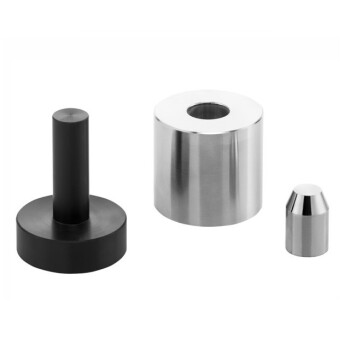
The primary function of a warm isostatic press (WIP) is to apply uniform, omnidirectional high pressure—typically around 490 MPa—to the battery assembly. This process forces electrode active materials and solid-state electrolyte particles into extremely tight physical contact, creating a dense, void-free structure. This densification is essential for lowering interfacial contact resistance and physically suppressing the growth of lithium dendrites, thereby ensuring the battery's longevity and safety.
While standard hydraulic pressing applies force from one direction, Warm Isostatic Pressing applies uniform pressure from all sides. This omnidirectional force is the key to eliminating internal voids and achieving the maximum electrolyte density required for efficient ion transport in solid-state batteries.
Overcoming the Solid-Solid Contact Barrier
The Challenge of Rigid Interfaces
Unlike traditional lithium-ion batteries that use liquid electrolytes to wet surfaces, all-solid-state batteries (ASSBs) rely on solid-to-solid interfaces.
Because solid particles are rigid, they naturally form voids and gaps when stacked. Without extreme intervention, these gaps impede the flow of lithium ions, leading to poor battery performance.
The Necessity of High Pressure
To bridge these gaps, substantial external pressure is required to mechanically deform the materials.
By compressing the powder components, you force the particles to touch at the atomic level. This establishes the physical foundation necessary for electrochemical reactions to occur.
Critical Functions of WIP in Assembly
Achieving Omnidirectional Densification
The unique advantage of a WIP over a standard laboratory hydraulic press is the application of omnidirectional pressure.
While a hydraulic press compresses vertically, a WIP applies pressure equally from all directions (isostatic). This ensures that the solid-state electrolyte layer, often made of deformable sulfides, is compacted uniformly into a dense, consistent layer without density gradients.
Drastic Reduction of Resistance
The high pressure (e.g., 490 MPa) facilitates intimate contact between the active cathode/anode materials and the solid electrolyte.
This tight contact significantly lowers interfacial contact resistance. By minimizing impedance at these junctions, the battery can achieve faster charge and discharge rates (improved electrochemical kinetics).
Suppression of Lithium Dendrites
One of the most critical roles of the WIP treatment is the physical suppression of lithium dendrites.
Dendrites are needle-like growths that form during charging and can pierce the electrolyte, causing short circuits. By eliminating voids and creating a hyper-dense electrolyte layer, the WIP process physically blocks these growths, which is vital for achieving a long cycle life.
Understanding the Trade-offs
Equipment Complexity vs. Interface Quality
While standard hydraulic pressing (uniaxial) is simpler and often used for basic pellet formation (200-370 MPa), it may result in uneven density distributions.
WIP adds complexity to the manufacturing process but offers superior uniformity. For high-performance applications where long cycle life is non-negotiable, the trade-off favors the use of isostatic pressing to ensure the structural integrity of the electrolyte layer.
Making the Right Choice for Your Goal
To maximize the effectiveness of your assembly process, consider your specific performance targets:
- If your primary focus is maximizing cycle life: Prioritize WIP treatment to achieve maximum density, as void elimination is the primary defense against dendrite propagation.
- If your primary focus is rate performance: Use the high-pressure capability of WIP to minimize interfacial impedance, ensuring rapid lithium-ion transport across the solid-solid boundaries.
Ultimately, the Warm Isostatic Press transforms a loose collection of powders into a unified, high-performance electrochemical system.
Summary Table:
| Feature | Standard Hydraulic Pressing | Warm Isostatic Pressing (WIP) |
|---|---|---|
| Pressure Direction | Uniaxial (One direction) | Omnidirectional (All sides) |
| Pressure Level | Typical 200–370 MPa | High-Pressure (Up to 490 MPa+) |
| Density Uniformity | Potential density gradients | High uniformity; void-free |
| Interface Quality | Moderate solid-solid contact | Atomic-level intimate contact |
| Key Benefit | Simple pellet formation | Dendrite suppression & low resistance |
Maximize Your ASSB Research with KINTEK Precision
Elevate your battery assembly with KINTEK’s comprehensive laboratory pressing solutions. Whether you are focusing on maximizing cycle life through void elimination or enhancing rate performance via minimized interfacial resistance, our advanced equipment delivers the high-pressure precision your research demands.
Our Specialized Range Includes:
- Warm Isostatic Presses (WIP): Perfect for omnidirectional densification and dendrite suppression.
- Cold Isostatic Presses (CIP): Reliable high-pressure powder compaction.
- Manual & Automatic Presses: Versatile options for standard lab applications.
- Glovebox-Compatible Models: Essential for moisture-sensitive battery research.
Contact KINTEK today to find the perfect press for your lab
References
- Yong-Gun Lee, In Taek Han. High-energy long-cycling all-solid-state lithium metal batteries enabled by silver–carbon composite anodes. DOI: 10.1038/s41560-020-0575-z
This article is also based on technical information from Kintek Solution Knowledge Base .
Related Products
- Warm Isostatic Press for Solid State Battery Research Warm Isostatic Press
- Lab Isostatic Pressing Molds for Isostatic Molding
- Lab Button Battery Tablet Press Sealing Mold
- Laboratory Hydraulic Press Lab Pellet Press Button Battery Press
- Lab Infrared Press Mold for Laboratory Applications
People Also Ask
- Why must composite cathodes be sealed in vacuum lamination bags for WIP? Ensure Battery Stability and Density
- How do sacrificial volume materials (SVM) maintain microchannels in isostatic pressing? Ensure Structural Integrity
- What is the function of elastic molds in warm isostatic pressing? Achieve Uniform Density in Composite Particles
- What is the role of the flexible material in warm isostatic pressing? Key to Uniform Density & Precision
- How does Warm Isostatic Pressing differ from traditional pressing methods? Unlock Uniform Density for Complex Parts