
At their core, modern hot press machines address environmental and safety concerns through a two-pronged engineering philosophy: integrated, multi-layered operator protection and a design focused on maximizing thermal and electrical efficiency. Key features include two-hand start buttons, emergency stops, and safety gratings to prevent accidents, while energy-efficient systems and minimal heat generation reduce the machine's ecological footprint and operating costs.
A hot press's commitment to safety and environmental responsibility is not an afterthought; it is engineered directly into its core systems. The safest machine is often the most efficient one, as both goals rely on precise control and the elimination of waste—be it wasted energy or wasted motion that could lead to an accident.
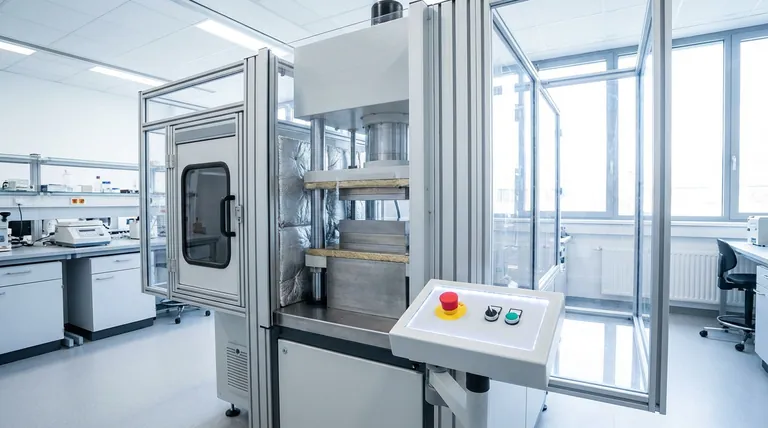
A Deep Dive into Operator Safety Systems
The primary safety objective of a hot press is to eliminate the possibility of an operator being harmed by the high pressure and high temperature zones. This is achieved through a series of redundant, layered systems.
Proactive Hazard Prevention: Two-Hand Start
The **two-hand start button** system is a fundamental proactive safety measure. It requires the operator to simultaneously press two separate buttons to initiate the machine's cycle.
This design intentionally forces the operator's hands to be occupied on the controls, ensuring they are safely away from the platen, mold, or any other moving parts during compression.
Reactive Failsafes: Emergency Stops and Gratings
Should an unsafe condition arise, reactive systems provide an immediate way to halt the machine. The **emergency stop switch**, typically a large red button, is designed to cut all power to the machine's actuators instantly.
**Safety gratings**, often implemented as light curtains, create an invisible electronic field around the press opening. If this field is broken by an object, hand, or arm, the machine will immediately stop its cycle or refuse to start, acting as a non-contact barrier.
Containment and Shielding: Sealed Doors
**Sealed doors** serve a critical dual purpose. They act as a physical barrier, preventing any accidental contact with the hot and high-pressure components during operation.
Furthermore, these doors provide containment, shielding the operator and surrounding environment from potential material splatter or component failure under extreme pressure.
Analyzing the Environmental Design Philosophy
The term "eco-friendly" in industrial machinery is a direct result of engineering for efficiency. Wasted energy is both an unnecessary cost and an environmental burden.
The Link Between Efficiency and Ecology
An **energy-efficient system** is, by definition, an environmentally conscious one. By using less electricity and fuel to achieve the same work, the machine lowers its operational carbon footprint.
This focus on efficiency translates directly into lower operating costs for the owner, creating a powerful financial incentive to adopt greener technology.
Minimizing Thermal Waste
A key feature is **minimal heat generation**, which refers to the machine's ability to direct thermal energy precisely where it is needed—into the platens and the workpiece—and prevent it from escaping into the environment.
This is accomplished through high-quality insulation around the heating elements and platens. It not only conserves a significant amount of energy but also contributes to a safer and more comfortable working environment by reducing ambient heat.
Understanding the Trade-offs and Limitations
While these systems represent a significant advancement, their effectiveness is dependent on proper use and maintenance.
The Human Factor in Safety
No safety system is foolproof if deliberately bypassed or ignored. Proper and continuous operator training on safety procedures is just as critical as the features themselves.
Complacency is a significant risk. Operators must understand not just the "how" but the "why" behind each safety mechanism to ensure they are always respected.
Maintenance is Non-Negotiable
Safety gratings can become misaligned, E-stop switches can fail, and seals can wear out. A rigorous and documented preventative maintenance schedule is essential to ensure these protective systems function as designed.
Likewise, degrading insulation or inefficient hydraulic systems can slowly erode the machine's energy efficiency, increasing costs and its environmental impact over time.
How to Evaluate a Hot Press for Your Needs
Your evaluation should be guided by your primary operational priorities.
- If your primary focus is operator safety and compliance: Look for redundancy in safety systems, such as the combination of physical guarding, sealed doors, and electronic light curtains.
- If your primary focus is operational cost and sustainability: Scrutinize the specifics of the "energy-efficient systems" by asking about insulation R-values, the type of heating elements used, and the efficiency ratings of hydraulic pumps or electric motors.
Ultimately, a well-designed hot press proves that a secure and sustainable operation is the foundation of a productive one.
Summary Table:
| Feature | Safety Benefit | Environmental Benefit |
|---|---|---|
| Two-Hand Start | Prevents operator contact with moving parts | N/A |
| Emergency Stop | Instantly halts machine in emergencies | N/A |
| Safety Gratings | Stops cycle if field is breached | N/A |
| Sealed Doors | Shields from hot components and splatter | N/A |
| Energy-Efficient Systems | N/A | Lowers carbon footprint and operating costs |
| Minimal Heat Generation | N/A | Reduces energy waste and ambient heat |
Upgrade your laboratory with KINTEK's advanced hot press machines! Specializing in lab press machines like automatic, isostatic, and heated lab presses, we deliver tailored solutions that enhance safety, boost efficiency, and cut costs. Contact us today to discuss how our equipment can meet your specific needs and drive your lab's success!
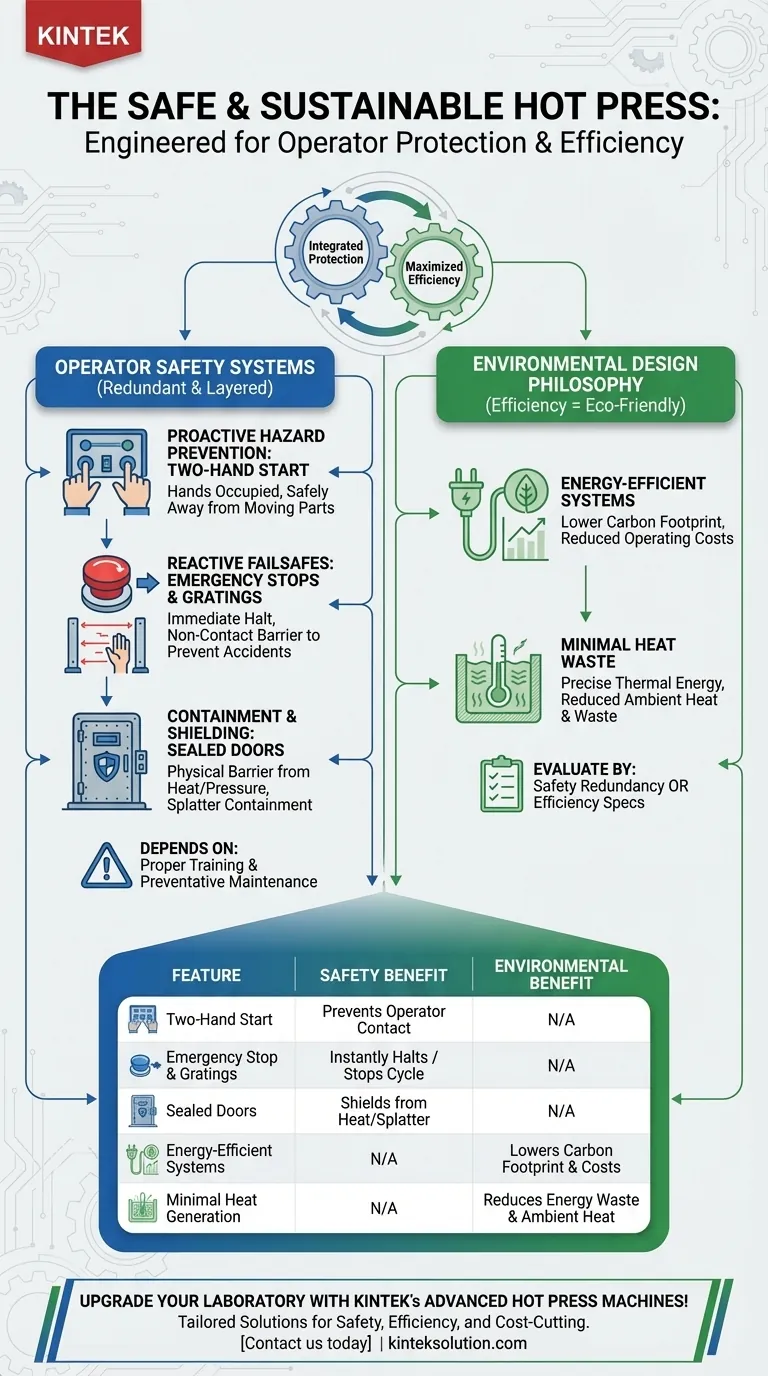
Visual Guide
Related Products
- Automatic High Temperature Heated Hydraulic Press Machine with Heated Plates for Lab
- Heated Hydraulic Press Machine with Heated Plates for Vacuum Box Laboratory Hot Press
- Automatic Heated Hydraulic Press Machine with Hot Plates for Laboratory
- Laboratory Split Manual Heated Hydraulic Press Machine with Hot Plates
- Heated Hydraulic Press Machine With Heated Plates For Vacuum Box Laboratory Hot Press
People Also Ask
- Function of a Laboratory Hydraulic Press with Heated Platens in SSE? Enhance Battery Density & Conductivity
- What are the requirements for electrode pressing with high-viscosity ionic liquids like EMIM TFSI? Optimize Performance
- How does a laboratory heated hydraulic press facilitate PBN sample prep for WAXS? Achieve Precise X-Ray Scattering
- What are the industrial applications of heated hydraulic presses? Master Heat & Force for Precision Manufacturing
- Why is a laboratory hydraulic press with heating plates required for PLA/TEC films? Achieve Precise Sample Integrity



















