
The precision of pressure control in a hydraulic press is the critical variable that dictates the structural integrity and density of a LiFePO₄ composite cathode. Without precise and stable pressure application during cold sintering, powder particles fail to rearrange efficiently, leaving voids that compromise the material. Accurate control directly correlates to maximized relative density, significantly outperforming traditional coating techniques.
Core Takeaway Precise pressure regulation is not merely about applying force; it is about ensuring uniform particle compaction and void elimination. This capability is the primary driver for increasing electrode density from standard levels of 1.9 g cm⁻³ to superior levels of 2.7 g cm⁻³, directly unlocking higher volumetric energy capacity.
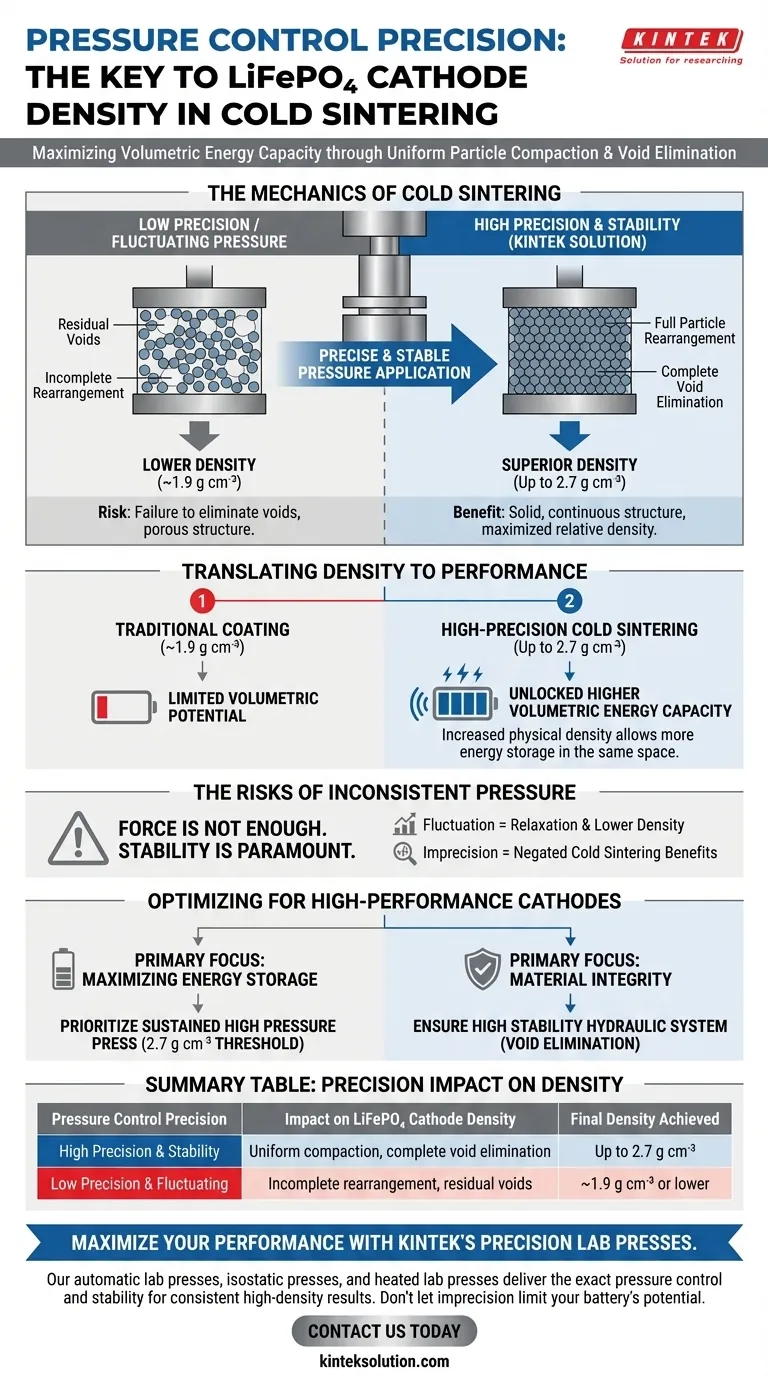
The Mechanics of Cold Sintering
Achieving Full Particle Rearrangement
High-precision hydraulic systems ensure that pressure is applied evenly across the composite material.
This forces the LiFePO₄ powder particles to shift and lock into their most compact configuration.
The Elimination of Micro-Voids
Stable pressure output is required to squeeze out air pockets trapped between particles.
Eliminating these voids is essential for creating a solid, continuous structure rather than a porous one.
Translating Density to Performance
Surpassing Traditional Benchmarks
Conventional coating methods often cap electrode density at approximately 1.9 g cm⁻³.
High-precision cold sintering overcomes these limitations, pushing physical density significantly higher.
Unlocking Volumetric Potential
By achieving densities as high as 2.7 g cm⁻³, the battery can store more energy in the same amount of physical space.
This direct increase in physical density is the catalyst for enhanced volumetric energy density, a key metric for modern battery performance.
The Risks of Inconsistent Pressure
The "Stability" Requirement
Force alone is insufficient to achieve high density; the stability of that force is paramount.
If the hydraulic press allows pressure to fluctuate, the powder particles will not remain in their rearranged state, leading to relaxation and lower density.
The Cost of Imprecision
A lack of control precision results in a failure to eliminate voids completely.
This prevents the electrode from reaching the target density of 2.7 g cm⁻³, effectively negating the benefits of the cold sintering process.
Optimizing for High-Performance Cathodes
To maximize the potential of your LiFePO₄ composite cathodes, align your equipment capabilities with your performance targets:
- If your primary focus is maximizing energy storage: Prioritize a press capable of sustaining high pressure to reliably hit the 2.7 g cm⁻³ density threshold.
- If your primary focus is material integrity: Ensure your hydraulic system offers high stability to guarantee complete void elimination and uniform particle rearrangement.
Achieving precision in your hydraulic pressing process is the defining step in transitioning from standard battery performance to high-density, high-capacity energy storage.
Summary Table:
| Pressure Control Precision | Impact on LiFePO₄ Cathode Density | Final Density Achieved |
|---|---|---|
| High Precision & Stability | Uniform compaction, complete void elimination | Up to 2.7 g cm⁻³ |
| Low Precision & Fluctuating | Incomplete rearrangement, residual voids | ~1.9 g cm⁻³ or lower |
Maximize your LiFePO₄ cathode performance with KINTEK's precision lab press machines. Our automatic lab presses, isostatic presses, and heated lab presses deliver the exact pressure control and stability you need to achieve consistent high-density results. Don't let imprecision limit your battery's potential—contact us today to discuss how our equipment can enhance your laboratory's capabilities!
Visual Guide
Related Products
- Automatic Laboratory Hydraulic Press for XRF and KBR Pellet Pressing
- Laboratory Hydraulic Press 2T Lab Pellet Press for KBR FTIR
- Automatic High Temperature Heated Hydraulic Press Machine with Heated Plates for Lab
- Laboratory Hydraulic Pellet Press for XRF KBR FTIR Lab Press
- Manual Laboratory Hydraulic Press Lab Pellet Press
People Also Ask
- Why is pressing powder into a pellet critical before sintering? Ensure Dense, Conductive Solid-State Electrolytes
- What is the role of a laboratory pressure machine and KBr in FTIR? Master Sample Preparation for Flame Retardants
- What are the advantages of using a laboratory automatic hydraulic press for HEA green compact forming?
- What are the advantages of using a lab automatic hydraulic press for HEA green body molding? Ensure Material Integrity
- How does an automatic laboratory hydraulic press improve KBr pellet preparation? Achieve Precision IR Spectroscopy



















