
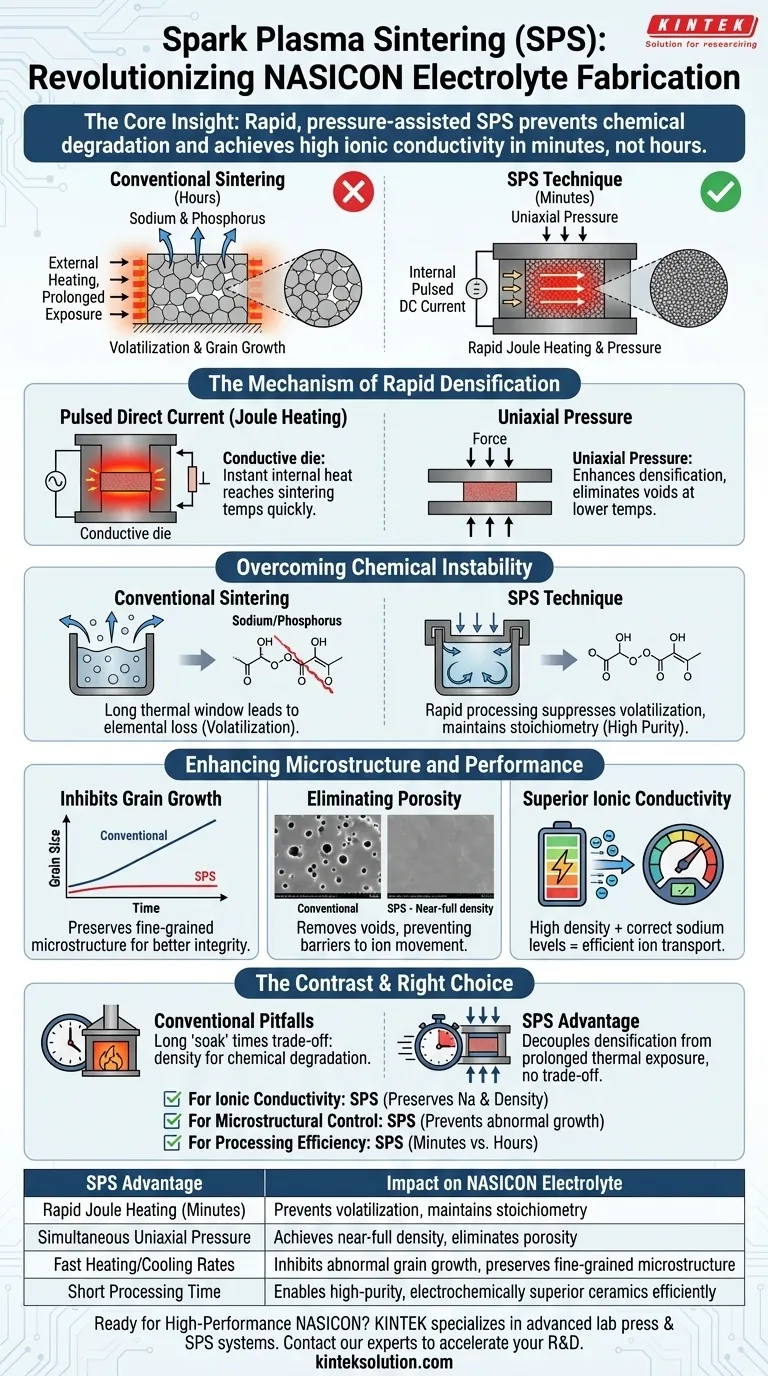
Spark Plasma Sintering (SPS) fundamentally transforms NASICON fabrication by leveraging pulsed direct current and uniaxial pressure to achieve complete material densification in minutes, rather than the hours required by conventional methods. This rapid processing is not merely faster; it is a critical technical requirement for preventing chemical degradation and ensuring high ionic conductivity in the final electrolyte.
The Core Insight The primary challenge in NASICON fabrication is the material's tendency to lose critical elements (volatilization) at high temperatures. SPS solves this by drastically reducing the thermal window, ensuring a chemically pure, fully dense, and fine-grained ceramic that delivers superior electrochemical performance.
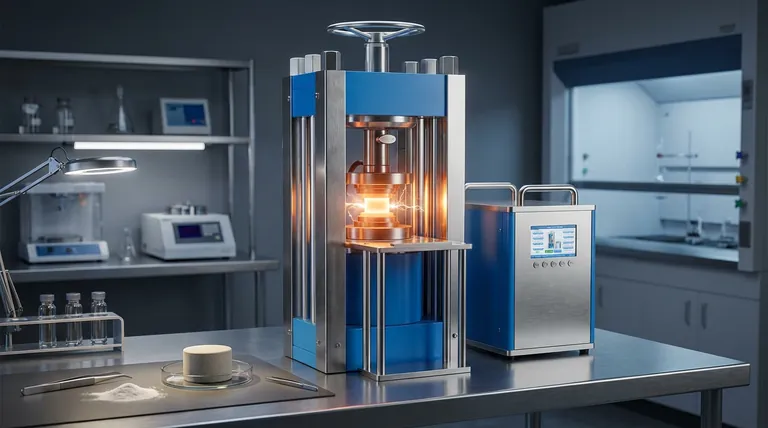
The Mechanism of Rapid Densification
Pulsed Direct Current and Joule Heating
Unlike conventional furnaces that heat a sample externally, SPS passes a pulsed direct current directly through the conductive die and the sample itself.
This generates rapid Joule heating internally. The heat is generated instantly where it is needed, allowing the material to reach sintering temperatures extremely quickly.
The Role of Uniaxial Pressure
SPS is a pressure-assisted method. While the current generates heat, the system applies simultaneous uniaxial pressure.
This pressure significantly enhances the driving force for densification. It allows the ceramic particles to pack together tightly, eliminating voids and porosity at temperatures lower than those required in pressure-less sintering.
Overcoming Chemical Instability
Suppressing Elemental Volatilization
One of the most significant risks during NASICON sintering is the evaporation of volatile elements, specifically sodium and phosphorus. In conventional sintering, long exposure to high heat causes these elements to escape.
SPS mitigates this through speed. Because the densification process occurs within minutes, there is insufficient time for significant volatilization to occur.
Maintaining Stoichiometry
By suppressing the loss of sodium and phosphorus, SPS preserves the intended chemical composition (stoichiometry) of the material.
This results in high-purity NASICON ceramics that retain the specific chemical balance necessary for optimal battery function.
Enhancing Microstructure and Performance
Inhibiting Grain Growth
Prolonged heating in conventional methods often leads to "abnormal grain growth," where crystal grains become too large, potentially weakening the material.
The rapid heating and cooling rates of SPS effectively inhibit grain growth. This preserves a fine-grained microstructure, which is generally associated with better mechanical integrity and electrical properties.
Eliminating Porosity
The combination of internal Joule heating and external pressure allows for the fabrication of nearly fully dense pellets.
Eliminating porosity is vital for solid electrolytes, as pores act as physical barriers to ion movement and can compromise the mechanical strength of the component.
Superior Ionic Conductivity
The cumulative effect of high density, retained stoichiometry (correct sodium levels), and fine grain structure is superior ionic conductivity. The electrolyte conducts ions more efficiently, directly improving the performance of the resulting battery.
The Contrast with Conventional Sintering
The Pitfalls of Standard Heating
It is important to understand what SPS avoids. Conventional sintering relies on external heating elements and long "soak" times to achieve density.
This often creates a trade-off: you must heat the material longer to remove pores, but that extra time leads to the volatilization of sodium and the coarsening of grains, degrading performance.
The SPS Advantage
SPS removes this trade-off. It provides the energy needed to density the material (via current and pressure) without the time penalty that damages the material's chemistry.
Making the Right Choice for Your Goal
If you are evaluating fabrication techniques for solid-state electrolytes, consider your specific performance metrics.
- If your primary focus is Ionic Conductivity: SPS is the superior choice because it preserves the sodium content and high density required for maximum ion transport.
- If your primary focus is Microstructural Control: SPS provides the rapid thermal processing necessary to maintain a fine-grained structure and prevent abnormal growth.
- If your primary focus is Processing Efficiency: SPS offers a distinct advantage by reducing sintering cycles from hours down to minutes.
By decoupling densification from prolonged thermal exposure, SPS enables the production of NASICON electrolytes that are both physically robust and electrochemically superior.
Summary Table:
| SPS Advantage | Impact on NASICON Electrolyte |
|---|---|
| Rapid Joule Heating (Minutes) | Prevents sodium/phosphorus volatilization, maintains stoichiometry |
| Simultaneous Uniaxial Pressure | Achieves near-full density, eliminates porosity |
| Fast Heating/Cooling Rates | Inhibits abnormal grain growth, preserves fine-grained microstructure |
| Short Processing Time | Enables high-purity, electrochemically superior ceramics efficiently |
Ready to fabricate high-performance NASICON electrolytes with superior ionic conductivity? KINTEK specializes in advanced lab press machines, including cutting-edge Spark Plasma Sintering (SPS) systems. Our equipment delivers the rapid, pressure-assisted sintering essential for preventing chemical degradation and achieving full densification in minutes. Whether you're developing next-generation solid-state batteries or advanced ceramics, our solutions ensure precise microstructural control and enhanced electrochemical performance. Contact our experts today to discuss how our SPS technology can accelerate your R&D and production goals.
Visual Guide
Related Products
People Also Ask
- Function of a Laboratory Hydraulic Press with Heated Platens in SSE? Enhance Battery Density & Conductivity
- What are the requirements for electrode pressing with high-viscosity ionic liquids like EMIM TFSI? Optimize Performance
- How does a laboratory heated hydraulic press facilitate PBN sample prep for WAXS? Achieve Precise X-Ray Scattering
- What are the industrial applications of heated hydraulic presses? Master Heat & Force for Precision Manufacturing
- Why is a laboratory hydraulic press with heating plates required for PLA/TEC films? Achieve Precise Sample Integrity
