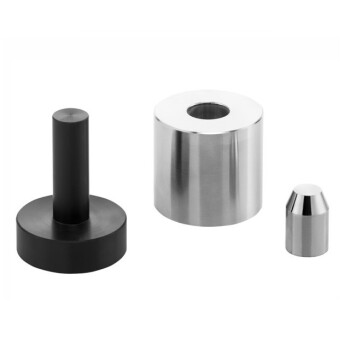
The application of a laboratory hydraulic press is fundamental to ensuring electrochemical stability in quasi-solid-state batteries. By delivering precise and uniform packaging pressure, the press enforces tight physical contact between the composite quasi-solid-state electrolyte, the lithium metal anode, and the cathode. This mechanical compression is the primary driver for minimizing interfacial resistance and stabilizing the battery during cycling.
The core value of the hydraulic press lies in its ability to standardize the interface between rigid components. By eliminating microscopic voids during packaging, it secures the necessary physical bonding to lower impedance and suppress lithium dendrite formation, directly influencing the battery's cycle life and safety.
The Critical Role of Interfacial Contact
The performance of composite quasi-solid-state electrolytes is heavily dependent on the quality of the interface between the solid material and the electrodes.
Reducing Interfacial Contact Resistance
The primary function of the hydraulic press during packaging is to overcome the natural roughness of solid materials. Unlike liquid electrolytes, quasi-solid-state electrolytes do not flow into pores naturally. Precise pressurization forces the electrolyte membrane against the cathode and anode, creating an intimate connection that significantly reduces interfacial contact resistance.
Inhibiting Lithium Dendrite Growth
Uniform pressure plays a mechanical role in battery safety. By maintaining stable pressure control during the packaging process, the press helps suppress the uneven deposition of lithium. This mechanical suppression assists in inhibiting the growth of lithium dendrites—needle-like structures that can puncture the electrolyte and cause short circuits—thereby extending the cycling stability of the cell.
Mechanisms of Performance Enhancement
Beyond the immediate interface, the use of a hydraulic press impacts the internal structural integrity of the battery cell.
Elimination of Internal Voids
During the sealing or "crimping" phase of a CR2025 coin cell, the press applies force to the stainless steel casing. This pressure eliminates internal air gaps and voids between the internal components (anode, separator/electrolyte, cathode). Eliminating these voids is critical for establishing efficient ion transport pathways, ensuring that ions can move freely without encountering dead zones caused by poor contact.
Ensuring Data Accuracy
For researchers, the hydraulic press is a tool for standardization. By applying consistent pressure (e.g., specific values like 50 kg cm⁻²), the press ensures that every coin cell produced has the same internal contact conditions. This consistency is vital for sensitive kinetic tests such as Electrochemical Impedance Spectroscopy (EIS), as it ensures that variations in data are due to material chemistry, not inconsistent assembly.
Understanding the Trade-offs
While pressure is essential, it must be applied with precision to avoid detrimental effects.
The Risk of Component Deformation
While the goal is tight contact, excessive pressure can damage the delicate composite electrolyte membrane or deform the soft lithium anode. The hydraulic press must be capable of fine adjustments; over-compression can lead to internal short circuits or the crushing of the porous cathode structure, which would hinder performance rather than help it.
Balancing Hermeticity and Integrity
The press serves a dual purpose: bonding the internal components and sealing the external case. The pressure must be sufficient to crimp the stainless steel case effectively to prevent electrolyte leakage and the ingress of moisture (hermeticity), but not so high that it warps the coin cell casing, which could compromise the internal stack pressure over time.
Making the Right Choice for Your Goal
The specific pressure settings and tooling you utilize should align with your primary testing objectives.
- If your primary focus is Cycle Life: Prioritize pressure uniformity to suppress dendrite growth and maintain long-term interfacial stability.
- If your primary focus is Kinetic Analysis (EIS): Focus on repeatability and eliminating voids to ensure low, consistent interfacial impedance values.
- If your primary focus is Safety: Ensure the press delivers sufficient force to guarantee a hermetic seal, preventing leakage and external contamination.
Ultimately, the laboratory hydraulic press transforms a stack of loose components into a unified, high-performance electrochemical system.
Summary Table:
| Impact Factor | Benefit to Battery Performance | Technical Mechanism |
|---|---|---|
| Interfacial Contact | Lowered impedance | Overcomes material roughness for intimate physical bonding |
| Dendrite Suppression | Enhanced safety & cycle life | Mechanical suppression of uneven lithium deposition |
| Internal Voids | Faster ion transport | Eliminates air gaps to create continuous ion pathways |
| Process Consistency | Improved data accuracy | Standardized pressure ensures repeatable EIS and kinetic results |
| Hermeticity | Moisture & leak prevention | Guarantees the integrity of the coin cell seal during crimping |
Maximize Your Battery Research Precision with KINTEK
Ensure the integrity of your quasi-solid-state electrolytes with KINTEK’s premium laboratory pressing solutions. Whether you are working on CR2025 coin cells or advanced battery research, our range of manual, automatic, heated, and glovebox-compatible hydraulic presses delivers the exact pressure control needed to minimize interfacial resistance and suppress lithium dendrite growth.
From cold and warm isostatic presses to multifunctional laboratory models, KINTEK specializes in providing researchers with the tools to achieve high-performance electrochemical results. Contact us today to find the perfect press for your laboratory and elevate your battery cell packaging process.
References
- Haoyang Yuan, Aishui Yu. Enhancement of Li+ Transport Through Intermediate Phase in High-Content Inorganic Composite Quasi-Solid-State Electrolytes. DOI: 10.1007/s40820-025-01774-5
This article is also based on technical information from Kintek Solution Knowledge Base .
Related Products
- Laboratory Hydraulic Press Lab Pellet Press Button Battery Press
- Button Battery Sealing Press Machine for Lab
- 24T 30T 60T Heated Hydraulic Lab Press Machine with Hot Plates for Laboratory
- Lab Button Battery Tablet Press Sealing Mold
- Automatic Heated Hydraulic Press Machine with Heated Plates for Laboratory
People Also Ask
- How is a laboratory hydraulic press used for HAP composite gels? Master Mineral Substrate Standardization
- What role does a laboratory hydraulic press play in the preparation of piezoelectric ceramic discs for DC-PG? | KINTEK
- What role does a laboratory hydraulic press play in reaction pellets? Optimizing Lunar Soil and Metal Fuel Density
- Why is a laboratory hydraulic press required for PBAT and PLA sample preparation? Achieve Flawless Characterization
- What role does a laboratory hydraulic press play in the assembly of all-solid-state battery test cells? Expert Guide