
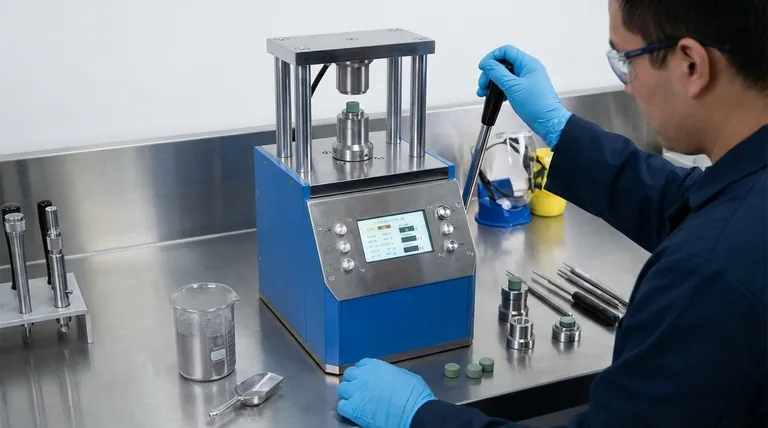
Hydraulic presses facilitate powder compacting by applying immense, controlled force to loose powdered materials confined within a rigid steel die. This process mechanically forces the particles together, deforming them to significantly increase density and creating a solid, cohesive shape known as a "green pellet" or compact.
The Core Insight: The primary goal of a hydraulic press in this context is not merely to shape the powder, but to achieve a specific green density. This initial compaction is the critical foundation that determines the structural integrity of the material during subsequent high-temperature sintering.
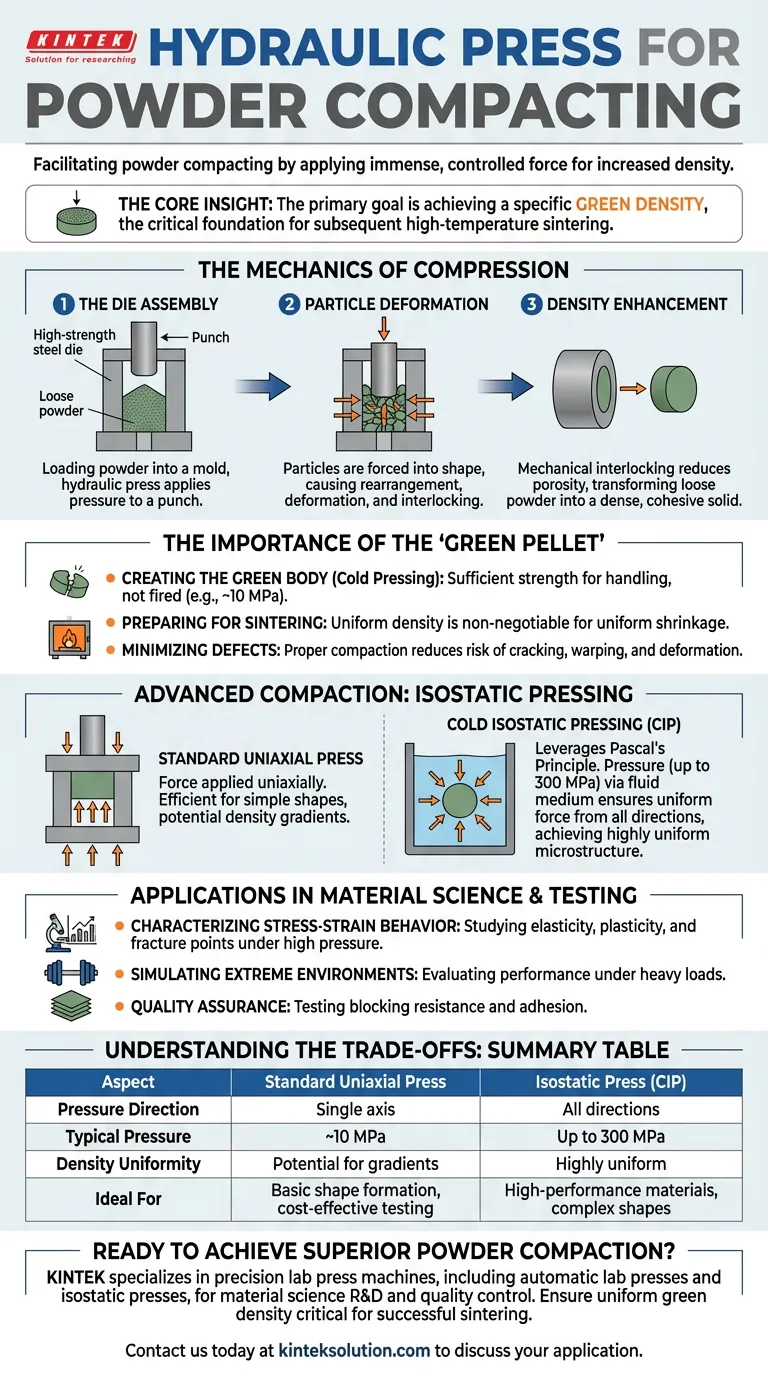
The Mechanics of Compression
The Die Assembly
The process begins by loading a specific powder mixture into a mold, typically a high-strength steel die. The hydraulic press applies pressure to a punch, which enters the die and compresses the powder.
Particle Deformation
As pressure increases, the powder particles are forced into the shape of the die. This compression occurs in stages, causing the particles to rearrange, deform, and interlock.
Density Enhancement
This mechanical interlocking significantly reduces porosity. The loose powder is transformed into a dense solid with defined geometry, capable of holding its shape outside the mold.
The Importance of the "Green Pellet"
Creating the Green Body
In laboratory settings, this process is often referred to as cold pressing. For example, a press might apply 10 MPa of pressure to form a "green pellet." This state possesses sufficient mechanical strength for handling but has not yet been fired.
Preparing for Sintering
A uniform and dense green pellet is a non-negotiable requirement for successful high-temperature sintering. If the hydraulic press fails to achieve uniform density, the material will likely suffer from uneven shrinkage during firing.
Minimizing Defects
Proper compaction reduces the risk of catastrophic defects later in the manufacturing process. It specifically helps mitigate cracking, warping, and deformation in the final product, such as ceramic electrolyte sheets.
Advanced Compaction: Isostatic Pressing
Leveraging Pascal’s Principle
For higher performance requirements, Cold Isostatic Pressing (CIP) is utilized. This method applies pressure (often as high as 300 MPa) via a fluid medium, ensuring force is applied equally from all directions.
Achieving Uniform Microstructure
Unlike a standard die that presses from one axis, isostatic pressing results in a highly uniform internal microstructure. This omnidirectional pressure allows for extremely high packing density, which is crucial for advanced material applications.
Applications in Material Science and Testing
Characterizing Stress-Strain Behavior
Beyond manufacturing shapes, hydraulic presses are indispensable for research. Scientists use them to subject materials to high pressure to study elasticity, plasticity, and fracture points.
Simulating Extreme Environments
Researchers use these presses to simulate environmental pressures. This helps evaluate how construction materials or laminates will perform under the heavy loads they will experience in real-world use.
Quality Assurance
Hydraulic presses are also used to test blocking resistance and adhesion. For instance, they can determine if a printed material will stick to itself when stacked under weight.
Understanding the Trade-offs
Directionality vs. Uniformity
A standard hydraulic die press applies force uniaxially (from top/bottom). While efficient for simple shapes, this can lead to density gradients where the center is less dense than the edges. Isostatic pressing solves this but requires more complex equipment.
The "Green" Vulnerability
It is vital to remember that the product exiting the press is fragile. While it has "green strength," it lacks the final chemical bonding of a finished ceramic or metal part. The press provides the potential for strength, but the sintering furnace provides the permanence.
Making the Right Choice for Your Goal
To select the correct hydraulic pressing method, you must identify your specific objective within the material development cycle.
- If your primary focus is basic shape formation: Utilize a standard uniaxial hydraulic press with a steel die to create cost-effective green pellets for general testing.
- If your primary focus is high-performance microstructures: Opt for Cold Isostatic Pressing (CIP) to ensure uniform density and eliminate internal gradients before sintering.
- If your primary focus is material characterization: Use the press as a testing apparatus to generate stress-strain data and analyze fracture points rather than for manufacturing parts.
Success in powder compacting relies on precise pressure control to turn loose potential into solid performance.
Summary Table:
| Aspect | Standard Uniaxial Press | Isostatic Press (CIP) |
|---|---|---|
| Pressure Direction | Single axis (uniaxial) | All directions (omnidirectional) |
| Typical Pressure | ~10 MPa | Up to 300 MPa |
| Density Uniformity | Potential for gradients | Highly uniform |
| Ideal For | Basic shape formation, cost-effective testing | High-performance materials, complex shapes |
Ready to achieve superior powder compaction in your lab?
KINTEK specializes in precision lab press machines, including automatic lab presses and isostatic presses, designed to meet the exacting demands of material science R&D and quality control. Our equipment ensures the uniform green density critical for successful sintering and high-integrity final products.
Contact us today to discuss your specific application and discover how our hydraulic press solutions can enhance your research and development process.
Visual Guide
Related Products
- Automatic High Temperature Heated Hydraulic Press Machine with Heated Plates for Lab
- Heated Hydraulic Press Machine with Heated Plates for Vacuum Box Laboratory Hot Press
- Manual Heated Hydraulic Lab Press with Integrated Hot Plates Hydraulic Press Machine
- Laboratory Hydraulic Press 2T Lab Pellet Press for KBR FTIR
- Laboratory Hydraulic Press Lab Pellet Press Machine for Glove Box
People Also Ask
- Function of a Laboratory Hydraulic Press with Heated Platens in SSE? Enhance Battery Density & Conductivity
- What are the requirements for electrode pressing with high-viscosity ionic liquids like EMIM TFSI? Optimize Performance
- How does a laboratory heated hydraulic press facilitate PBN sample prep for WAXS? Achieve Precise X-Ray Scattering
- What are the industrial applications of heated hydraulic presses? Master Heat & Force for Precision Manufacturing
- Why is a laboratory hydraulic press with heating plates required for PLA/TEC films? Achieve Precise Sample Integrity



















