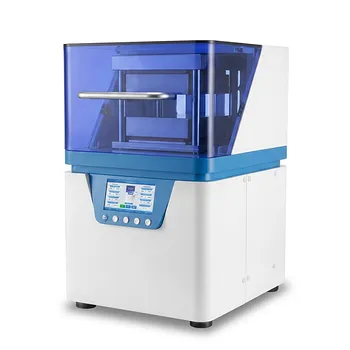
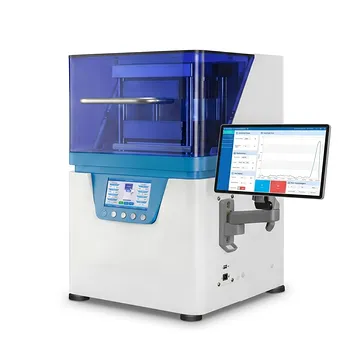
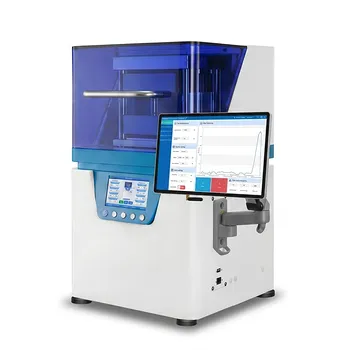
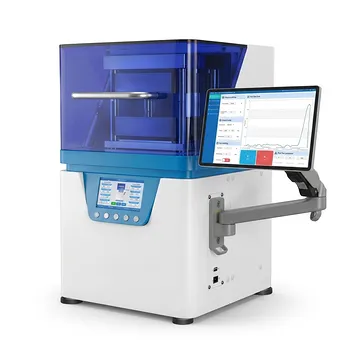
In XRF spectroscopy, a hydraulic press serves a singular, critical function: it applies high-tonnage force to compress loose powdered materials into solid, durable sample pellets. By squeezing the sample between pressure plates, the press transforms granular raw material into a compacted disc with a uniform surface, rendering it suitable for precise elemental analysis.
The Core Insight While loose powders can be analyzed, they often introduce significant errors due to air gaps and surface irregularities. The hydraulic press eliminates these variables by creating a homogenous sample with uniform density, ensuring that the X-ray data reflects the material's true composition rather than its physical texture.
The Mechanics of Sample Compaction
Transforming Powder to Solid
The primary role of the hydraulic press is to take a loose powder mixture and force it into a cohesive shape. The machine squeezes the sample material between two pressure plates within a die.
This high-pressure application ensures complete compaction, converting a pile of dust into a stable, solid pellet that maintains its integrity throughout the handling and analysis process.
Achieving Surface Uniformity
For X-ray fluorescence to be accurate, the radiation must interact with a consistent surface. A laboratory hydraulic press creates pellets characterized by extremely flat surfaces.
This flatness ensures a consistent distance between the X-ray source and the sample. It prevents the scattering errors that would occur if the spectrometer were analyzing a rough, uneven pile of powder.
Eliminating Internal Voids
Beyond the surface, the internal structure of the sample matters. High-precision pressing eliminates internal pores and density gradients within the powder.
This ensures that the sample is tightly packed throughout. A lack of voids guarantees that the X-ray penetration is uniform, which is essential for experimental repeatability.
Why Pressure Matters for XRF Accuracy
Mitigating the "Grain Size Effect"
In geological and material sciences, the size of individual particles can skew results. This is known as the grain size effect.
By compressing the material under high pressure, the hydraulic press minimizes these discrepancies. It forces particles into a dense arrangement, reducing the influence of individual particle size on the final reading.
Reducing the "Mineral Effect"
Similarly, inherent variations in mineral structures can lead to inconsistent data. This is referred to as the mineral effect, particularly in samples like shale.
High-pressure pelletizing creates a homogenous sample that mitigates these mineralogical variances. This standardization allows for a reliable geological background analysis that is quantitatively accurate.
Critical Considerations for Preparation
The Necessity of Homogeneity
The press is not just about making the sample fit the machine; it is about creating a standard. Without sufficient pressure, a pellet may contain density gradients.
If a sample is denser in one area than another, the spectrometer may yield different results depending on where the X-ray beam strikes. A hydraulic press is the tool used to enforce this necessary uniformity.
Reproducibility vs. Speed
Using a press adds a step to the workflow compared to loose powder analysis. However, this step is the defining factor for reproducibility.
For scientific accuracy, simply pouring powder into a cup is often insufficient. The mechanical consolidation provided by the press ensures that if you prepare the same sample twice, you will get the same density and the same analytical result.
Making the Right Choice for Your Goal
To determine how best to utilize a hydraulic press in your lab, consider your analytical requirements:
- If your primary focus is quantitative accuracy: Use the press to create high-density pellets to eliminate grain size and mineral effects, ensuring the highest level of data reliability.
- If your primary focus is experimental repeatability: Ensure your press settings are standardized to produce pellets with identical density and flat surfaces every time, eliminating variables between tests.
Ultimately, the hydraulic press transforms a variable physical material into a consistent analytical standard, acting as the foundation for reliable XRF spectroscopy.
Summary Table:
| Feature | Benefit for XRF Analysis |
|---|---|
| High-Tonnage Compaction | Transforms loose powder into stable, solid pellets for easy handling. |
| Surface Flattening | Ensures consistent X-ray source-to-sample distance, reducing scattering. |
| Void Elimination | Removes internal pores and density gradients for uniform X-ray penetration. |
| Grain Size Mitigation | Minimizes particle size effects to provide more accurate quantitative data. |
| Standardized Density | Guarantees reproducibility across multiple samples and experimental runs. |
Elevate Your XRF Accuracy with KINTEK Pressing Solutions
Precise spectroscopy begins with perfect sample preparation. KINTEK specializes in comprehensive laboratory pressing solutions designed to eliminate density gradients and surface irregularities in your XRF workflows.
Whether you are conducting battery research or geological surveys, our extensive range of equipment includes:
- Manual & Automatic Presses for versatile lab environments.
- Heated & Multifunctional Models for advanced material synthesis.
- Glovebox-Compatible & Isostatic Presses (CIP/WIP) for specialized sensitive materials.
Don't let sample texture compromise your data. Contact KINTEK today to find the ideal high-pressure solution for your laboratory's needs.
Related Products
- Automatic Hydraulic Hot Press with Large Plate and Precision Temperature Control for Advanced Material Sample Preparation and Industrial Research
- Automatic Hydraulic Heat Press Machine with Multi Stage Programmable Control and Integrated Water Cooling Plate Size 180x180mm
- Automatic High Temperature Heated Hydraulic Press Machine with Heated Plates for Lab
- Automatic Heated Hydraulic Lab Press with Programmable Touch Screen Controls and Precision Temperature Regulation
- Manual Heated Hydraulic Lab Press with Integrated Hot Plates Hydraulic Press Machine
People Also Ask
- What are the specific features and applications of hydraulic hot press machines? Precision Solutions for Modern Labs
- How does an automatic hydraulic press operate? Achieve Precision and Consistency in Lab Pelleting
- What are the advantages and common applications of an automatic hydraulic press? Elevate Your Lab's Precision
- What is the technical significance of setting a precise dwell time? Achieve Peak Material Density and Stability
- When is an automatic hydraulic press more suitable than a manual press? Scale Your Lab with Precision & Speed