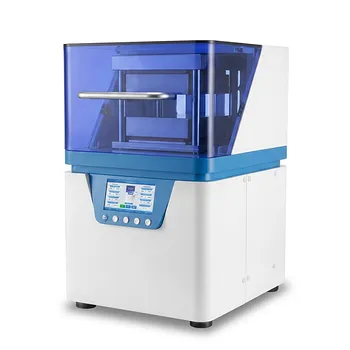
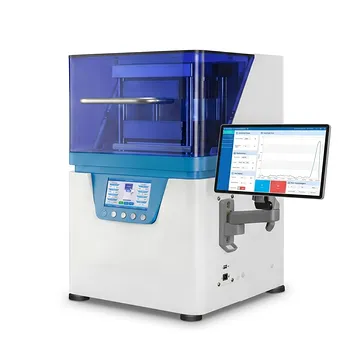
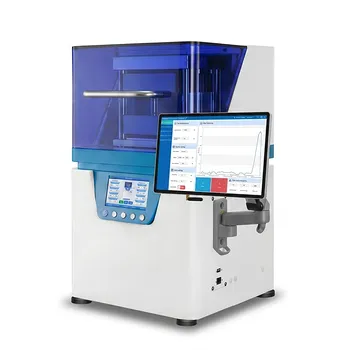
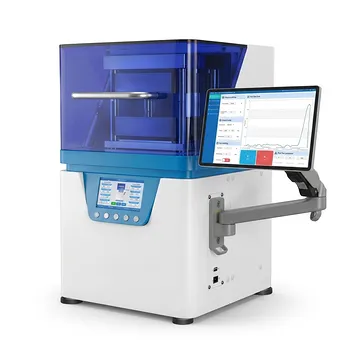
In pharmaceutical research and development, the hydraulic press acts as a foundational tool for determining product efficacy and ensuring analytical precision. Its primary function is to facilitate dissolution testing by subjecting pharmaceutical products to mechanical pressure, causing them to break down into smaller fragments for potency analysis. Beyond this, it is critical for preparing uniform samples for spectroscopic analysis and testing the physical durability of materials.
The hydraulic press converts raw, variable pharmaceutical materials into consistent, testable forms. Its ability to apply precise, high-tonnage force eliminates variables like air pockets and density inconsistencies, ensuring that data regarding drug potency and efficacy remains accurate.
The Role in Efficacy and Dissolution Testing
Facilitating Dissolution Evaluation
According to standard protocols, a hydraulic press is directly utilized to support dissolution testing, a key quality control process. The device applies controlled mechanical stress to a drug sample placed within a vessel.
Analyzing Potency via Breakdown
This mechanical pressure causes the pharmaceutical product to fracture and break into smaller pieces. These fragments are subsequently analyzed to determine the drug's potency and release characteristics, ensuring the medication performs as intended in the human body.
Sample Preparation and Analytical Chemistry
Creating Pellets for Spectroscopy
In analytical workflows, the press is essential for transforming loose powders into solid, compressed samples. This is particularly vital for spectroscopic analysis, where light must pass through a medium to identify chemical compounds.
Eliminating Data Errors
By compressing the powder, the press ensures the sample is uniform and free of air pockets. Air inclusions or inconsistent density can scatter light and skew analytical results; the hydraulic press mitigates this risk by creating a dense, homogeneous pellet.
Enhancing Compound Extraction
In chemical and biological workflows, the press is used to crush or compact samples effectively. This physical preparation aids in the extraction of specific compounds or elements, making it easier to isolate and analyze active pharmaceutical ingredients (APIs).
Material Characterization and Durability
Testing Structural Integrity
Before a drug reaches the market, its physical form must be robust enough to withstand shipping and handling. A laboratory hydraulic press exerts significant force to test the strength and durability of materials.
Investigating Pressure Effects
Researchers use the press to investigate how different substances react under high pressure. This data helps formulation scientists understand the physical limits of the tablet or material, ensuring it maintains integrity until the moment of use.
Understanding the Trade-offs
The Risk of Over-Compaction
While pressure creates uniformity, excessive force can alter the physical state of the sample. In some cases, high pressure may induce polymorphic changes (changing the crystal structure of the drug), which can fundamentally alter its solubility and bioavailability.
Safety and Precision Balance
Laboratory presses are designed for safety, but they involve immense force. Operators must balance the need for high tonnage to achieve density with the precision required to avoid destroying the sample or creating a pellet that is too dense to dissolve or extract properly.
Making the Right Choice for Your Goal
To maximize the utility of a hydraulic press in your pharmaceutical workflow, align your usage with your specific R&D objective:
- If your primary focus is Quality Control (QC): Prioritize the press for dissolution testing preparation to break down samples consistently for accurate potency verification.
- If your primary focus is Analytical Chemistry: Use the press to create air-free pellets, ensuring that spectroscopic readings are not distorted by sample voids.
- If your primary focus is Formulation Development: Utilize the press for stress testing, applying high force to determine the physical breaking point and durability of new tablet formulations.
By controlling the variable of physical density, the hydraulic press transforms raw compounds into reliable data points, securing the foundation of pharmaceutical discovery.
Summary Table:
| Application | R&D Function | Key Benefit |
|---|---|---|
| Dissolution Testing | Mechanical breakdown of samples | Accurate potency and release rate analysis |
| Spectroscopy | Creating uniform, air-free pellets | Eliminates data errors and light scattering |
| Material Testing | High-tonnage stress application | Verifies structural integrity for shipping/handling |
| Compound Extraction | Compacting/crushing raw materials | Improves isolation of active ingredients (APIs) |
| Formulation | Investigating pressure effects | Determines physical limits and crystal stability |
Elevate Your Pharmaceutical R&D with KINTEK Precision
At KINTEK, we understand that analytical accuracy starts with perfect sample preparation. Whether you are conducting critical dissolution testing or preparing pellets for spectroscopic analysis, our comprehensive laboratory pressing solutions deliver the consistency your research demands.
Why Choose KINTEK?
- Versatile Range: From manual and automatic presses to heated and multifunctional models.
- Specialized Tech: Glovebox-compatible designs and advanced isostatic presses (CIP/WIP) for battery and material research.
- Reliable Results: Engineered to eliminate air pockets and density inconsistencies for reproducible data.
Contact KINTEK Today to Find Your Ideal Pressing Solution
Related Products
- Automatic Hydraulic Hot Press with Large Plate and Precision Temperature Control for Advanced Material Sample Preparation and Industrial Research
- Automatic Hydraulic Heat Press Machine with Multi Stage Programmable Control and Integrated Water Cooling Plate Size 180x180mm
- Automatic High Temperature Heated Hydraulic Press Machine with Heated Plates for Lab
- Automatic Heated Hydraulic Lab Press with Programmable Touch Screen Controls and Precision Temperature Regulation
- Manual Heated Hydraulic Lab Press with Integrated Hot Plates Hydraulic Press Machine
People Also Ask
- What are the specific features and applications of hydraulic hot press machines? Precision Solutions for Modern Labs
- How does an automatic hydraulic press operate? Achieve Precision and Consistency in Lab Pelleting
- What are the advantages and common applications of an automatic hydraulic press? Elevate Your Lab's Precision
- What is the technical significance of setting a precise dwell time? Achieve Peak Material Density and Stability
- When is an automatic hydraulic press more suitable than a manual press? Scale Your Lab with Precision & Speed