
At its core, a hot press is controlled through an advanced electronic system that serves as the machine's brain. This system allows for the precise and automated adjustment of the three critical process variables: temperature, pressure, and time. While the electronic controller dictates the commands, the physical work is performed by integrated heating elements and hydraulic or pneumatic systems that apply force.
Achieving a perfect bond isn't about brute force; it's about precision orchestrated through a closed-loop control system. This system continuously measures process variables and makes real-time adjustments to physical components to ensure the final product meets exact specifications for strength, durability, and accuracy.
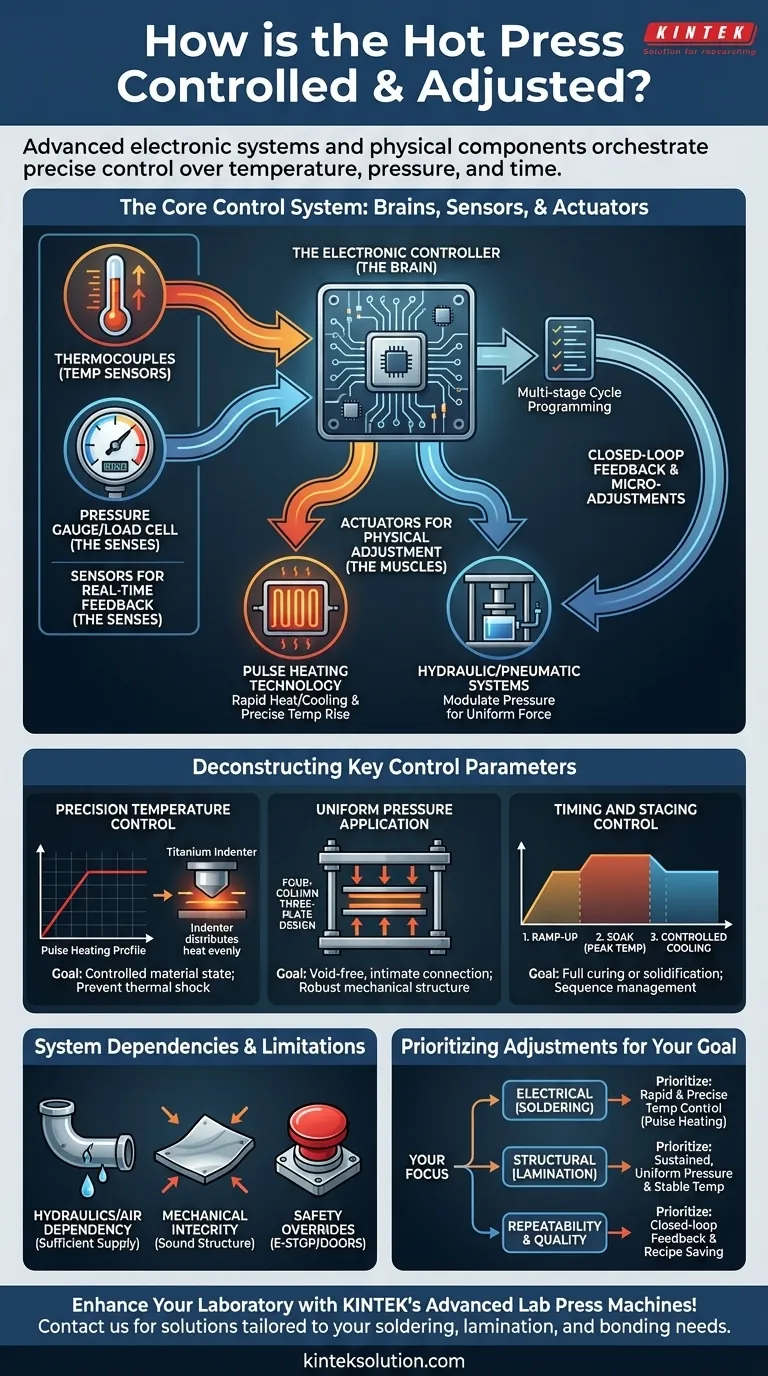
The Core Control System: Brains, Sensors, and Actuators
To understand how a hot press is adjusted, you must first understand its three fundamental components. These parts work in a constant feedback loop to execute a programmed process.
The Electronic Controller (The Brain)
The central controller is where the entire process recipe is defined. It allows an operator to program multi-stage cycles, setting specific temperature targets, pressure levels, and durations for each phase of the operation.
This unit processes real-time data and executes the pre-planned instructions with high precision.
Sensors for Real-Time Feedback (The Senses)
For a controller to work effectively, it needs to "see" what is happening. Thermocouples or other temperature sensors, often embedded near the heating element, provide constant temperature readings.
Similarly, a digital pressure gauge or load cell measures the exact amount of force being applied to the workpiece. This feedback is critical for making micro-adjustments.
Actuators for Physical Adjustment (The Muscles)
The controller sends signals to the actuators to perform the physical work. Pulse heating technology, for example, allows for extremely rapid heating and cooling by precisely controlling the electrical current to the heating element.
Force is applied by a hydraulic press or pneumatic system. The controller modulates oil pressure or compressed air to increase, decrease, or hold the pressure at the exact level required by the process recipe.
Deconstructing the Key Control Parameters
Every adjustment on a hot press is meant to manipulate one of three key variables. The sophistication of the control system determines how accurately these can be managed.
Precision Temperature Control
The primary goal of temperature control is to bring materials (like solder or adhesive) to a specific state in a controlled manner. Advanced systems use pulse heating with rapid sampling (e.g., 0.1s) to follow a programmed temperature rise profile precisely.
This prevents thermal shock to components and ensures the material melts and flows correctly. The use of a titanium indenter or similar high-conductivity tool ensures this heat is distributed evenly across the entire bonding surface.
Uniform Pressure Application
Pressure is essential for creating a void-free, intimate connection between parts. This is typically achieved with a robust mechanical structure, such as a four-column three-plate design, which resists deflection and keeps the plates perfectly parallel under load.
The controller adjusts the hydraulic or pneumatic system to apply uniform pressure, squeezing out air gaps and ensuring the molten solder or curing adhesive forms a complete, reliable bond.
Timing and Staging Control
A bonding process is not a single event but a sequence. The electronic controller manages the duration of each stage, from the initial heat ramp-up, to the "soak" time at peak temperature, to the controlled cooling phase.
This temporal control ensures that adhesives have enough time to cure fully or that solder solidifies properly, forming a strong mechanical and electrical connection.
Understanding System Dependencies and Limitations
Even the most advanced control system is subject to physical constraints and operational requirements. Understanding these is key to troubleshooting and achieving consistent results.
The Dependency on Hydraulics and Compressed Air
The electronic controller is powerless if the hydraulic or pneumatic systems are compromised. The system requires sufficient air pressure and volume (or hydraulic fluid pressure) to actuate the press correctly.
A leak or insufficient supply will prevent the machine from reaching its target pressure, regardless of what the controller commands.
The Importance of Mechanical Integrity
The precision of the control system is lost if the machine's physical structure is not sound. A warped plate or a worn-out four-column structure will result in non-uniform pressure, undermining the goal of a perfect bond.
Regular maintenance and calibration of the mechanical components are just as critical as the electronic controls.
Safety System Overrides
All modern hot presses are equipped with safety mechanisms like emergency stop switches and safety doors. These systems are hard-wired to override the main controller, instantly halting operations to ensure operator safety.
How to Prioritize Adjustments for Your Goal
The "correct" settings are entirely dependent on your application. Use these principles to guide your adjustments.
- If your primary focus is electrical connection (soldering): Prioritize rapid and precise temperature control, using pulse heating to melt solder quickly without overheating sensitive components.
- If your primary focus is structural bonding (lamination): Prioritize sustained, uniform pressure and stable temperature to ensure the adhesive cures completely across the entire surface area.
- If your primary focus is process repeatability and quality assurance: Prioritize a system with closed-loop feedback, real-time temperature display, and the ability to save and recall specific process recipes.
Ultimately, mastering hot press control is about understanding how the electronic commands translate into the physical forces of heat and pressure.
Summary Table:
| Control Parameter | Key Components | Function |
|---|---|---|
| Temperature | Electronic Controller, Thermocouples, Pulse Heating | Ensures precise heating and cooling for material bonding |
| Pressure | Hydraulic/Pneumatic System, Digital Pressure Gauge | Applies uniform force to eliminate voids and ensure strong bonds |
| Time | Multi-stage Cycle Programming | Manages process stages for curing and solidification |
Enhance your laboratory's efficiency and precision with KINTEK's advanced lab press machines! Whether you're working on soldering, lamination, or other bonding processes, our automatic lab presses, isostatic presses, and heated lab presses offer closed-loop control, real-time adjustments, and reliable performance tailored to your needs. Contact us today to discuss how our solutions can optimize your workflow and deliver superior results!
Visual Guide
Related Products
- Automatic High Temperature Heated Hydraulic Press Machine with Heated Plates for Lab
- Heated Hydraulic Press Machine with Heated Plates for Vacuum Box Laboratory Hot Press
- Automatic Heated Hydraulic Press Machine with Hot Plates for Laboratory
- Heated Hydraulic Press Machine With Heated Plates For Vacuum Box Laboratory Hot Press
- Laboratory Split Manual Heated Hydraulic Press Machine with Hot Plates
People Also Ask
- Function of a Laboratory Hydraulic Press with Heated Platens in SSE? Enhance Battery Density & Conductivity
- What are the requirements for electrode pressing with high-viscosity ionic liquids like EMIM TFSI? Optimize Performance
- How does a laboratory heated hydraulic press facilitate PBN sample prep for WAXS? Achieve Precise X-Ray Scattering
- What are the industrial applications of heated hydraulic presses? Master Heat & Force for Precision Manufacturing
- Why is a laboratory hydraulic press with heating plates required for PLA/TEC films? Achieve Precise Sample Integrity



















