
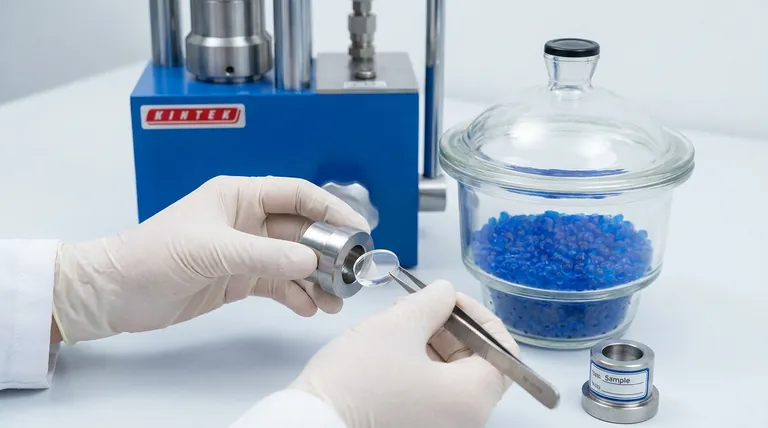
Preserving the optical quality of a Potassium Bromide (KBr) pellet requires immediate isolation from atmospheric moisture and careful mechanical handling. Once formed, you should carefully remove the anvils from the collar; the pellet can often remain inside the collar for support or be gently ejected for placement in a sample holder. To prevent the salt from degrading, you must store the finished pellet immediately in a desiccator or a similarly controlled dry environment.
Potassium Bromide is naturally hygroscopic, meaning it aggressively absorbs moisture from the air, which ruins transparency and spectral accuracy. To maintain data integrity, you must minimize the pellet's exposure to ambient air and strictly store it in a moisture-free environment.
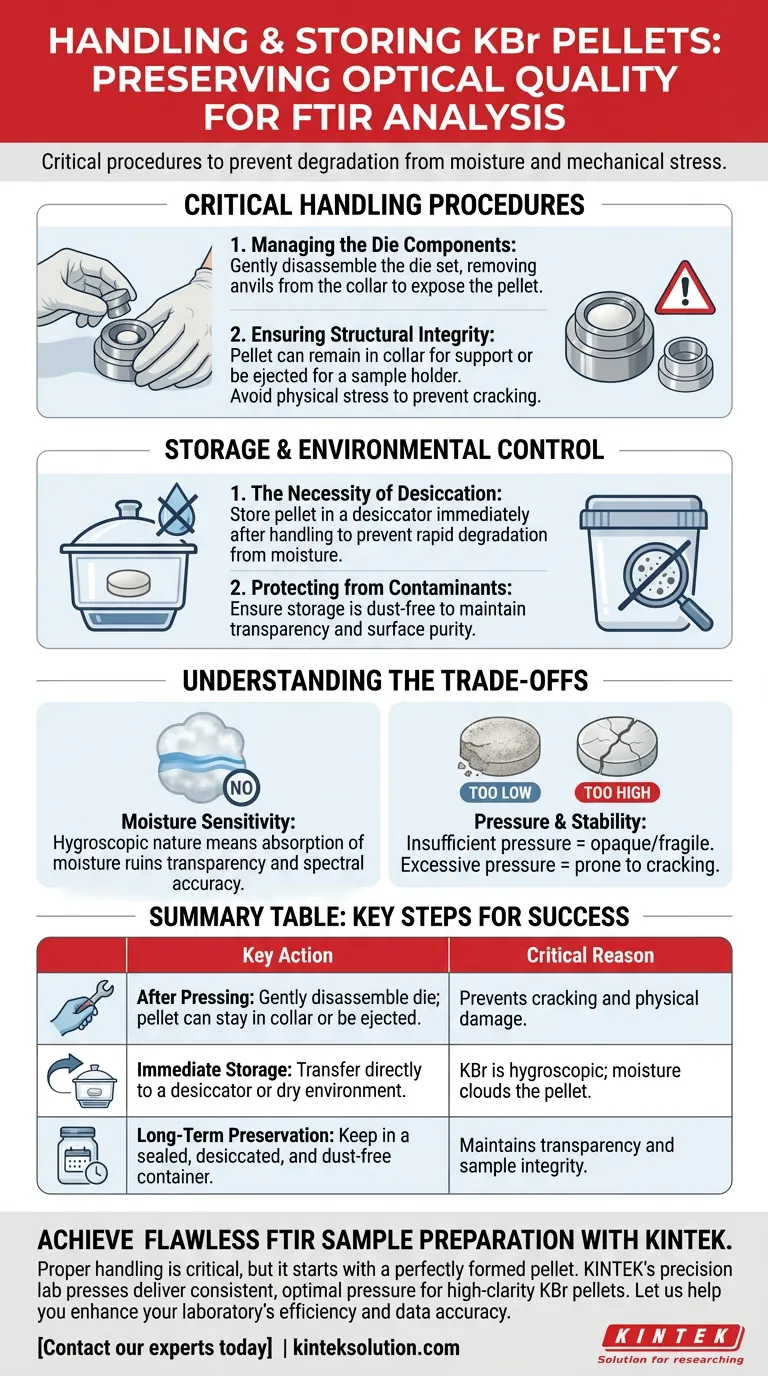
Critical Handling Procedures
Managing the Die Components
After the pressing cycle is complete, the first step is the careful disassembly of the die set. You should gently remove the anvils from the collar to expose the pellet.
Ensuring Structural Integrity
References indicate that the pellet may remain inside the collar for stability, or be ejected to be placed in a separate sample holder. Regardless of the method, the transition must be handled with extreme care to prevent physical stress that could crack the disc.
Storage and Environmental Control
The Necessity of Desiccation
Because KBr is chemically prone to absorbing water, leaving a pellet on a benchtop will lead to rapid degradation. You must store the pellet in a desiccator or an equivalent dry environment immediately after handling.
Protecting from Contaminants
While moisture is the primary enemy, physical contaminants also pose a threat to spectral quality. Ensure the storage environment is dust-free to maintain the pellet's transparency and surface purity.
Understanding the Trade-offs
The Moisture Sensitivity Factor
The most significant limitation of KBr pellets is their hygroscopic nature. If the pellet absorbs moisture, it loses transparency and introduces water bands into your infrared spectrum, potentially obscuring the data you need to analyze.
Balancing Pressure and Stability
While not a storage issue per se, the history of the pellet's formation affects its shelf-life. If the pellet was pressed with insufficient pressure, it may be opaque and fragile; if pressed with excessive pressure, it may be prone to cracking during handling or storage.
Making the Right Choice for Your Goal
To ensure your FTIR analysis is accurate, apply the following protocols based on your immediate needs:
- If your primary focus is immediate analysis: Minimize the time between ejection and the spectrometer to reduce moisture uptake.
- If your primary focus is preserving a sample for later reference: Place the pellet in a desiccator immediately, as prolonged exposure to ambient humidity will irreversibly cloud the KBr matrix.
Treat the KBr pellet not just as a sample, but as a moisture-sensitive optical component that requires a strictly dry environment to function correctly.
Summary Table:
| Handling & Storage Step | Key Action | Critical Reason |
|---|---|---|
| After Pressing | Gently disassemble die; pellet can stay in collar or be ejected. | Prevents cracking and physical damage to the fragile disc. |
| Immediate Storage | Transfer directly to a desiccator or dry environment. | KBr is hygroscopic; moisture clouds the pellet and ruins spectral data. |
| Long-Term Preservation | Keep in a sealed, desiccated, and dust-free container. | Maintains transparency and sample integrity for future analysis. |
Achieve flawless FTIR sample preparation with KINTEK.
Proper handling and storage are critical, but it all starts with a perfectly formed pellet. KINTEK's precision lab presses, including automatic and heated models, are engineered to deliver the consistent, optimal pressure required to create stable, high-clarity KBr pellets every time.
Let us help you enhance your laboratory's efficiency and data accuracy.
Contact our experts today to find the ideal lab press for your specific application and ensure your sample preparation is never a variable in your results.
Visual Guide
Related Products
- XRF KBR Plastic Ring Lab Powder Pellet Pressing Mold for FTIR
- Laboratory Hydraulic Press 2T Lab Pellet Press for KBR FTIR
- XRF KBR Steel Ring Lab Powder Pellet Pressing Mold for FTIR
- Automatic Laboratory Hydraulic Press for XRF and KBR Pellet Pressing
- Laboratory Hydraulic Pellet Press for XRF KBR FTIR Lab Press
People Also Ask
- What is the purpose of making KBr pellets for FTIR? Achieve Precise Molecular Analysis with Solid Samples
- What factors should be considered when choosing a lab press for XRF pellet preparation? Ensure Accurate and Consistent Results
- Why are pellets used in XRF analysis, and what is their limitation? Boost Accuracy and Speed in Your Lab
- How are pellets prepared for XRF analysis and what is a potential drawback? Master XRF Sample Prep and Accuracy
- What are the different types of XRF pellet preparation methods available? Manual, Hydraulic, and Automated Presses Explained















