
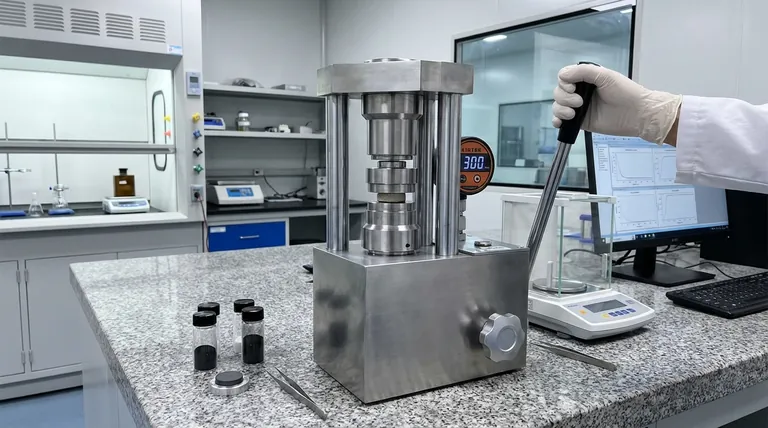
The laboratory hydraulic press acts as the fundamental enabler of electrochemical performance in the assembly of all-solid-state batteries using Li2S–GeSe2–P2S5 electrolytes. It transcends simple assembly; it applies the precise, massive force required to transform loose powders and distinct layers into a unified, dense system capable of efficient ion transport.
The Core Insight In liquid batteries, the electrolyte naturally "wets" the electrodes to facilitate ion movement. In solid-state systems, this natural contact does not exist. The hydraulic press solves the critical problem of high interfacial impedance by mechanically forcing materials into intimate contact, creating the physical pathways necessary for the battery to function.
Overcoming the Solid-Solid Interface Challenge
The primary obstacle in solid-state battery fabrication is the "solid-solid" interface. Unlike liquids, solid materials naturally resist forming a seamless connection.
Moving Beyond Point Contact
Without significant pressure, rigid electrolytes and electrode materials only touch at microscopic peaks, creating "point contacts."
This limited contact area results in extremely high resistance, choking the flow of current. The hydraulic press applies force to generate plastic deformation, specifically in softer materials like lithium metal anodes.
Filling Microscopic Voids
By deforming the materials, the press forces them to fill microscopic depressions and surface irregularities.
This effectively eliminates voids between the layers. The removal of these voids is non-negotiable; even small gaps act as insulators that block lithium-ion transport and degrade performance.
Establishing Ion Transport Highways
The ultimate goal of this compression is to create a continuous, low-resistance pathway.
When the press eliminates voids and maximizes surface area, it ensures ions can move uniformly through the cell. This directly dictates the battery's cycling stability and rate performance.
The Assembly Sequence
The hydraulic press is utilized in distinct stages to build the cell architecture from the ground up.
Densifying the Electrolyte Separator
The process often begins by compacting the Li2S–GeSe2–P2S5 powder into a standalone membrane.
High pressures (often exceeding 300 MPa) are applied to compact the powder into a high-density pellet. This density prevents physical short circuits and ensures structural integrity.
Integrating the Composite Cathode
Once the separator is formed, the composite cathode material is added and pressed against the electrolyte.
This step binds the cathode to the separator, ensuring the active material has direct, seamless access to the electrolyte for ion exchange.
Bonding the Lithium Anode
The final stage involves attaching the lithium metal anode to the stack.
Pressure is applied to bond the anode securely to the electrolyte. This creates a tight seal that prevents delamination during the volume changes that occur when the battery charges and discharges.
Critical Considerations and Trade-offs
While pressure is essential, the application of that pressure requires precision to avoid damaging the cell.
Uniformity vs. Cracking
The pressure applied must be perfectly uniform across the surface area of the pellet.
If the force is uneven, the brittle solid electrolyte pellet can crack or shatter. A cracked electrolyte leads to immediate short circuits and cell failure.
Precision and Repeatability
For prototype development, the ability to replicate exact pressure conditions is vital.
Variations in pressure between different test cells will result in inconsistent impedance data, making it impossible to accurately evaluate the chemistry of the Li2S–GeSe2–P2S5 electrolyte.
Making the Right Choice for Your Goal
The way you utilize the hydraulic press should adapt based on your specific research objectives.
- If your primary focus is Electrolyte Characterization: Prioritize maximizing pressure (up to 300+ MPa) to achieve the highest possible pellet density and ionic conductivity.
- If your primary focus is Full Cell Cycling: Focus on optimizing the pressure duration and uniformity to ensure robust interfacial bonding without compromising the structural integrity of the active materials.
The hydraulic press is not merely a tool for assembly; it is the instrument that physically constructs the conductive pathways required for a solid-state battery to exist.
Summary Table:
| Press Function | Key Benefit | Impact on Battery Performance |
|---|---|---|
| Eliminates Voids & Point Contacts | Reduces Interfacial Impedance | Enables efficient ion transport |
| Densifies Electrolyte Pellet | Prevents short circuits | Ensures structural integrity |
| Bonds Electrode Layers | Creates robust interfaces | Improves cycling stability & rate capability |
Ready to optimize your solid-state battery research?
KINTEK's precision laboratory presses—including automatic, isostatic, and heated models—deliver the uniform, high-pressure compaction essential for fabricating reliable Li2S–GeSe2–P2S5 battery prototypes. Achieve consistent interfacial bonding and reproducible results for accurate electrolyte and full-cell characterization.
Contact our experts today to discuss how our lab press solutions can accelerate your development cycle.
Visual Guide

Related Products
- Laboratory Hydraulic Press Lab Pellet Press Machine for Glove Box
- Laboratory Hydraulic Press 2T Lab Pellet Press for KBR FTIR
- 24T 30T 60T Heated Hydraulic Lab Press Machine with Hot Plates for Laboratory
- Laboratory Hydraulic Press Lab Pellet Press Button Battery Press
- Laboratory Hydraulic Pellet Press for XRF KBR FTIR Lab Press
People Also Ask
- How does a laboratory hydraulic press contribute to the preparation of Li3-3xScxSb samples? Optimize Ionic Conductivity
- What is the function of a laboratory hydraulic press in FT-IR of curcumin-coated MWCNTs? Achieve Optical Clarity.
- Why is a laboratory hydraulic press required for compression molding boron-siloxane? Solve High-Loading Density Challenges
- What role does a laboratory hydraulic press play in the preparation of piezoelectric ceramic discs for DC-PG? | KINTEK
- What role does a laboratory hydraulic press play in reaction pellets? Optimizing Lunar Soil and Metal Fuel Density



















