
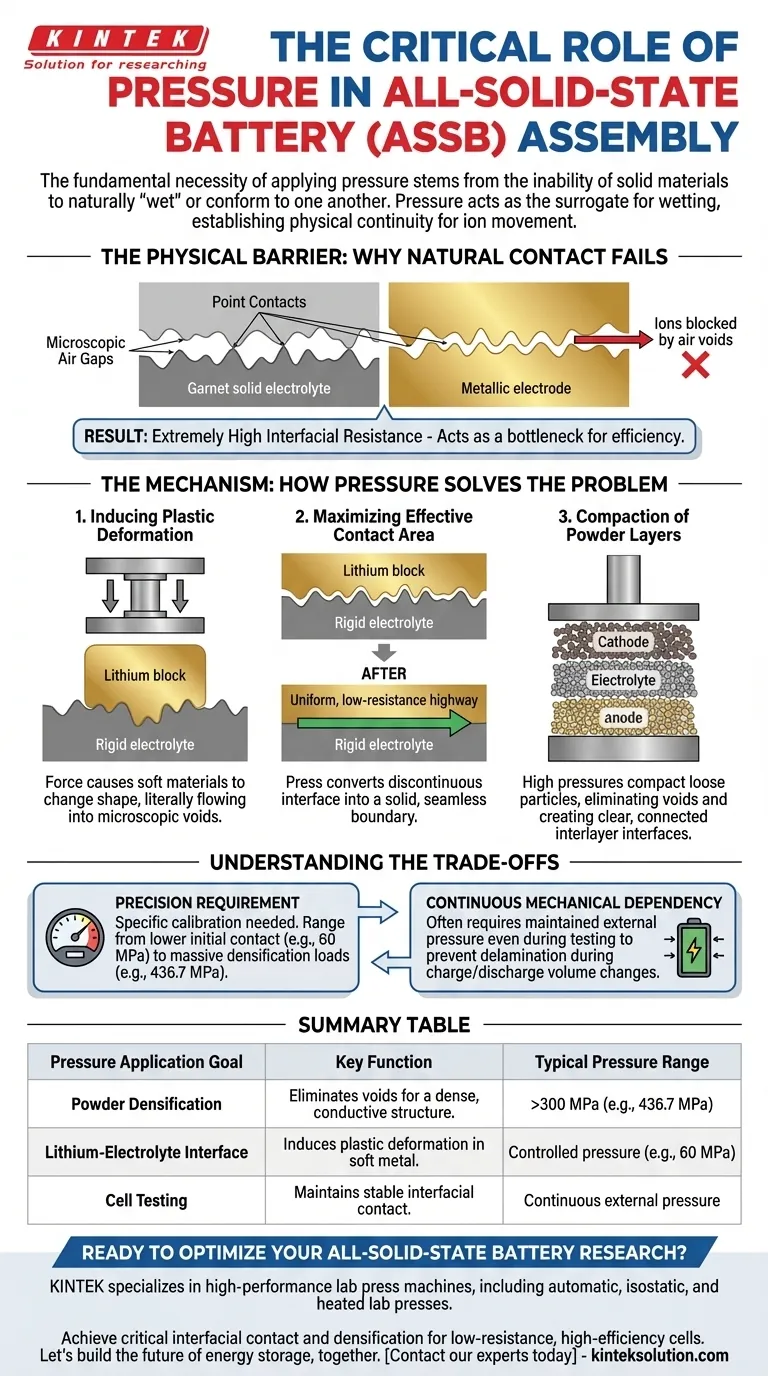
The fundamental necessity of applying pressure in all-solid-state battery (ASSB) assembly stems from the inability of solid materials to naturally "wet" or conform to one another. Unlike liquid electrolytes, which flow into every microscopic crevice, solid components require significant mechanical force—often applied via a hydraulic or hot press—to establish the physical continuity required for ions to move.
The Core Reality: In traditional batteries, the liquid electrolyte does the work of connecting the internal components. In solid-state batteries, pressure acts as the surrogate for wetting, mechanically forcing incompatible, rigid surfaces to behave as a unified, conductive interface.
The Physical Barrier: Why Natural Contact Fails
The Phenomenon of "Point Contacts"
On a microscopic level, even polished solid surfaces are rough. When you place a rigid garnet solid electrolyte against a metal electrode without external force, they only touch at their highest peaks.
This results in "point contacts," leaving the majority of the interface separated by microscopic air gaps.
The Impact on Interfacial Resistance
Ions cannot travel through air voids; they require a continuous material pathway.
Because the contact area is so limited in an unpressurized state, the interfacial resistance becomes extremely high. This acts as a bottleneck, preventing the battery from functioning efficiently—or at all.
The Mechanism: How Pressure Solves the Problem
Inducing Plastic Deformation
A primary function of the press is to force softer materials to change shape.
When applying pressure to a soft electrode material, such as metallic lithium, the force causes it to undergo plastic deformation. The metal literally flows into the microscopic voids and depressions of the harder electrolyte surface.
Maximizing Effective Contact Area
By forcing the materials to mesh together, the press converts a discontinuous interface into a solid, seamless boundary.
This dramatically increases the effective contact area, ensuring that ions have a uniform, low-resistance highway to travel between the anode, electrolyte, and cathode.
Compaction of Powder Layers
For batteries assembled from powders (cathode, solid electrolyte, and anode particles), pressure serves a densification role.
High pressures (often exceeding 300-400 MPa) are used to compact these loose particles into a single, dense structure. This eliminates voids between particles and creates clear, connected interlayer interfaces necessary for ion transport.
Understanding the Trade-offs
The Requirement for Precision
Applying pressure is not a brute-force exercise; it requires specific calibration. References indicate a wide range of necessary pressures depending on the step, from lower initial contact pressures (e.g., 60 MPa) to massive densification loads (e.g., 436.7 MPa).
Continuous Mechanical Dependency
Unlike liquid cells, which are largely self-contained once sealed, solid-state cells often require maintained external pressure even during testing.
The trade-off is an increase in mechanical complexity: you must ensure the cell stack remains under compression to prevent the interfaces from delaminating or losing contact during the volume changes associated with charging and discharging.
Making the Right Choice for Your Goal
To optimize your assembly process, tailor your pressure application to the specific material stage you are working on.
- If your primary focus is powder densification: Apply ultra-high pressures (e.g., >300 MPa) to eliminate inter-particle voids and create a dense, self-supporting pellet.
- If your primary focus is the Lithium-Electrolyte interface: Use controlled pressure to induce plastic deformation, ensuring the soft metal fills the surface texture of the rigid electrolyte.
- If your primary focus is cell testing: Maintain a stable, continuous external pressure to preserve interfacial contact against the stresses of ion transport and volume expansion.
Ultimately, the hydraulic press is not just a manufacturing tool; it is an active component in defining the electrochemical reality of the battery cell.
Summary Table:
| Pressure Application Goal | Key Function | Typical Pressure Range |
|---|---|---|
| Powder Densification | Eliminates voids between particles to create a dense, conductive structure. | >300 MPa (e.g., 436.7 MPa) |
| Lithium-Electrolyte Interface | Induces plastic deformation in soft metal to fill the rigid electrolyte's surface texture. | Controlled pressure (e.g., 60 MPa) |
| Cell Testing | Maintains stable interfacial contact against volume changes during cycling. | Continuous external pressure |
Ready to Optimize Your All-Solid-State Battery Research?
Precise pressure application is not just a step—it's the foundation of a functional solid-state battery. KINTEK specializes in high-performance lab press machines, including automatic lab presses, isostatic presses, and heated lab presses, designed to meet the exacting demands of battery R&D.
Our equipment helps you achieve the critical interfacial contact and densification required for low-resistance, high-efficiency cells. Let's build the future of energy storage, together.
Contact our experts today to find the perfect press for your laboratory's needs!
Visual Guide
Related Products
- Laboratory Hydraulic Press Lab Pellet Press Machine for Glove Box
- Laboratory Hydraulic Press 2T Lab Pellet Press for KBR FTIR
- Laboratory Hydraulic Press Lab Pellet Press Button Battery Press
- 24T 30T 60T Heated Hydraulic Lab Press Machine with Hot Plates for Laboratory
- Automatic Laboratory Hydraulic Press Lab Pellet Press Machine
People Also Ask
- How does a laboratory hydraulic press contribute to the preparation of Li3-3xScxSb samples? Optimize Ionic Conductivity
- What is the function of a laboratory hydraulic press in FT-IR of curcumin-coated MWCNTs? Achieve Optical Clarity.
- Why is a laboratory hydraulic press required for compression molding boron-siloxane? Solve High-Loading Density Challenges
- What role does a laboratory hydraulic press play in reaction pellets? Optimizing Lunar Soil and Metal Fuel Density
- What role does a laboratory hydraulic press play in the preparation of piezoelectric ceramic discs for DC-PG? | KINTEK



















