
The primary function of using a laboratory press machine in the conventional sintering of LiTa2PO8 (LTPO) is to transform loose powder into a dense, cohesive "green body" prior to heating. By applying significant uniaxial pressure, the machine forces particles into intimate contact, drastically reducing the voids between them. This pre-densification is the mechanical prerequisite for successful diffusion during high-temperature sintering.
Core Takeaway While sintering provides the thermal energy for bonding, the laboratory press provides the necessary mechanical proximity. Without the pre-pressing stage to increase particle contact area, the material cannot migrate effectively during heating, leading to a porous structure with poor ionic conductivity.
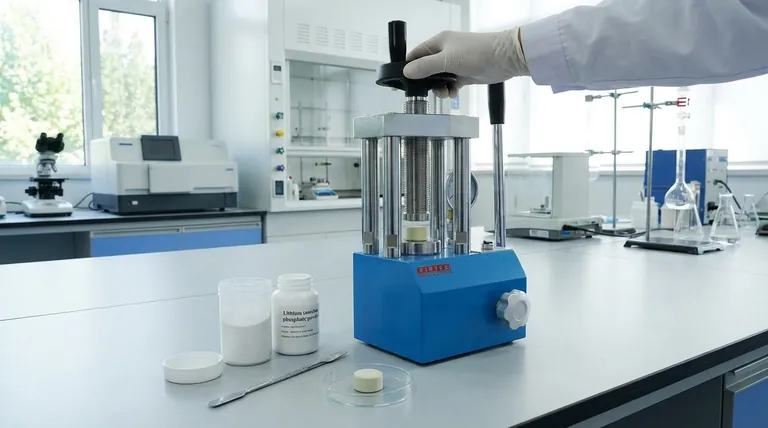
The Mechanics of Green Body Formation
Overcoming Loose Powder Limitations
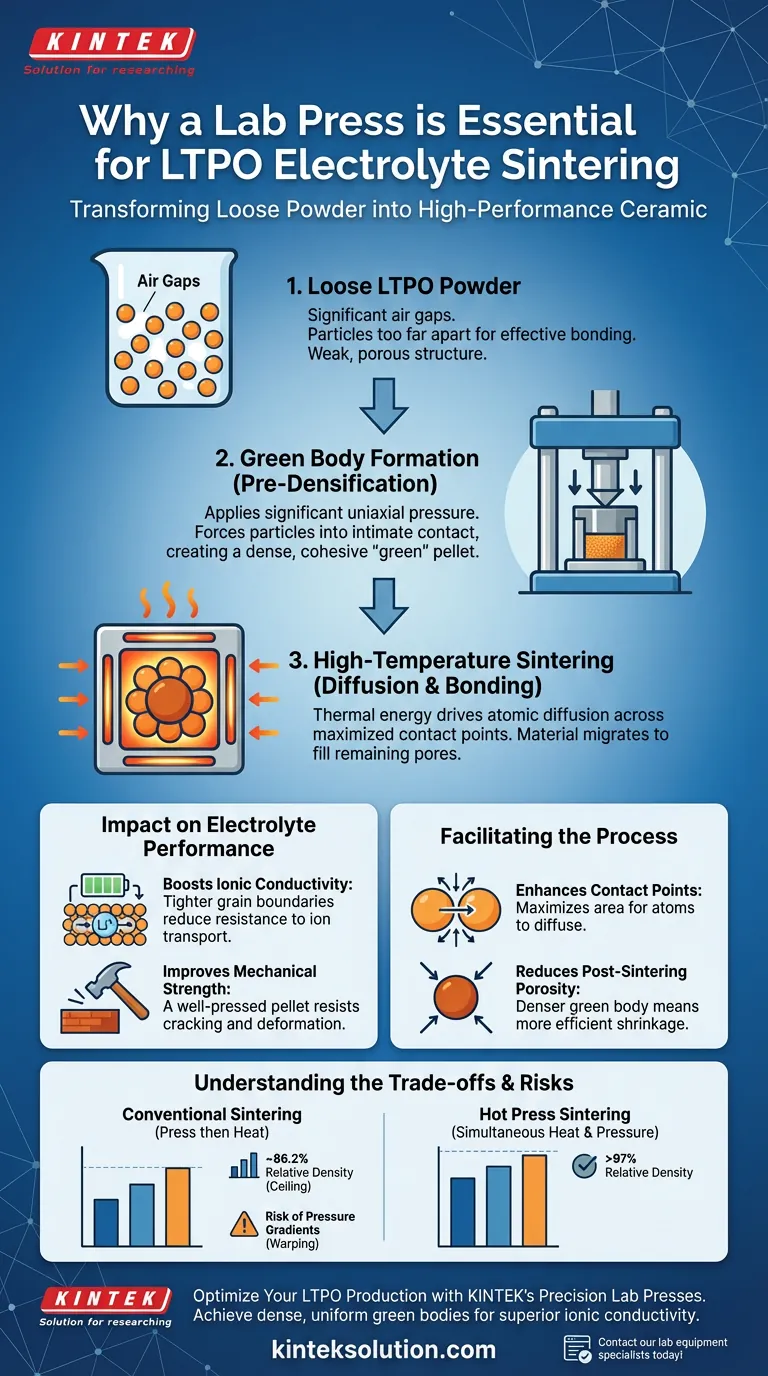
Loose LTPO powder consists of individual particles separated by significant air gaps. Sintering loose powder directly results in weak, porous structures because particles are too far apart to bond.
Creating the "Green" Pellet
The laboratory press compacts this loose material into a solid shape known as a green body. This compact possesses sufficient mechanical strength to be handled and transferred to a furnace without crumbling.
Maximizing Particle Packing
The pressure applied by the machine forces particles to rearrange and pack tightly. This minimizes inter-particle voids and creates a uniform density gradient throughout the pellet.
Facilitating the Sintering Process
Enhancing Contact Points
For sintering to occur, atoms must diffuse across particle boundaries. The press machine maximizes the contact points and contact area between neighboring particles.
Promoting Material Migration
High-temperature sintering relies on material migration to fill pores. By establishing close particle proximity beforehand, the press machine significantly lowers the energy barrier for this migration.
Reducing Post-Sintering Porosity
A denser green body leads to more efficient shrinkage during the heating phase. This direct correlation ensures that the final ceramic retains minimal internal porosity.
Impact on Electrolyte Performance
Boosting Ionic Conductivity
The ultimate goal of an LTPO electrolyte is to transport lithium ions. High density translates to tighter grain boundaries and fewer pores, which effectively reduces the resistance to ion transport.
Improving Mechanical Strength
A well-pressed pellet yields a structurally sound ceramic. Proper pressing prevents defects such as cracking or deformation that often occur when sintering low-density compacts.
Understanding the Trade-offs
The Density Ceiling
While a laboratory press is essential for conventional sintering, it has limitations. Conventional sintering (cold press followed by heat) typically achieves lower relative densities (e.g., ~86.2%) compared to hot press sintering, which applies heat and pressure simultaneously to reach densities upwards of 97%.
The Risk of Pressure Gradients
If the laboratory press does not apply pressure uniformly, the green body may develop internal density gradients. This lack of uniformity can lead to warping or structural failure during the shrinkage phase of sintering.
Making the Right Choice for Your Goal
To maximize the efficacy of your LTPO preparation, align your pressing parameters with your specific performance targets.
- If your primary focus is Ionic Conductivity: Ensure your press applies sufficient force to maximize particle contact, as this is the primary driver for reducing resistance.
- If your primary focus is Structural Integrity: Focus on precise, uniform pressure application to create a homogeneous green body that resists cracking during shrinkage.
Success in conventional sintering is determined before the furnace is even turned on; it begins with the quality of the pressed green body.
Summary Table:
| Function | Impact on LTPO Sintering | Key Benefit |
|---|---|---|
| Green Body Formation | Transforms loose powder into cohesive pellet | Enables handling and furnace transfer |
| Particle Packing | Maximizes contact points between particles | Reduces energy barrier for atomic diffusion |
| Pre-Densification | Minimizes inter-particle voids | Lowers post-sintering porosity |
| Uniform Pressure | Creates homogeneous density gradient | Prevents warping and structural defects |
Ready to optimize your LTPO electrolyte pellet production? KINTEK's precision lab press machines (including automatic, isostatic, and heated models) are engineered to create the dense, uniform green bodies essential for high-performance solid electrolytes. Our expertise ensures maximum particle contact area and minimized porosity—directly translating to superior ionic conductivity and mechanical strength in your final sintered ceramics. Contact our lab equipment specialists today to discuss how our presses can enhance your conventional sintering results!
Visual Guide
Related Products
- Lab Polygon Press Mold
- Lab Round Bidirectional Press Mold
- Automatic Heated Hydraulic Press Machine with Hot Plates for Laboratory
- Automatic Laboratory Hydraulic Press Lab Pellet Press Machine
- Laboratory Hydraulic Press Lab Pellet Press Machine for Glove Box
People Also Ask
- What is the purpose of incorporating cartridge heaters into a lab press mold for MLCC block compression? Optimize Results
- How do the design and geometric precision of pressing molds and mandrels affect the quality of PTFE composite samples?
- What role do precision positioning and pressure molds play in single-lap joints? Ensure 100% Data Integrity
- What are the requirements for pressing molds when using SSCG? Key Materials for Complex Single Crystal Production
- How do industrial-grade pressure molds affect zinc metal pouch cells? Maximize Energy Density & Performance



















