
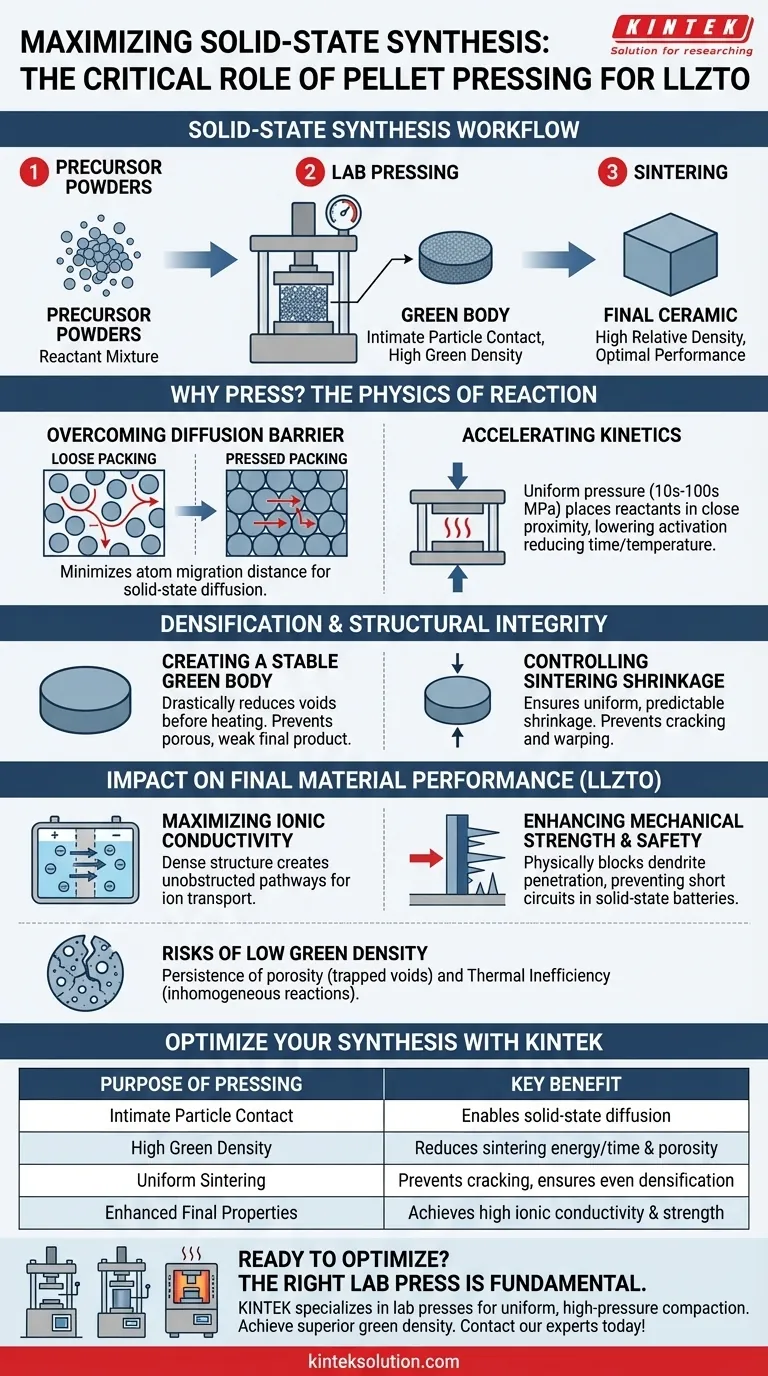
The primary purpose of pressing precursor powders into a pellet is to mechanically force reactant particles into intimate physical contact, creating a "green body" with high packing density. This step is the fundamental prerequisite for solid-state diffusion, as it minimizes the distance atoms must migrate to react and densify during the subsequent sintering phase.
By maximizing the "green density" of the pellet before heating, you significantly reduce the energy and time required for chemical reactions. A well-pressed pellet serves as the structural foundation that ensures the final ceramic achieves the high relative density necessary for optimal ionic conductivity and mechanical strength.
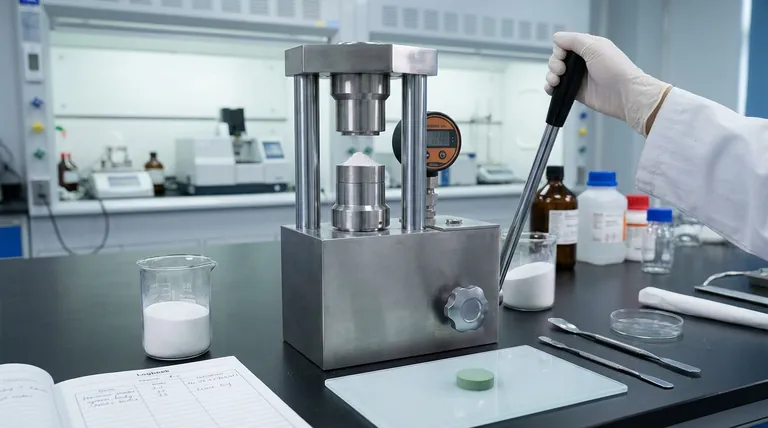
The Physics of Solid-State Reaction
Overcoming the Diffusion Barrier
Unlike liquid-phase synthesis where reactants mix freely, solid-state synthesis relies entirely on atomic migration across grain boundaries.
If particles are loosely packed, the contact area is insufficient for atoms to diffuse effectively. Pressing the powder increases the number of contact points between particles, establishing the physical pathways required for the chemical reaction to occur.
Accelerating Reaction Kinetics
A laboratory press allows you to apply uniform pressure, typically ranging from tens to hundreds of megapascals.
This intense compaction places reactants in such close proximity that it accelerates reaction kinetics. By reducing the diffusion distance, you lower the activation energy required, often allowing for reduced reaction temperatures and shorter dwell times while ensuring a more complete chemical conversion.
Densification and Structural Integrity
Creating a Stable "Green Body"
The pressed pellet, known as a green body, creates a cohesive structure with a specific initial density and mechanical strength.
This step drastically reduces voids (air pockets) between particles before heat is ever applied. If these voids are not removed mechanically during pressing, the sintering process often fails to close them, leaving the final product porous and weak.
Controlling Sintering Shrinkage
Ceramics shrink as they sinter and densify.
A pre-compacted pellet ensures that this shrinkage occurs uniformly and predictably. By establishing a solid foundation for material migration, pressing prevents common failure modes such as cracking, warping, or deformation that occur when loose powders settle unevenly during high-temperature treatment.
Impact on Final Material Performance
Maximizing Ionic Conductivity
For solid electrolytes like LLZTO, performance is directly tied to density.
A dense green body facilitates the formation of a final ceramic with high relative density. This continuous, void-free structure provides unobstructed pathways for ion transport, which is the primary requirement for achieving high ionic conductivity.
Enhancing Mechanical Strength and Safety
In battery applications, the physical density of the electrolyte serves a protective function.
A fully densified LLZTO pellet possesses the mechanical strength required to physically block the penetration of lithium dendrites. This is critical for preventing short circuits and ensuring the safety of solid-state batteries.
Understanding the Risks of Low Green Density
The Persistence of Porosity
It is a common misconception that sintering alone will remove all porosity.
If the initial pressing pressure is insufficient, the green density will be too low. Sintering cannot bridge large inter-particle voids; instead, these voids become trapped in the final microstructure, permanently degrading the material's electrical and mechanical properties.
Thermal Inefficiency
Loose powders act as thermal insulators due to the air trapped between particles.
Pressing creates a dense medium that promotes uniform heat conduction throughout the sample. This ensures that the entire pellet experiences the same thermal history, preventing temperature gradients that lead to inhomogeneous reactions or impure phases.
Making the Right Choice for Your Synthesis
To optimize your solid-state synthesis of materials like LLZTO, align your pressing parameters with your specific performance goals:
- If your primary focus is Ionic Conductivity: Prioritize maximizing pressing pressure to achieve the highest possible green density, as this is the limiting factor for eliminating ion-blocking voids.
- If your primary focus is Phase Purity: Ensure the precursor mixture is homogenous before pressing to guarantee that the increased contact points facilitate a complete and uniform chemical reaction.
- If your primary focus is Structural Integrity: Focus on applying uniform, uniaxial pressure to create a green body that can withstand handling and shrink evenly without cracking.
Ultimately, the lab press is not just a shaping tool; it is a reactor that sets the kinetic and structural boundaries for the entire synthesis process.
Summary Table:
| Purpose of Pressing | Key Benefit |
|---|---|
| Intimate Particle Contact | Enables solid-state diffusion for chemical reactions. |
| High Green Density | Reduces sintering energy/time and minimizes final porosity. |
| Uniform Sintering | Prevents cracking and ensures even densification. |
| Enhanced Final Properties | Achieves high ionic conductivity and mechanical strength. |
Ready to optimize your solid-state synthesis? The right lab press is fundamental to creating high-performance ceramics like LLZTO. KINTEK specializes in lab press machines (including automatic, isostatic, and heated lab presses) designed to deliver the uniform, high-pressure compaction your research demands. Achieve superior green density and unlock the full potential of your materials. Contact our experts today to find the perfect press for your laboratory's needs!
Visual Guide
Related Products
- 24T 30T 60T Heated Hydraulic Lab Press Machine with Hot Plates for Laboratory
- Manual Heated Hydraulic Lab Press with Integrated Hot Plates Hydraulic Press Machine
- Laboratory Hydraulic Pellet Press for XRF KBR FTIR Lab Press
- Lab Infrared Press Mold for Laboratory Applications
- Laboratory Hydraulic Press Lab Pellet Press Machine for Glove Box
People Also Ask
- Function of a Laboratory Hydraulic Press with Heated Platens in SSE? Enhance Battery Density & Conductivity
- Why is a laboratory hydraulic press with heating plates required for PLA/TEC films? Achieve Precise Sample Integrity
- What role does a laboratory heated hydraulic press play in LTCC? Essential for High-Density Ceramic Lamination
- What is the primary function of a laboratory heated hydraulic press? Mastering Thermoplastic Carbon Fiber Composites
- What is the critical role of a laboratory heated hydraulic press? Mastering PVC Sample Prep for Testing



















