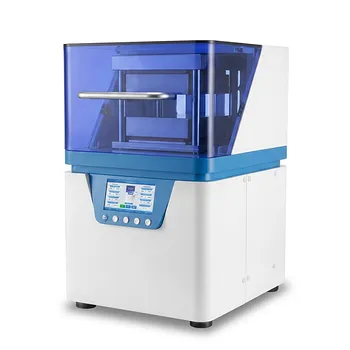
Hydraulic mini presses are primarily found in specialized scientific environments such as pharmaceutical laboratories, polymer testing facilities, and undergraduate chemistry departments. These devices are fixtures in settings where Fourier Transform Infrared Spectroscopy (FTIR) is a routine technique, offering a compact solution for essential sample preparation.
The Core Insight While standard hydraulic presses are industrial workhorses, the mini press is a precision laboratory tool designed specifically for space-constrained environments. Its utility is defined by the need to prepare small-scale samples—specifically KBr discs for spectroscopy—without the footprint or cost of full-sized machinery.
Primary Operational Environments
Pharmaceutical and Polymer Laboratories
In professional research settings, the hydraulic mini press is a standard piece of benchtop equipment.
It is heavily utilized in pharmaceutical labs and polymer testing facilities for the preparation of solid samples.
The primary application here is preparing samples for FTIR spectroscopy and X-ray Fluorescence (XRF) analysis, specifically the creation of 7 mm diameter KBr (potassium bromide) discs.
Undergraduate Chemistry Labs
Academic institutions favor these devices for their teaching laboratories.
Because they are handheld and relatively low-cost, they allow students to learn sample preparation techniques safely.
They are robust enough for repeated student use but lack the danger and complexity of industrial-scale pressing machinery.
Why These Settings Choose Mini Presses
Maximizing Limited Bench Space
Laboratory real estate is often at a premium, making full-sized floor presses impractical.
Weighing approximately 4 kilograms, a mini press is highly portable and can be easily stored in a cabinet when not in use.
This portability allows researchers to move the unit between different workstations or labs as needed.
Specific Pressure Requirements
These environments rarely require the massive force of industrial metal forming.
A mini press typically generates up to 2 tons of pressure, which is the "Goldilocks" zone for analytical sample preparation.
This is sufficient to compress powders into discs but prevents the overkill of using a 20-ton industrial press for a delicate chemical sample.
Cost-Effective Operation
Budget constraints in both academic and commercial labs often drive the decision to use mini presses.
They operate manually via a pump handle, eliminating the need for expensive electrical or pneumatic power systems.
This manual operation also reduces maintenance costs compared to automated systems.
Understanding the Trade-offs
Pressure Limitations
It is critical to understand that "mini" strictly refers to capacity as well as size.
With a maximum output generally capped at 2 tons, these devices cannot handle metal forming, heavy-duty composite molding, or high-force industrial tasks.
Attempting to use them for applications beyond spectroscopy discs or small powder compaction will result in equipment failure.
Manual Operation Fatigue
While the hydraulic mechanism reduces effort compared to mechanical screw presses, it still requires physical input.
The user must manually pump a handle to move the oil-filled plunger and generate pressure.
For high-volume laboratories processing hundreds of samples daily, the manual effort required may become a bottleneck compared to automated alternatives.
Making the Right Choice for Your Goal
If you are equipping a lab, the decision to use a hydraulic mini press depends entirely on your throughput and application.
- If your primary focus is FTIR or XRF analysis: The mini press is the industry standard for creating consistent KBr pellets with minimal footprint.
- If your primary focus is educational instruction: These presses offer the best balance of safety, durability, and low cost for student use.
- If your primary focus is high-volume manufacturing: You must look beyond mini presses to automated or standard industrial hydraulic systems to avoid operator fatigue.
The hydraulic mini press is the definitive solution when precision and portability outweigh the need for raw industrial force.
Summary Table:
| Setting Type | Primary Application | Key Benefits |
|---|---|---|
| Pharmaceutical Labs | FTIR & XRF KBr disc preparation | Precision, small sample handling |
| Polymer Testing | Solid sample compaction | Benchtop portability, low cost |
| Undergraduate Labs | Teaching sample prep techniques | Safety, durability, ease of use |
| Research Facilities | Portable analytical workstations | Space-saving, manual operation |
Optimize Your Lab Space with KINTEK Precision Solutions
Maximize your research efficiency without sacrificing valuable bench space. KINTEK specializes in comprehensive laboratory pressing solutions, offering a versatile range of manual, automatic, heated, and multifunctional models, as well as specialized cold and warm isostatic presses designed for advanced applications like battery research.
Whether you are equipping an undergraduate teaching lab or a high-throughput pharmaceutical facility, our experts will help you find the perfect balance of pressure and portability.
Ready to upgrade your sample preparation? Contact us today to find your ideal press!
Related Products
- Automatic Hydraulic Hot Press with Large Plate and Precision Temperature Control for Advanced Material Sample Preparation and Industrial Research
- Automatic Laboratory Hydraulic Press Lab Pellet Press Machine
- Laboratory Hydraulic Press Lab Pellet Press Machine for Glove Box
- Automatic Hydraulic Heat Press Machine with Multi Stage Programmable Control and Integrated Water Cooling Plate Size 180x180mm
- Laboratory Hydraulic Press Lab Pellet Press Button Battery Press
People Also Ask
- What are the specific features and applications of hydraulic hot press machines? Precision Solutions for Modern Labs
- How does an automatic hydraulic press operate? Achieve Precision and Consistency in Lab Pelleting
- What are the advantages and common applications of an automatic hydraulic press? Elevate Your Lab's Precision
- What is the technical significance of setting a precise dwell time? Achieve Peak Material Density and Stability
- When is an automatic hydraulic press more suitable than a manual press? Scale Your Lab with Precision & Speed