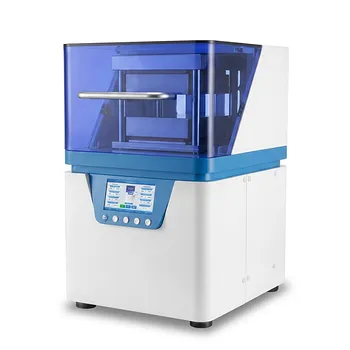
Hydraulic mini presses dramatically lower the barrier to entry for precision laboratory work by utilizing hydraulic advantage to minimize the manual force required for operation. By condensing high-pressure capabilities into a compact, lightweight chassis, they eliminate the need for expansive floor space or heavy-duty benches, making them uniquely suited for crowded laboratory environments.
The core value of a hydraulic mini press lies in its efficiency-to-size ratio: it delivers the necessary force for sample preparation while significantly reducing operator fatigue and preserving critical countertop real estate.
Optimizing Operator Efficiency
Reducing Physical Strain
The primary ergonomic benefit of a hydraulic mini press is the reduction of physical effort required to operate it. Unlike manual screw presses that rely entirely on the operator's muscle power, hydraulic systems amplify force.
This mechanical advantage means the operator can generate significant pressure with minimal exertion. Consequently, the risk of operator fatigue is drastically lowered, even during high-volume sample preparation.
Improving Consistency Through Ergonomics
There is a direct link between operator comfort and the quality of the output. When physical strain is removed from the equation, the repeatability of sample production improves.
Manual methods often introduce variability as the operator tires, leading to inconsistent densities or pellet formations. Hydraulic assistance ensures that pressure is applied consistently every time, regardless of how many samples have been processed that day.
Maximizing Laboratory Real Estate
The Compact Advantage
Laboratory counter space is often a scarce resource, particularly in pharmaceutical, polymer testing, and undergraduate chemistry environments. Hydraulic mini presses are designed with a small physical footprint, allowing them to fit easily onto crowded benches.
This compactness contrasts sharply with larger, full-sized industrial presses that often require dedicated floor space or reinforced tables. By occupying less room, these units allow labs to maintain a diverse array of equipment without overcrowding.
Versatility Without Bulk
Despite their reduced size, these units do not sacrifice essential utility. They are capable of generating significant pressure (up to 2 tons), making them versatile enough for tasks ranging from KBr pellet pressing to XRF sample preparation.
This balance of size and power allows researchers to perform heavy-duty applications—such as pressing metals, ceramics, and polymers—without the logistical burden of heavy machinery.
Understanding the Trade-offs
Capacity Limitations
While hydraulic mini presses are excellent for standard laboratory tasks, they have absolute force limits. If your application requires forces significantly exceeding 2 tons, the compact design becomes a limitation rather than an asset, and a full-sized floor model may be required.
Complexity vs. Simplicity
Compared to purely mechanical manual presses, hydraulic systems are slightly more complex. They rely on oil and seals to generate force. While generally durable and low-maintenance, they do introduce the potential for hydraulic fluid leaks or seal wear over time, which requires a basic level of preventative maintenance that mechanical screws do not.
Making the Right Choice for Your Goal
To determine if a hydraulic mini press fits your specific laboratory needs, consider your primary constraints:
- If your primary focus is Space Optimization: Choose a mini press to preserve bench space in shared or crowded facilities like undergraduate or quality control labs.
- If your primary focus is Sample Consistency: Leverage the hydraulic mechanism to eliminate human error and fatigue-induced variability in your sample preparation.
- If your primary focus is Extreme High-Pressure: Acknowledge the 2-ton limit of mini models and opt for a full-sized industrial press for heavy-metallurgy applications.
By aligning the equipment's ergonomic and spatial benefits with your workflow, you ensure a safer, more efficient, and more productive laboratory environment.
Summary Table:
| Feature | Hydraulic Mini Press | Traditional Manual Press | Benefit |
|---|---|---|---|
| Physical Effort | Minimal (Hydraulic Advantage) | High (Manual Torque) | Reduces fatigue & improves consistency |
| Footprint | Compact & Portable | Large & Heavy | Saves critical countertop real estate |
| Force Output | Up to 2 Tons | Variable/Limited by User | Sufficient for KBr, XRF, and polymers |
| Repeatability | High (Consistent Pressure) | Low (Operator Dependent) | Ensures uniform sample density |
Upgrade Your Sample Preparation with KINTEK Precision
Maximize your laboratory’s productivity while minimizing physical strain. KINTEK specializes in comprehensive laboratory pressing solutions, offering a diverse range of manual, automatic, heated, multifunctional, and glovebox-compatible models, as well as specialized cold and warm isostatic presses widely applied in battery research and material science.
Whether you need to save space or ensure the highest repeatability for your samples, our experts are ready to help you find the perfect fit. Contact KINTEK today to discover how our pressing solutions can transform your research efficiency!
Related Products
- Automatic Hydraulic Hot Press with Large Plate and Precision Temperature Control for Advanced Material Sample Preparation and Industrial Research
- Automatic Laboratory Hydraulic Press Lab Pellet Press Machine
- Laboratory Hydraulic Press Lab Pellet Press Machine for Glove Box
- Automatic Hydraulic Heat Press Machine with Multi Stage Programmable Control and Integrated Water Cooling Plate Size 180x180mm
- Laboratory Hydraulic Press Lab Pellet Press Button Battery Press
People Also Ask
- What are the specific features and applications of hydraulic hot press machines? Precision Solutions for Modern Labs
- How does an automatic hydraulic press operate? Achieve Precision and Consistency in Lab Pelleting
- What are the advantages and common applications of an automatic hydraulic press? Elevate Your Lab's Precision
- What is the technical significance of setting a precise dwell time? Achieve Peak Material Density and Stability
- When is an automatic hydraulic press more suitable than a manual press? Scale Your Lab with Precision & Speed