
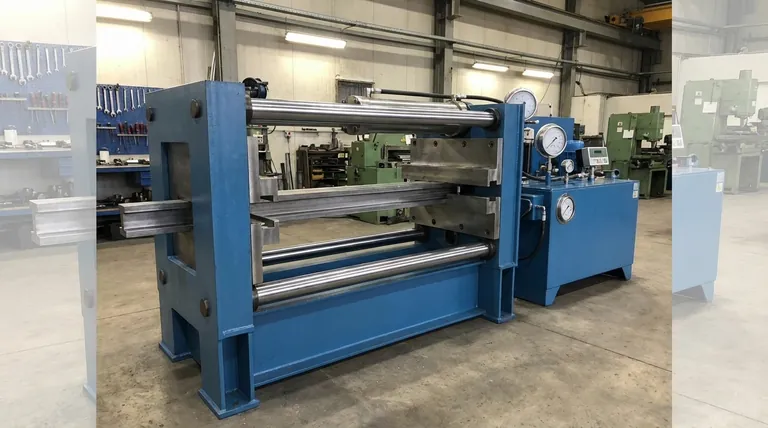
A horizontal hydraulic press is primarily utilized when the physical dimensions of a workpiece—specifically its length or height—make it impractical to process using a conventional vertical press. Instead of relying on a downward stroke, this machine operates by applying pressure horizontally between a fixed platen and a movable platen to shape these larger components.
Core Takeaway: The horizontal hydraulic press is the definitive solution for components with awkward geometries—such as excessive length or height—that exceed the physical clearance or handling capabilities of standard vertical machinery.
Overcoming Dimensional Constraints
The Limitations of Vertical Presses
Standard vertical presses operate within a fixed vertical daylight (opening).
When a workpiece is exceptionally long or tall, fitting it upright into a vertical press becomes physically impossible or operationally unsafe.
The Horizontal Advantage
The horizontal press solves this by shifting the axis of force.
By laying the operation flat, the machine removes the ceiling constraint, allowing for the shaping of parts that would otherwise be considered impractical due to their size.
Operational Mechanics and Versatility
How Force is Applied
The mechanism functions by generating pressure between two key points.
A movable platen extends horizontally to compress the workpiece against a fixed platen, ensuring stable and controlled deformation.
Tooling Adaptability
These machines are designed for flexibility beyond simple compression.
They can accommodate various attached tools, allowing operators to customize the press for different shaping requirements despite the unique orientation.
Understanding the Safeguards
System Protection
Hydraulic systems generate immense force, creating potential risks for the machinery.
To mitigate this, horizontal hydraulic presses include a protective mechanism on the hydraulic system specifically designed to prevent overload, ensuring the longevity of the equipment and the safety of the operation.
Making the Right Choice for Your Goal
If you are deciding between press configurations, consider the geometry of your material as the deciding factor.
- If your primary focus is handling long or tall components: Choose a horizontal press to bypass the clearance limitations of vertical frames.
- If your primary focus is operational safety: Rely on the built-in hydraulic overload mechanisms to protect your investment during high-force applications.
Ultimately, the horizontal press is not just an alternative; it is a necessary adaptation for workpieces that defy standard vertical dimensions.
Summary Table:
| Application Scenario | Key Advantage of Horizontal Press |
|---|---|
| Processing long workpieces | Eliminates vertical height constraints |
| Processing tall workpieces | Allows component to be laid flat for stable operation |
| High-force applications | Built-in overload protection safeguards the system |
| Versatile shaping needs | Accommodates various attached tools for different tasks |
Struggling to process long or tall components in your lab?
A KINTEK horizontal hydraulic press is the specialized solution for workpieces that defy standard vertical dimensions. Our lab presses, including automatic and heated models, are engineered for safety, precision, and handling challenging geometries.
Let KINTEK empower your research and production:
- Overcome Size Limitations: Perfect for long or tall materials that won't fit in a vertical press.
- Ensure Operational Safety: Benefit from built-in hydraulic overload protection.
- Achieve Precise Results: Experience stable, controlled force application for consistent shaping.
Don't let component size limit your capabilities. Contact KINTEK today to find the perfect horizontal press solution for your laboratory needs!
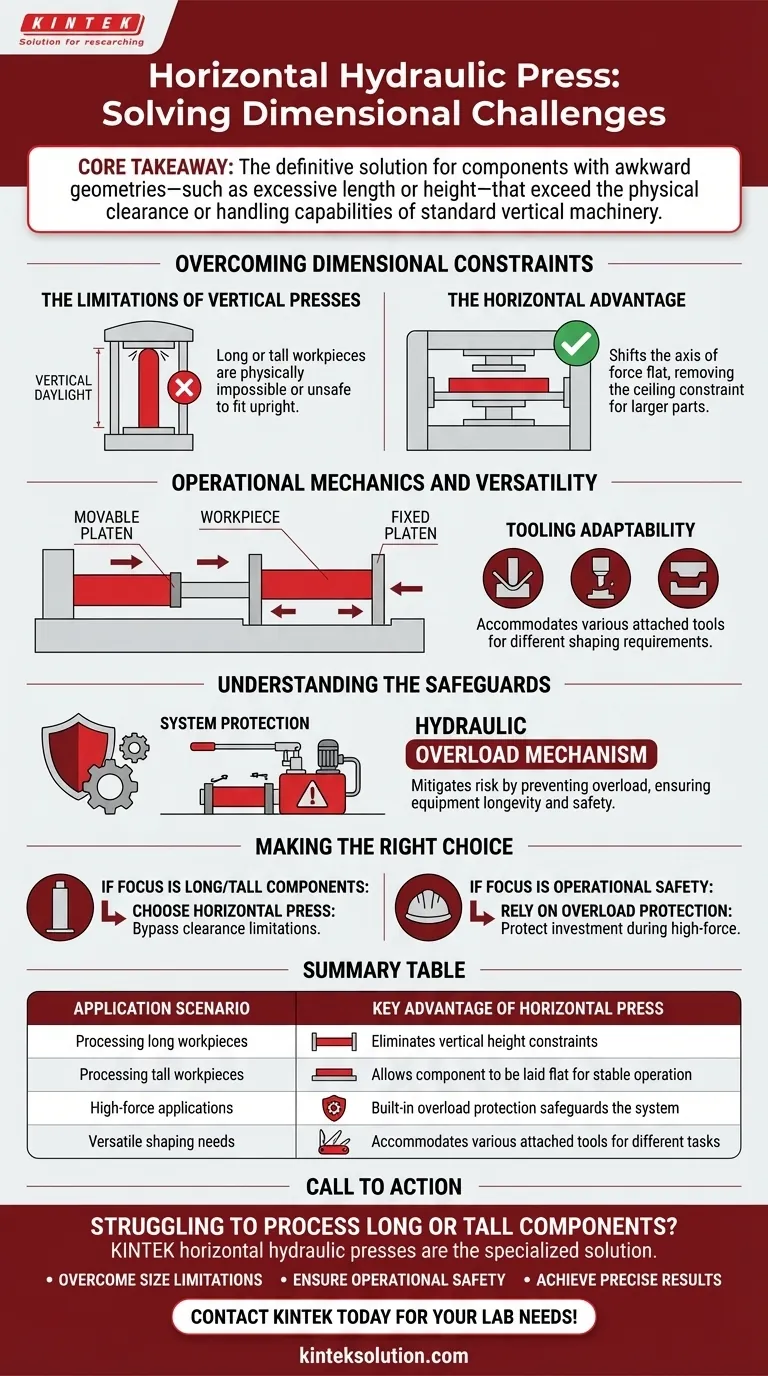
Visual Guide
Related Products
- Automatic Laboratory Hydraulic Press for XRF and KBR Pellet Pressing
- Laboratory Hydraulic Press 2T Lab Pellet Press for KBR FTIR
- Laboratory Hydraulic Pellet Press for XRF KBR FTIR Lab Press
- Automatic Heated Hydraulic Press Machine with Heated Plates for Laboratory
- Laboratory Hydraulic Press Lab Pellet Press Machine for Glove Box
People Also Ask
- Why is pressing powder into a pellet critical before sintering? Ensure Dense, Conductive Solid-State Electrolytes
- What is the role of a laboratory pressure machine and KBr in FTIR? Master Sample Preparation for Flame Retardants
- What are the advantages of using a laboratory automatic hydraulic press for HEA green compact forming?
- What are the advantages of using a lab automatic hydraulic press for HEA green body molding? Ensure Material Integrity
- How does an automatic laboratory hydraulic press improve KBr pellet preparation? Achieve Precision IR Spectroscopy



















