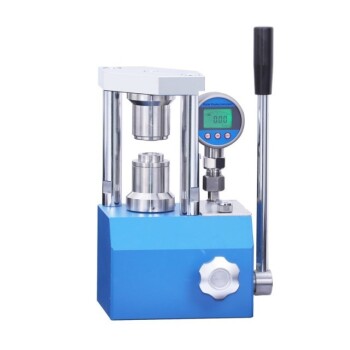
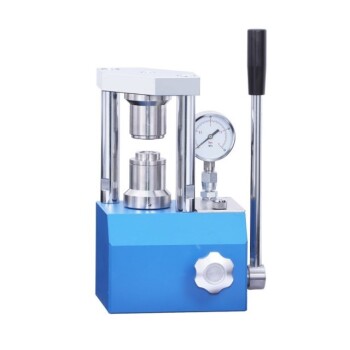
The definitive advantage of an electric crimper is the delivery of consistent, precisely controlled sealing force. Unlike manual equipment, which introduces variability through human operation, an electric crimper applies uniform pressure to ensure a tight, durable bond between the coin cell case, gasket, and internal components. This automation eliminates the risk of human error, guaranteeing a reliable mechanical seal for every single unit produced.
While manual crimping works for casual testing, electric crimpers provide the uniform structural integrity necessary to maintain internal stability and ensure valid data during long-term battery cycle testing.
The Mechanics of a Reliable Seal
Precision Pressure Control
Manual crimpers rely on physical leverage or hand-pumped hydraulics, leading to slight variations in pressure from cell to cell.
Electric crimpers utilize a motor-driven system to apply exact, pre-set pressure. This consistency is paramount for creating a uniform bond across the entire batch of test cells.
Environmental Isolation and Leak Prevention
A primary failure mode in coin cells is the leakage of electrolyte or the ingress of external moisture and air.
By applying consistent electric pressure, the machine ensures the gasket is compressed perfectly against the casing. This isolation creates a hermetic seal that protects the internal chemistry from external contaminants.
Impact on Electrochemical Data
Optimizing Internal Contact
A coin cell is a stack of components—current collectors, electrode sheets, separators, and springs—that must be pressed together firmly.
The constant sealing pressure provided by an electric crimper forces these components into tight physical contact. This compression is critical for engaging the spring mechanism correctly and minimizing gaps between layers.
Reducing Contact Resistance
When internal components are not compressed uniformly, internal resistance fluctuates, skewing test results.
Tight physical contact reduces contact resistance significantly. This ensures that the electrochemical data you record reflects the true performance of your battery chemistry, rather than artifacts of a poor mechanical assembly.
Data Repeatability
For research to be valid, it must be repeatable.
Because electric crimpers remove the variable of "operator feel," they ensure that differences in performance between cells are due to the materials being tested, not the assembly process.
Understanding the Trade-offs
Equipment Complexity and Cost
Electric crimpers are generally more expensive and mechanically complex than manual toggle presses or hydraulic pumps.
They require a power source and may contain electronic components that are sensitive to the harsh environment of a glovebox (argon atmosphere) if not specifically designed for it.
"Feel" vs. Automation
Manual crimping allows an experienced operator to "feel" the crimp, potentially noticing a misaligned gasket before applying full force.
Electric crimpers execute the cycle automatically. If a cell is misaligned prior to activation, the machine will crimp it regardless, potentially leading to a wasted case or damaged die.
Making the Right Choice for Your Goal
To determine if the advantages of electric crimping justify the investment for your specific application, consider your testing priorities:
- If your primary focus is long-term cycle life: The electric crimper is essential to maintain internal stability and prevent seal failure over weeks or months of testing.
- If your primary focus is data precision: The consistent reduction of contact resistance provided by electric pressure is required for accurate, low-noise electrochemical impedance spectroscopy (EIS) or high-rate cycling.
Consistency in assembly is the invisible variable that defines the reliability of your research.
Summary Table:
| Feature | Manual Crimper | Electric Crimper |
|---|---|---|
| Pressure Consistency | Variable (Human dependent) | Highly Uniform (Motor-driven) |
| Sealing Quality | Risk of human error/leakage | Hermetic seal; high reliability |
| Contact Resistance | Inconsistent across batches | Minimized and stable |
| Data Accuracy | Potential for mechanical artifacts | Reflects true chemical performance |
| Ease of Use | Physically demanding | Fully automated; one-touch operation |
Elevate Your Battery Research with KINTEK Precision
Consistency in assembly is the foundation of reliable electrochemical data. KINTEK specializes in comprehensive laboratory pressing solutions, offering a diverse range of manual, automatic, heated, multifunctional, and glovebox-compatible models, as well as cold and warm isostatic presses.
Whether you are scaling up your battery research or need to eliminate variables in long-term cycle testing, our electric crimping solutions provide the uniform structural integrity your project demands.
Ready to optimize your lab's efficiency and data precision?
Contact KINTEK today to find the perfect press for your application.
References
- Mohammad K. Shehab, Hani M. El‐Kaderi. Metalated Covalent Organic Frameworks as Electrocatalytic Sulfur Cathodes for High-Performance Lithium–Sulfur Batteries. DOI: 10.1021/acsaem.5c01625
This article is also based on technical information from Kintek Solution Knowledge Base .
Related Products
- Button Battery Sealing Press Machine for Lab
- Button Battery Sealing Machine for Button Batteries
- Manual Button Battery Sealing Machine for Battery Sealing
- Lab Button Battery Tablet Press Sealing Mold
- Lab Button Battery Disassembly and Sealing Mold
People Also Ask
- Why use standardized CR2032 components & high-precision presses? Ensure reliability in lithium metal battery research.
- Why is a laboratory battery sealing press essential for desolvation energy testing? Ensure Reliable Kinetic Data
- Why is a laboratory hydraulic press or battery sealing machine essential? Ensure Coin Cell Data Integrity
- How do laboratory battery sealing machines ensure performance consistency? Master Your Lithium and LFP Battery Assembly
- What role does a laboratory sealing press play in thermal analysis of solid dispersion films? Ensure Data Integrity