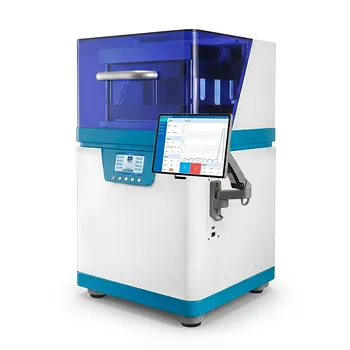
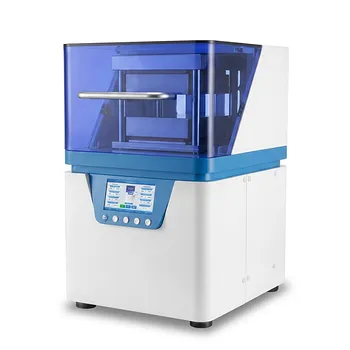
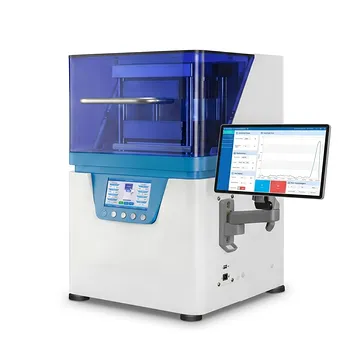
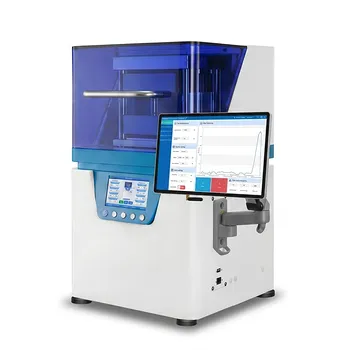
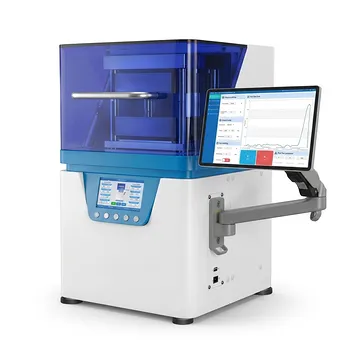
In the specific context of analytical chemistry, hydraulic presses—historically known as Bramah presses—serve a critical role in the preparation of solid samples for spectroscopic analysis. They are primarily utilized to compress powdered materials into dense, uniform pellets or discs suitable for Infra-Red (IR) spectroscopy.
The core function of the Bramah press in a laboratory is to transform loose powder into a solid form. By applying immense pressure, the press eliminates air gaps and particle scattering, creating a sample dense enough to yield accurate spectroscopic data.
The Critical Role in Sample Preparation
Transforming Powders for Analysis
Many analytical techniques, particularly Infra-Red (IR) spectroscopy, require samples to be in a solid, consolidated state. Loose powders are difficult to analyze directly because they scatter light unpredictably.
Achieving Sample Homogeneity
The hydraulic press applies consistent force to the sample material. This ensures that the resulting solid pellet has a uniform density and thickness, which is essential for reproducible results.
Enabling Optical Clarity
For IR spectroscopy, the sample often needs to be transparent or semi-transparent to infrared light. The high pressure exerted by the press forces the powder particles (often mixed with a matrix) to fuse, creating a clear disc that allows light transmission.
Mechanism of Action
Leveraging Hydraulic Principles
These presses operate on Pascal’s Law, utilizing fluid pressure to generate significant force. A small amount of mechanical effort is amplified into tons of compressive force, capable of reshaping solid matter.
The Compaction Process
In a typical workflow, the sample powder is placed inside a steel die. The hydraulic ram compresses the die, forcing the powder to coalesce into a cohesive solid without the need for heat or binders that might interfere with chemical analysis.
Common Pitfalls to Avoid
Inconsistent Pressure Application
While hydraulic presses are powerful, applying pressure too rapidly or unevenly can lead to fractured or cloudy pellets. This results in poor spectral quality and the need to repeat the preparation process.
Die Contamination
The high pressures involved can cause sample material to adhere strictly to the pressing die. If the equipment is not meticulously cleaned between uses, cross-contamination will occur, compromising the analytical purity of subsequent samples.
Optimizing Your Laboratory Workflow
If you are selecting or utilizing a hydraulic press for your laboratory, consider how its capabilities align with your specific analytical needs.
- If your primary focus is Standard IR Spectroscopy: Prioritize a press that offers consistent, repeatable pressure levels to ensure uniform pellet thickness and clarity.
- If your primary focus is Material Behavior Research: Look for equipment that allows for variable pressure control to study how materials deform or change under different high-pressure conditions.
Mastering the use of the hydraulic press is the first step toward ensuring the fidelity of your solid-state analytical data.
Summary Table:
| Feature | Role in Analytical Chemistry |
|---|---|
| Primary Use | Creating solid pellets/discs for IR Spectroscopy |
| Core Mechanism | Pascal's Law (Fluid pressure amplification) |
| Key Benefit | Eliminates air gaps and reduces light scattering |
| Resulting Quality | High optical clarity and sample homogeneity |
| Sample Form | Compressed powder in a consolidated solid state |
Elevate Your Analytical Precision with KINTEK
Ready to achieve superior sample clarity and reproducible spectroscopic data? KINTEK specializes in comprehensive laboratory pressing solutions tailored for precision research. Whether you are conducting standard IR spectroscopy or advanced battery research, our range of manual, automatic, heated, and multifunctional presses—including specialized glovebox-compatible and isostatic models—ensures the perfect pellet every time.
Don't let inconsistent sample preparation compromise your results. Contact us today to find the ideal pressing solution for your lab!
Related Products
- Automatic Hydraulic Hot Press with Large Plate and Precision Temperature Control for Advanced Material Sample Preparation and Industrial Research
- Automatic Hydraulic Heat Press Machine with Multi Stage Programmable Control and Integrated Water Cooling Plate Size 180x180mm
- Automatic High Temperature Heated Hydraulic Press Machine with Heated Plates for Lab
- Automatic Heated Hydraulic Lab Press with Programmable Touch Screen Controls and Precision Temperature Regulation
- Manual Heated Hydraulic Lab Press with Integrated Hot Plates Hydraulic Press Machine
People Also Ask
- What are the specific features and applications of hydraulic hot press machines? Precision Solutions for Modern Labs
- How does an automatic hydraulic press operate? Achieve Precision and Consistency in Lab Pelleting
- What are the advantages and common applications of an automatic hydraulic press? Elevate Your Lab's Precision
- What is the technical significance of setting a precise dwell time? Achieve Peak Material Density and Stability
- When is an automatic hydraulic press more suitable than a manual press? Scale Your Lab with Precision & Speed