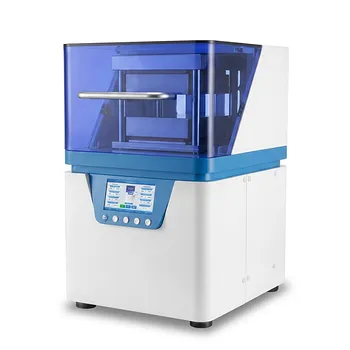
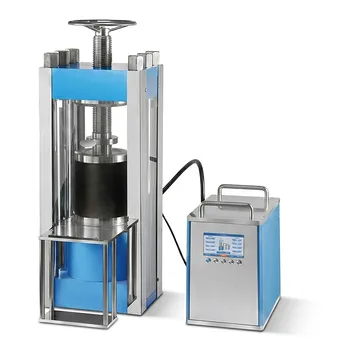
Vacuum Hot Pressing (VHP) is primarily utilized for processing advanced materials that require high density and structural integrity, specifically ceramics, refractory metals, and specialized powders. Common applications include the manufacturing of transparent optical lenses, high-wear industrial cutting tools, and critical components for the aerospace and defense sectors.
Core Takeaway VHP is not a general-purpose manufacturing method; it is a specialized consolidation technique designed for materials that are difficult to densify. It is the preferred choice when you need to achieve near-theoretical density and eliminate porosity in high-melting-point materials without inducing oxidation.
Advanced Ceramics and Optics
Transparent Ceramics
VHP is critical for producing transparent ceramics, such as those used in optical lenses and laser windows.
Eliminating Porosity
To achieve transparency, a material must be virtually free of pores. VHP removes trapped gases and applies pressure to close voids, ensuring the material allows light transmission without scattering.
High-Performance Industrial Ceramics
Materials like silicon carbide and silicon nitride are processed using VHP for extreme industrial environments.
Wear Resistance
These ceramics are formed into cutting tools and wear parts. The high density achieved through VHP ensures these components can withstand intense friction and mechanical stress without premature failure.
Sputter Targets and Specialized Compounds
VHP is frequently used to consolidate ceramic materials like boron carbide and various sputter targets. These targets require uniform density to ensure consistent film deposition during semiconductor manufacturing.
Refractory Metals and Aerospace
Consolidating Refractory Metals
Refractory metals and alloys have extremely high melting points and are often difficult to process via conventional melting.
Preventing Oxidation
Because VHP operates in a vacuum, it prevents these reactive metals from oxidizing at high temperatures. This allows for the successful consolidation of powders into solid, high-strength billets.
Defense and Aerospace Applications
The resulting components are essential for aerospace and defense systems. These industries rely on VHP-processed materials to withstand the thermal shock and mechanical loads found in jet engines and ballistic armor.
Understanding the Trade-offs
Process Speed vs. Material Quality
VHP is a batch process that is significantly slower than continuous manufacturing methods. It is best reserved for high-value components where material performance is more critical than production volume.
Complexity and Cost
The equipment required to maintain a high vacuum while applying tons of pressure at high temperatures is capital-intensive. This makes VHP less suitable for low-cost consumer goods (like standard plywood or foam mats) and more aligned with precision engineering.
Geometric Limitations
VHP is generally limited to simple shapes, such as plates, disks, or cylinders. Complex geometries often require significant machining after the pressing phase, adding to the total cost of the component.
Making the Right Choice for Your Goal
When deciding if VHP is the correct manufacturing route for your application, consider your performance requirements:
- If your primary focus is Optical Clarity: Choose VHP for transparent ceramics to eliminate porosity that causes light scattering.
- If your primary focus is Extreme Wear Resistance: Use VHP for silicon carbide or boron carbide to create dense, durable cutting tools and armor.
- If your primary focus is High-Temperature Strength: Rely on VHP for consolidating refractory metals for aerospace applications to prevent oxidation during forming.
VHP is the definitive solution when standard sintering cannot achieve the density or purity required for your critical applications.
Summary Table:
| Application Category | Common Materials | Key Performance Benefit |
|---|---|---|
| Advanced Optics | Transparent Ceramics, Laser Windows | Zero porosity for maximum light transmission |
| Industrial Wear | Silicon Carbide, Boron Carbide | Extreme hardness and resistance to mechanical stress |
| Aerospace & Defense | Refractory Metals, Ballistic Armor | High-temperature strength and oxidation prevention |
| Semiconductors | Sputter Targets | Uniform density for consistent film deposition |
Elevate Your Material Performance with KINTEK
Are you struggling to achieve theoretical density or eliminate porosity in your advanced ceramics and refractory metals? KINTEK specializes in comprehensive laboratory pressing solutions, providing the precision technology needed for cutting-edge battery research and high-performance material science.
Our range of manual, automatic, heated, and multifunctional models—including specialized cold and warm isostatic presses—ensures that your lab can achieve the structural integrity required for aerospace, defense, and industrial applications. Don't let oxidation or residual porosity compromise your results.
Contact KINTEK today to find the perfect pressing solution for your research!
Related Products
- Heated Hydraulic Press Machine with Heated Plates for Vacuum Box Laboratory Hot Press
- Heated Hydraulic Press Machine With Heated Plates For Vacuum Box Laboratory Hot Press
- Automatic Hydraulic Hot Press with Large Plate and Precision Temperature Control for Advanced Material Sample Preparation and Industrial Research
- Automatic Hydraulic Heat Press Machine with Multi Stage Programmable Control and Integrated Water Cooling Plate Size 180x180mm
- Automatic High Temperature Heated Hydraulic Press Machine with Heated Plates for Lab
People Also Ask
- What are the requirements for electrode pressing with high-viscosity ionic liquids like EMIM TFSI? Optimize Performance
- How does a laboratory heated hydraulic press facilitate PBN sample prep for WAXS? Achieve Precise X-Ray Scattering
- What are the industrial applications of heated hydraulic presses? Master Heat & Force for Precision Manufacturing
- Function of a Laboratory Hydraulic Press with Heated Platens in SSE? Enhance Battery Density & Conductivity
- How are heated hydraulic presses utilized in the preparation of thin films? Key Mechanisms and Applications