
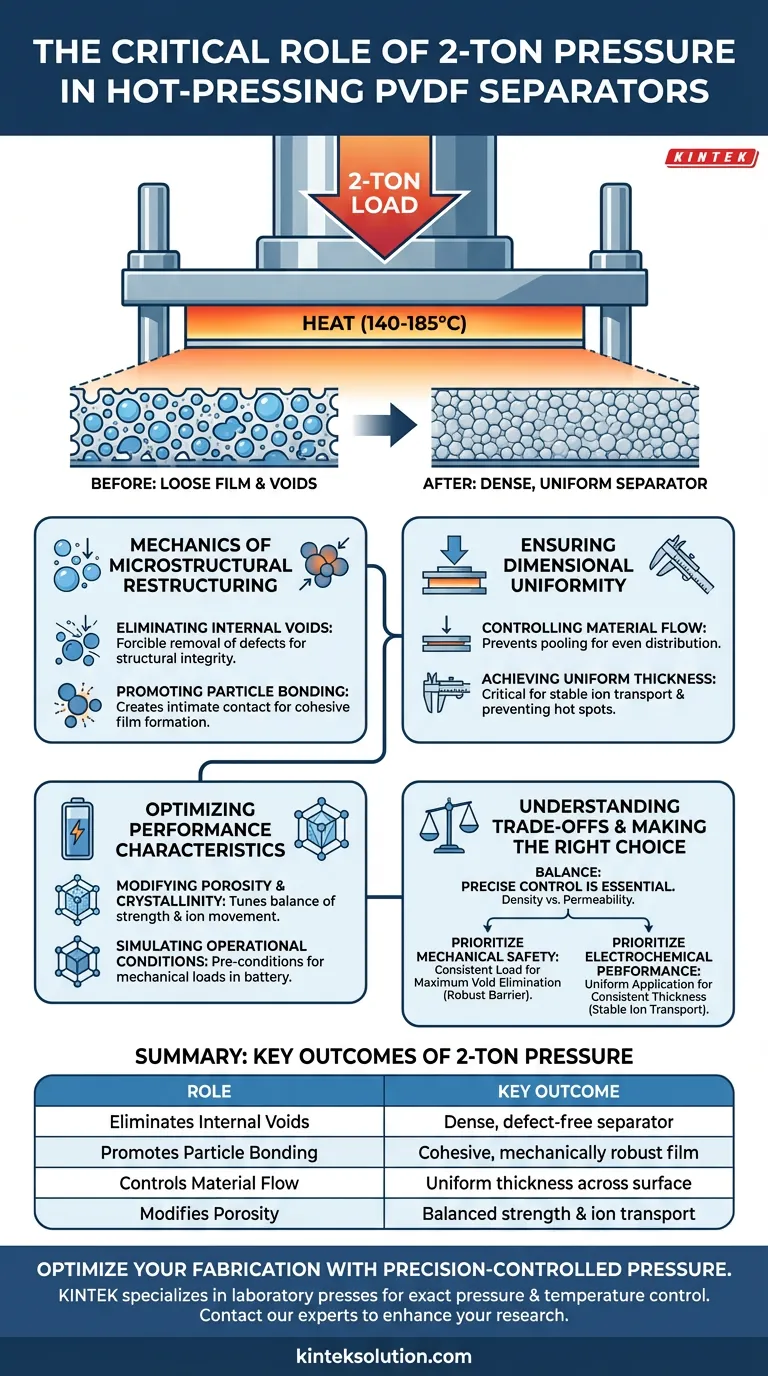
The specific role of the 2-ton pressure applied during the hot-pressing of PVDF separators is to act as a critical restructuring force. By applying this constant mechanical load while the material is heated (typically between 140-185°C), the press forcibly eliminates internal voids and promotes intimate bonding between polymer particles. This ensures the softened material flows uniformly, resulting in a defect-free separator with consistent thickness.
The application of 2-ton pressure is not merely about compaction; it is a fundamental restructuring mechanism that defines the separator's final microstructure. This force is essential for transforming a loose film into a dense, uniform layer capable of withstanding the internal mechanical and thermal loads of a battery.

The Mechanics of Microstructural Restructuring
Eliminating Internal Voids
The primary function of the 2-ton load is the forcible removal of defects. Initial PVDF films often contain microscopic voids or air pockets that can compromise structural integrity.
The hydraulic pressure collapses these voids, creating a dense and continuous material. This densification is non-negotiable for preventing mechanical failure inside the battery cell.
Promoting Particle Bonding
Heat softens the PVDF, but pressure is required to fuse it. The 2-ton force pushes the polymer particles into intimate contact with one another.
This contact facilitates physical bonding as the material softens or melts. Without this pressure, the particles would remain distinct, resulting in a weak, crumbly structure rather than a cohesive film.
Ensuring Dimensional Uniformity
Controlling Material Flow
As the PVDF reaches temperatures of 140-185°C, it transitions to a softened or melted state. The 2-ton pressure dictates how this viscous material moves.
It forces the material to extend uniformly across the mold or platen. This controlled flow prevents the pooling of material in specific areas, which would otherwise lead to irregularities.
Achieving Uniform Thickness
Precise pressure control is the determining factor for the separator's final geometry. It ensures the film is flattened to a specific, uniform thickness across its entire surface area.
Uniform thickness is critical for battery performance. Variations in thickness can lead to uneven ion transport or "hot spots" that degrade battery life.
Optimizing Performance Characteristics
Modifying Porosity and Crystallinity
The combination of thermal load and mechanical pressure intentionally modifies the film's internal architecture. This process adjusts the crystallinity and porosity of the PVDF.
By manipulating these parameters, manufacturers can tune the separator to balance mechanical strength with the ability to facilitate ion movement.
Simulating Operational Conditions
The hot-pressing process serves as a simulation of the actual environment inside a battery. The 2-ton pressure mimics the mechanical loads the separator will endure during operation.
Fabricating the separator under these conditions ensures it is pre-conditioned to perform reliably under the physical stresses of a working cell.
Understanding the Trade-offs
The Necessity of Precise Control
While high pressure is beneficial, the application must be exact. The references emphasize that precise pressure control is essential.
If the pressure fluctuates or is applied unevenly, the material flow will become erratic. This results in defects rather than the intended defect-free layer.
Balancing Density and Permeability
The goal is to eliminate voids, not to crush the material into an impermeable block. The pressure must be sufficient to densify the layer without destroying the porous network required for ion transport.
The process is a balancing act between creating a mechanically robust barrier and maintaining the microstructure necessary for electrochemical function.
Making the Right Choice for Your Goal
To optimize your PVDF separator fabrication process, you must align the pressure parameters with your specific performance targets.
- If your primary focus is Mechanical Safety: Prioritize the consistency of the 2-ton load to ensure maximum void elimination and particle bonding, creating a robust barrier against short circuits.
- If your primary focus is Electrochemical Performance: Focus on the uniformity of the pressure application to guarantee consistent thickness, which ensures stable and predictable ion transport across the cell.
The 2-ton pressure is the tool that transforms a raw polymer film into a precision-engineered component, turning potential defects into structural reliability.
Summary Table:
| Role of 2-Ton Pressure | Key Outcome |
|---|---|
| Eliminates Internal Voids | Creates a dense, defect-free separator |
| Promotes Particle Bonding | Ensures a cohesive, mechanically robust film |
| Controls Material Flow | Guarantees uniform thickness across the separator |
| Modifies Porosity | Balances mechanical strength with ion transport capability |
Optimize your PVDF separator fabrication with precision-controlled pressure. KINTEK specializes in laboratory press machines, including automatic and heated lab presses, designed to deliver the exact pressure and temperature control required for producing high-performance battery components. Our expertise ensures your process achieves the critical balance between mechanical integrity and electrochemical performance. Contact our experts today to discuss how our lab press solutions can enhance your research and development.
Visual Guide
Related Products
- Laboratory Hydraulic Press 2T Lab Pellet Press for KBR FTIR
- 24T 30T 60T Heated Hydraulic Lab Press Machine with Hot Plates for Laboratory
- Laboratory Hydraulic Pellet Press for XRF KBR FTIR Lab Press
- Laboratory Hydraulic Press Lab Pellet Press Machine for Glove Box
- Automatic Laboratory Hydraulic Press Lab Pellet Press Machine
People Also Ask
- What is the role of a laboratory pressure machine and KBr in FTIR? Master Sample Preparation for Flame Retardants
- What is the role of a laboratory hydraulic press in high-loading NCM811 cathode prep for solid-state batteries?
- Why is a laboratory hydraulic press necessary for sample preparation? Precise Pelleting for Spiro Heterocyclic Analysis
- What role does a laboratory hydraulic press play in reaction pellets? Optimizing Lunar Soil and Metal Fuel Density
- What role does a laboratory hydraulic press play in perovskite R&D? Essential for High-Density Material Synthesis


















