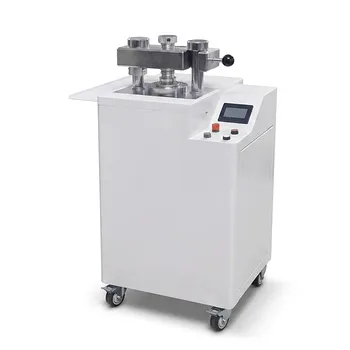
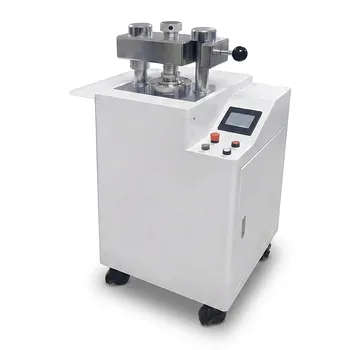
The primary advantages of using a hand press for KBr pellets are its portability and ease of use, allowing researchers to produce transparent pellets with minimal physical effort and negligible lab space. However, these benefits come at the cost of sample durability, as the resulting pellets are generally unsuitable for long-term storage and lack the efficient vacuum evacuation capabilities of hydraulic press die sets.
Core Takeaway While the hand press effectively democratizes IR sample preparation by removing the need for bulky equipment, it is best used for immediate analysis rather than archival purposes. Its inability to fully evacuate air and moisture makes it a tool for convenience rather than permanence.
The Advantages: Efficiency and Accessibility
Operational Simplicity
One of the most significant benefits of a hand press is the minimal effort required to operate it. Unlike complex hydraulic systems, a hand press is designed to produce excellent quality, transparent pellets without demanding physical exertion or extensive training.
Space Optimization and Portability
The hand press requires very little laboratory space, making it ideal for crowded workbenches. Its design is inherently portable, allowing it to be moved easily between workstations or taken into the field, a flexibility that stationary hydraulic presses cannot offer.
Immediate Results
Despite being a manual tool, the hand press is capable of producing pellets with high optical quality. It provides a quick turnaround for spectral analysis, streamlining the workflow when immediate results are prioritized over archival storage.
The Disadvantages: Stability and Storage
Suitability for Long-Term Storage
The major technical drawback of the hand press is sample longevity. Pellets created with this method are not well-suited for long-term storage, meaning the sample integrity may degrade over time if not analyzed quickly.
Inefficient Evacuation
Achieving a completely dry, air-free pellet often requires pulling a vacuum to remove trapped air and moisture. Hand presses are typically either not evacuable or cannot be evacuated as efficiently as a die set designed for a hydraulic press. This can lead to minor spectral interferences from atmospheric water or carbon dioxide.
Understanding the Trade-offs: Quality Control
The Moisture Challenge
Because KBr is hygroscopic (absorbs moisture from the air), the lack of efficient evacuation in a hand press makes environmental control critical. Without the ability to mechanically remove moisture via vacuum during pressing, you must ensure your environment and reagents are exceptionally dry to avoid cloudy pellets.
Preparation Precision
While the press itself is easy to use, the "garbage in, garbage out" principle remains. You must still adhere to strict preparation rules—such as ensuring the KBr powder and anvils are at the same temperature and using the correct particle size—to prevent scattering IR light.
Making the Right Choice for Your Goal
To determine if a hand press is the right tool for your specific application, consider your end goal for the sample:
- If your primary focus is rapid, daily analysis: The hand press is the superior choice due to its speed, portability, and minimal space requirements.
- If your primary focus is archival storage or trace analysis: You should utilize a hydraulic press with an evacuable die set to ensure the removal of all air and moisture for a stable, long-lasting pellet.
The hand press is a tool of convenience and speed, perfect for quick verification but limited when sample permanence is required.
Summary Table:
| Feature | Hand Press (Manual) | Hydraulic Press (Evacuable Die) |
|---|---|---|
| Portability | High - Compact & lightweight | Low - Stationary & bulky |
| Ease of Use | Simple - Minimal training required | Complex - Requires setup and force control |
| Vacuum Capability | Limited or None | High - Efficient moisture/air removal |
| Sample Longevity | Short-term - Best for immediate use | Long-term - Suitable for archival storage |
| Space Required | Minimal bench space | Significant lab footprint |
| Best Application | Rapid, routine analysis | Trace analysis & research-grade precision |
Elevate Your IR Analysis with KINTEK Precision
Whether you need the rapid portability of a hand press or the uncompromising stability of an automatic hydraulic system, KINTEK specializes in comprehensive laboratory pressing solutions. Our range includes manual, automatic, heated, and glovebox-compatible models, as well as specialized isostatic presses designed for the most demanding battery research and material science applications.
Don't let moisture or air interference compromise your spectral results. Contact KINTEK today to find the perfect pellet-pressing solution tailored to your lab's efficiency and precision goals!
Related Products
- Laboratory Hydraulic Press 2T Lab Pellet Press for KBR FTIR
- Automatic Laboratory Hydraulic Press for XRF and KBR Pellet Pressing
- Laboratory Hydraulic Pellet Press for XRF KBR FTIR Lab Press
- XRF KBR Plastic Ring Lab Powder Pellet Pressing Mold for FTIR
- Manual Laboratory Hydraulic Press Lab Pellet Press
People Also Ask
- What is the role of a laboratory pressure machine and KBr in FTIR? Master Sample Preparation for Flame Retardants
- What is the role of a laboratory hydraulic press in high-loading NCM811 cathode prep for solid-state batteries?
- Why is a laboratory hydraulic press necessary for sample preparation? Precise Pelleting for Spiro Heterocyclic Analysis
- What role does a laboratory hydraulic press play in reaction pellets? Optimizing Lunar Soil and Metal Fuel Density
- What is the role of a laboratory hydraulic press in denture preparation? Achieve High-Density Dental Prosthetics