
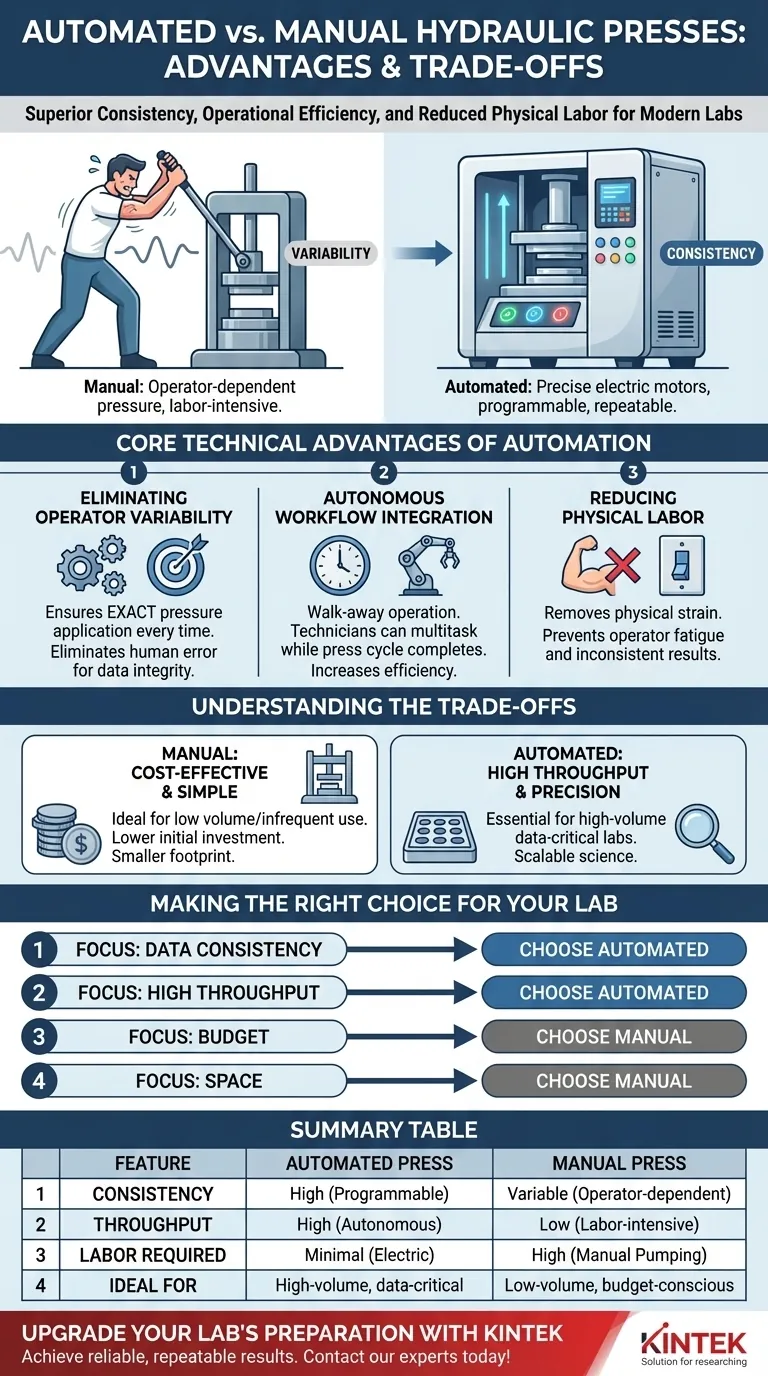
Automated hydraulic presses primarily outperform manual versions through superior consistency, operational efficiency, and reduced physical labor. By replacing hand-operated levers with electric motors and programmable switches, these systems decouple the quality of the sample preparation from the physical technique of the operator.
While manual presses are cost-effective solutions for infrequent use, automated presses are essential for environments prioritizing data integrity and high throughput. The core value of automation lies in eliminating human error to guarantee that every sample encounters identical pressure conditions.

The Core Technical Advantages
Eliminating Operator Variability
The most significant technical advantage of an automated press is repeatability.
Manual presses rely on a hand-operated lever, meaning the pressure applied can vary slightly depending on the operator's physical technique.
Automated systems utilize electric motors to drive the pump and control relief valves, ensuring the exact same pressure is applied across every single use.
Autonomous Workflow Integration
Automated presses are designed to operate independently once programmed.
This allows laboratory technicians to walk away and focus on other tasks, such as sample preparation or data analysis, while the press cycle completes.
In busy, high-throughput laboratories, this multitasking capability significantly improves overall operational efficiency.
Reducing Physical Labor
Manual hydraulic presses are labor-intensive, requiring repetitive physical effort to pump the piston.
For laboratories processing a high volume of samples, this can lead to operator fatigue, which may further degrade the consistency of the results.
Automated models remove the physical strain entirely, using electric switches to manage the workload.
Understanding the Trade-offs
While automation offers technical superiority regarding consistency, it is not always the pragmatic choice for every facility.
Cost-Effectiveness for Low Volume
Manual presses are significantly more affordable than their automated counterparts.
If a laboratory only requires a press infrequently, the high cost of automation may not yield a sufficient return on investment.
Simplicity and Footprint
Manual presses are mechanically simpler and often offer a smaller footprint.
Some manual versions are even handheld, making them ideal for facilities with strictly limited bench space.
Despite their simplicity, manual presses can still deliver high-quality results if the operator is skilled and the throughput volume is low.
Making the Right Choice for Your Lab
Deciding between manual and automated systems comes down to the balance between your budget and your need for data reproducibility.
- If your primary focus is Data Consistency: Choose an automated press to eliminate human error and ensure identical pressure application for every sample.
- If your primary focus is High Throughput: Choose an automated press to allow technicians to multitask and process higher volumes without physical fatigue.
- If your primary focus is Budget: Choose a manual press, which offers a cost-effective solution for low-volume or infrequent sampling needs.
- If your primary focus is Space: Choose a manual press, particularly handheld models, to accommodate tight workspaces without sacrificing basic functionality.
Automation transforms sample preparation from a manual craft into a precise, scalable science.
Summary Table:
| Feature | Automated Press | Manual Press |
|---|---|---|
| Consistency | High (Programmable) | Variable (Operator-dependent) |
| Throughput | High (Autonomous operation) | Low (Labor-intensive) |
| Labor Required | Minimal (Electric operation) | High (Manual pumping) |
| Ideal For | High-volume, data-critical labs | Low-volume, budget-conscious labs |
Upgrade your lab's sample preparation with KINTEK's precision automated hydraulic presses.
Struggling with inconsistent results or low throughput due to manual press limitations? KINTEK specializes in high-performance lab press machines, including automatic lab presses, isostatic presses, and heated lab presses, designed to eliminate operator error, enhance efficiency, and ensure data integrity for laboratories like yours.
Let us help you achieve reliable, repeatable results—contact our experts today to find the perfect press for your needs!
Visual Guide
Related Products
- Automatic Heated Hydraulic Press Machine with Hot Plates for Laboratory
- Automatic Laboratory Hydraulic Press Lab Pellet Press Machine
- Automatic Heated Hydraulic Press Machine with Heated Plates for Laboratory
- Split Automatic Heated Hydraulic Press Machine with Heated Plates
- Automatic High Temperature Heated Hydraulic Press Machine with Heated Plates for Lab
People Also Ask
- Function of a Laboratory Hydraulic Press with Heated Platens in SSE? Enhance Battery Density & Conductivity
- Why is a laboratory hydraulic press with heating plates required for PLA/TEC films? Achieve Precise Sample Integrity
- What are the requirements for electrode pressing with high-viscosity ionic liquids like EMIM TFSI? Optimize Performance
- How does a laboratory heated hydraulic press facilitate PBN sample prep for WAXS? Achieve Precise X-Ray Scattering
- What are the industrial applications of heated hydraulic presses? Master Heat & Force for Precision Manufacturing



















