
The primary advantage of a heated laboratory press for sintering NASICON electrolytes is the simultaneous application of high temperature and uniaxial pressure. Unlike conventional sintering, which relies primarily on thermal energy to fuse particles, this method introduces a mechanical driving force that significantly accelerates densification. This allows for the fabrication of nearly fully dense ceramic pellets at lower temperatures and shorter durations, directly resulting in superior ionic conductivity.
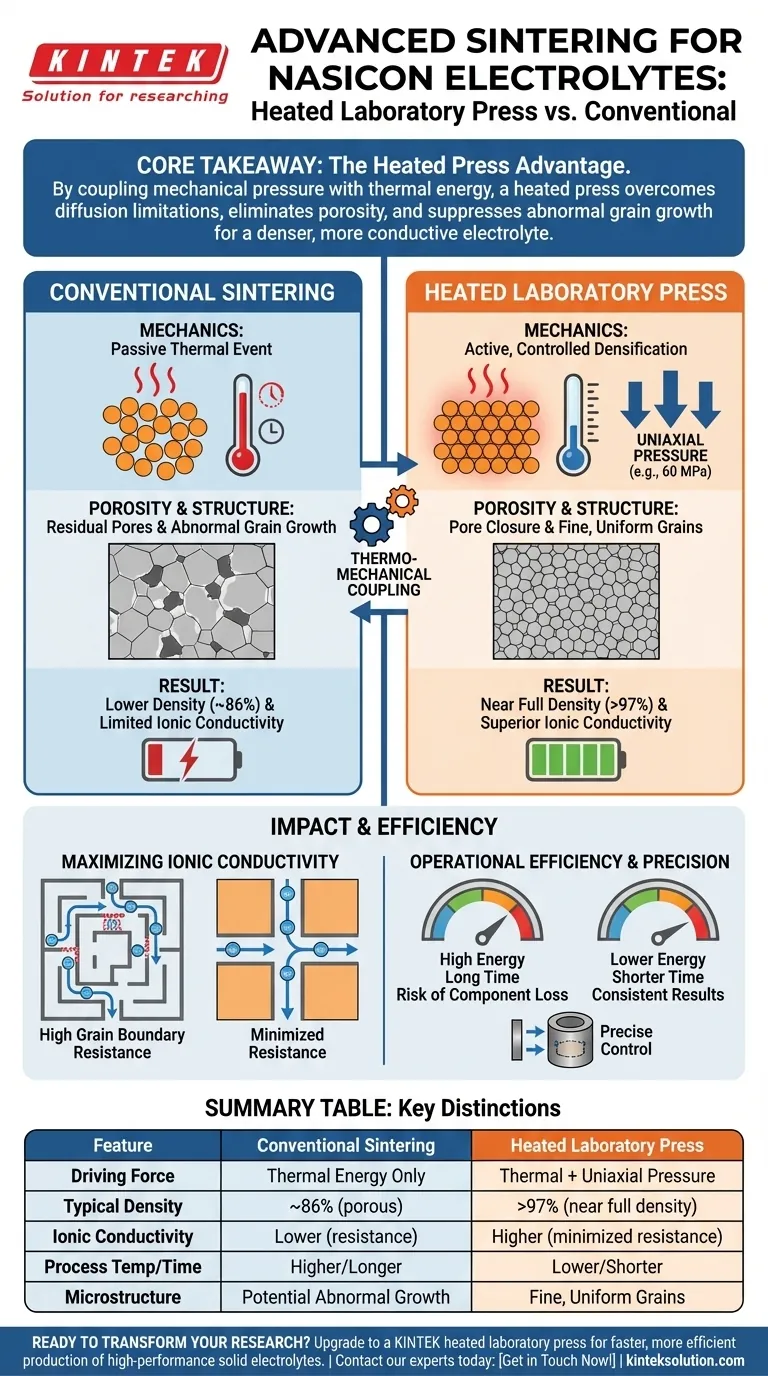
Core Takeaway: By coupling mechanical pressure with thermal energy, a heated press overcomes the diffusion limitations of conventional sintering. It eliminates porosity and suppresses abnormal grain growth, creating a denser, more conductive electrolyte with tighter grain boundaries.
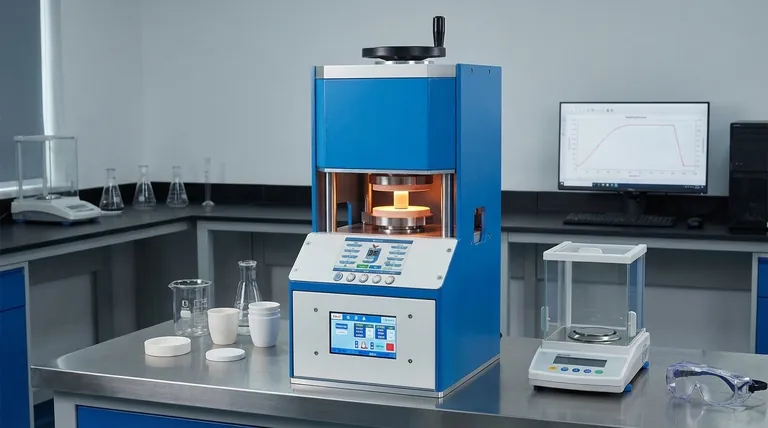
The Mechanics of Enhanced Densification
Thermo-Mechanical Coupling
In conventional sintering, you rely on heat to encourage particles to bond. A heated laboratory press (hot press) adds uniaxial pressure (e.g., 60 MPa) to this equation.
This combination creates a synergistic effect known as thermo-mechanical coupling. The pressure physically forces particles together while the heat activates atomic diffusion.
Eliminating Residual Porosity
Conventional sintering often leaves microscopic pores within the ceramic body. These voids act as barriers to ion transport.
The external pressure applied by a heated press forces the closure of these residual pores. This leads to relative densities approaching the theoretical maximum (e.g., increasing from ~86% to over 97%), which is difficult to achieve with pressureless sintering.
Impact on Material Performance
Maximizing Ionic Conductivity
The density of a NASICON electrolyte is directly linked to its performance. Higher density means fewer pores and tighter grain boundaries.
By minimizing the resistance at grain boundaries, the hot pressing process opens a clearer pathway for ions. This leads to a substantial improvement in the electrolyte's room-temperature ionic conductivity.
Suppressing Abnormal Grain Growth
High temperatures required in conventional sintering can sometimes cause grains to grow uncontrollably, which degrades mechanical strength.
Because a heated press promotes densification at lower temperatures or faster rates, it effectively suppresses abnormal grain growth. This results in a fine, uniform microstructure that improves both the mechanical integrity and the electrochemical stability of the pellet.
Operational Efficiency and Precision
Lowering the Thermal Budget
Conventional sintering often requires prolonged exposure to extreme heat to achieve density.
A heated press achieves similar or better results with reduced processing time and often at lower temperatures. This efficiency not only saves energy but also reduces the risk of volatile component loss (common in some ceramic compositions) during long heating cycles.
Consistency and Reproducibility
Precision is critical for high-quality manufacturing. A hydraulic heated press offers precise control over the compression and bonding process.
This ensures consistent results with minimal variation between batches, providing a reliable method for producing standardized electrolyte samples for testing or production.
Understanding the Distinctions (Trade-offs)
Uniaxial vs. Isostatic Pressure
It is important to distinguish a standard heated press from a Hot Isostatic Press (HIP). A standard heated press applies uniaxial pressure (from top and bottom).
While superior to conventional sintering, uniaxial pressure may not be as effective as the omnidirectional pressure applied by a HIP (e.g., 120+ MPa) for complex geometries. HIP can further eliminate closed pores via plastic deformation from all sides, potentially reaching even higher densities than uniaxial pressing alone.
Making the Right Choice for Your Goal
If you are deciding between conventional sintering and pressure-assisted methods, consider your specific performance targets.
- If your primary focus is maximizing conductivity: Choose the heated press to minimize grain boundary resistance and achieve near-theoretical density.
- If your primary focus is process efficiency: Leverage the heated press to reduce sintering times and lower the required temperature, preventing lithium loss.
- If your primary focus is ultimate density for critical applications: Consider moving beyond a standard hot press to Hot Isostatic Pressing (HIP) to eliminate even the smallest closed pores through omnidirectional pressure.
Switching to a heated laboratory press transforms the sintering process from a passive thermal event into an active, controlled densification strategy.
Summary Table:
| Feature | Conventional Sintering | Heated Laboratory Press |
|---|---|---|
| Driving Force | Thermal energy only | Thermal energy + Uniaxial pressure |
| Typical Density | ~86% (porous) | >97% (near full density) |
| Ionic Conductivity | Lower (grain boundary resistance) | Higher (minimized resistance) |
| Process Temperature/Time | Higher/Longer | Lower/Shorter |
| Microstructure | Potential for abnormal grain growth | Fine, uniform grains |
Ready to transform your NASICON electrolyte research and development?
Upgrade from conventional sintering to a KINTEK heated laboratory press and unlock the potential for faster, more efficient production of high-performance solid electrolytes. Our automatic lab presses, isostatic presses, and heated lab presses are engineered to deliver the precise temperature and pressure control you need to achieve superior density and ionic conductivity, saving you time and energy while preventing component loss.
Contact our experts today to discuss how our specialized lab press solutions can meet your specific sintering goals.
Visual Guide
Related Products
- Automatic High Temperature Heated Hydraulic Press Machine with Heated Plates for Lab
- 24T 30T 60T Heated Hydraulic Lab Press Machine with Hot Plates for Laboratory
- Automatic Heated Hydraulic Press Machine with Heated Plates for Laboratory
- Automatic Heated Hydraulic Press Machine with Hot Plates for Laboratory
- Cylindrical Lab Electric Heating Press Mold for Laboratory Use
People Also Ask
- Function of a Laboratory Hydraulic Press with Heated Platens in SSE? Enhance Battery Density & Conductivity
- What are the requirements for electrode pressing with high-viscosity ionic liquids like EMIM TFSI? Optimize Performance
- How does a laboratory heated hydraulic press facilitate PBN sample prep for WAXS? Achieve Precise X-Ray Scattering
- What are the industrial applications of heated hydraulic presses? Master Heat & Force for Precision Manufacturing
- Why is a laboratory hydraulic press with heating plates required for PLA/TEC films? Achieve Precise Sample Integrity



















