
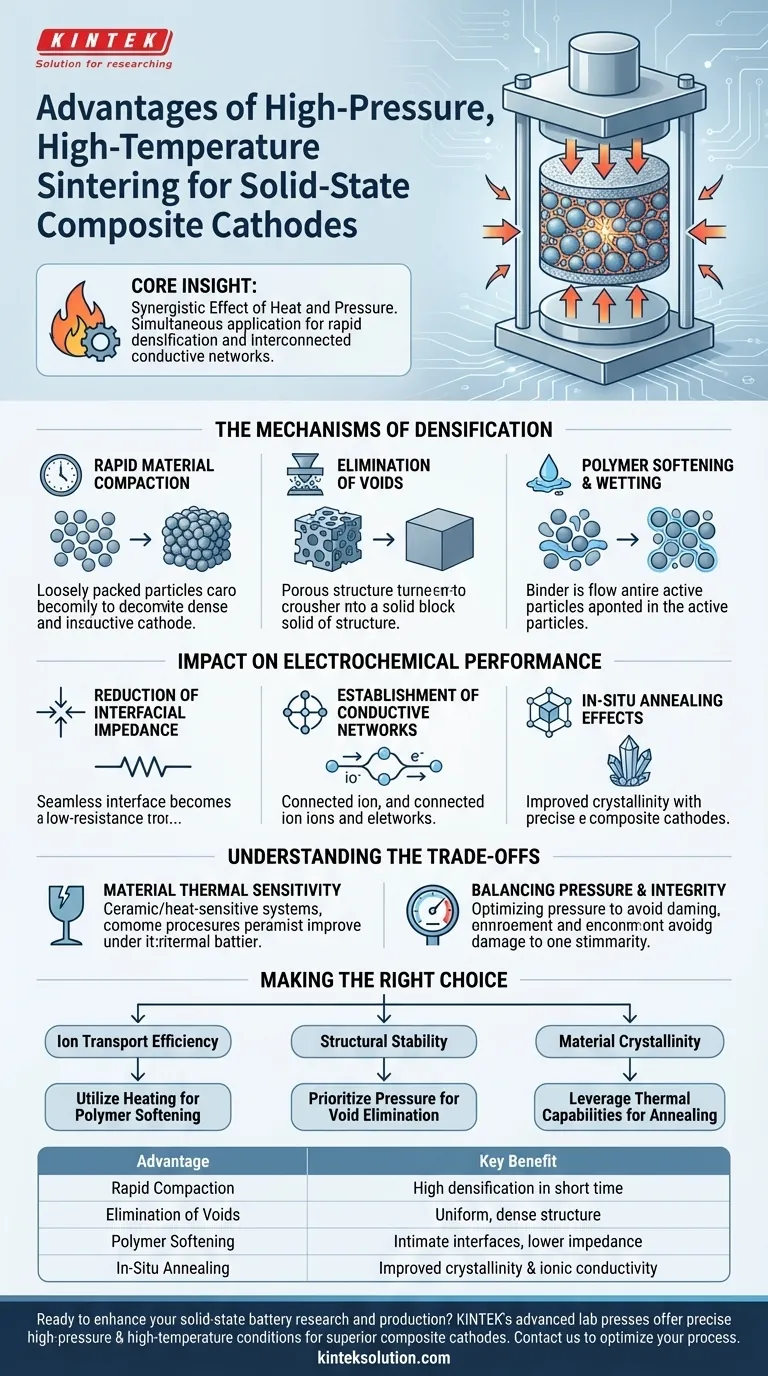
High-pressure, high-temperature sintering provides a critical manufacturing advantage by overcoming the inherent physical resistance of solid-solid interfaces. By simultaneously applying thermal energy and mechanical force, this technique achieves rapid material densification that pressure alone often cannot accomplish.
The Core Insight The defining value of this technique is the synergistic effect of heat and pressure. While pressure eliminates structural voids, heat softens the material components to facilitate plastic flow, resulting in an interconnected, low-impedance conductive network that is vital for high-performance solid-state batteries.
The Mechanisms of Densification
Rapid Material Compaction
The primary advantage of high-pressure, high-temperature sintering is the ability to achieve a high degree of material densification in a very short timeframe.
This efficiency makes it particularly effective for producing high-loading solid-state composite electrodes, which require a tightly packed structure to function correctly.
Elimination of Voids
The mechanical pressure component works to physically eliminate inter-particle voids.
By forcing the powder particles into a tightly packed arrangement, the press creates a uniform structure. This transforms an initially loose, porous coating into a dense, continuous whole.
Polymer Softening and Wetting
The thermal component—precisely controlled heat—softens polymeric components within the mixture, such as PEO (polyethylene oxide).
This softening enables the binder or electrolyte to "wet" and encapsulate the active material particles. This flow creates intimate solid-solid interfaces that are difficult to achieve through cold mechanical pressing alone.
Impact on Electrochemical Performance
Reduction of Interfacial Impedance
The combination of void elimination and material softening drastically lowers interfacial impedance.
By creating a seamless contact interface between the active material and the solid electrolyte, the press removes the physical barriers that typically impede ion movement.
Establishment of Conductive Networks
A high-pressure forming step ensures the initial intimate contact required to build a functional conductive network.
This network facilitates both ion and electron transport, which is fundamental to achieving high capacity and superior rate performance in the final battery cell.
In-Situ Annealing Effects
Beyond physical shaping, the hot-pressing procedure can act as an in-situ annealing treatment.
For certain electrolytes, this heat treatment improves crystallinity. Enhanced crystallinity often correlates directly with improved ionic conductivity within the composite electrode.
Understanding the Trade-offs
Material Thermal Sensitivity
While heat assists in densification, it is not suitable for all chemistries.
Ceramic-based or heat-sensitive composite systems may degrade under high temperatures. in these cases, a high-pressure cold press is required, relying on massive pressure (hundreds of megapascals) rather than thermal softening to achieve the necessary particle contact.
Balancing Pressure and Integrity
Applying pressure is critical, but it must be optimized.
The goal is to eliminate voids without crushing the active material particles or damaging the current collector. The addition of heat often allows for better densification at lower pressures compared to cold pressing, preserving the mechanical integrity of delicate components.
Making the Right Choice for Your Goal
When integrating a sintering press into your fabrication line, consider your specific material limitations and performance targets.
- If your primary focus is Ion Transport Efficiency: Utilize the heating function to soften polymer electrolytes, ensuring they fully encapsulate active particles to minimize resistance.
- If your primary focus is Structural Stability: Prioritize the pressure parameters to eliminate porosity, creating a mechanically robust electrode that can withstand cycling.
- If your primary focus is Material Crystallinity: Leverage the thermal capabilities of the press to perform in-situ annealing, enhancing the intrinsic conductivity of the electrolyte.
By mastering the interplay between thermal softening and mechanical compaction, you transform raw powder into a highly efficient, integrated energy storage system.
Summary Table:
| Advantage | Key Benefit |
|---|---|
| Rapid Material Compaction | Achieves high densification in a short timeframe. |
| Elimination of Voids | Creates a uniform, dense structure by removing porosity. |
| Polymer Softening & Wetting | Facilitates intimate solid-solid interfaces for lower impedance. |
| In-Situ Annealing | Can improve electrolyte crystallinity and ionic conductivity. |
Ready to enhance your solid-state battery research and production?
KINTEK's advanced lab press machines, including our automatic, isostatic, and heated lab presses, are engineered to provide the precise high-pressure and high-temperature conditions required for fabricating superior composite cathodes. Our equipment helps you achieve critical goals like rapid densification, minimized interfacial impedance, and improved ionic conductivity.
Let us help you optimize your sintering process. Contact our experts today to discuss your specific application and discover the perfect press for your laboratory's needs.
Visual Guide
Related Products
- Automatic High Temperature Heated Hydraulic Press Machine with Heated Plates for Lab
- Special Shape Lab Press Mold for Laboratory Applications
- Lab Polygon Press Mold
- 24T 30T 60T Heated Hydraulic Lab Press Machine with Hot Plates for Laboratory
- Warm Isostatic Press for Solid State Battery Research Warm Isostatic Press
People Also Ask
- Function of a Laboratory Hydraulic Press with Heated Platens in SSE? Enhance Battery Density & Conductivity
- How does a laboratory heated hydraulic press facilitate PBN sample prep for WAXS? Achieve Precise X-Ray Scattering
- What are the requirements for electrode pressing with high-viscosity ionic liquids like EMIM TFSI? Optimize Performance
- What are the industrial applications of heated hydraulic presses? Master Heat & Force for Precision Manufacturing
- Why is a laboratory hydraulic press with heating plates required for PLA/TEC films? Achieve Precise Sample Integrity



















