
At its core, a hot press offers three primary advantages: efficiency, precision, and versatility. By combining intense heat and mechanical force in a single, highly controlled operation, these machines create superior bonds, laminations, and assemblies that are often impossible to achieve through other methods. This simultaneous application of heat and pressure dramatically reduces processing time while ensuring consistent, high-quality results across a wide range of materials.
The fundamental value of a hot press is not merely applying heat and pressure, but in its ability to apply them simultaneously and with extreme precision. This synergy unlocks a level of process control that directly translates into higher product quality, faster production cycles, and greater reliability.
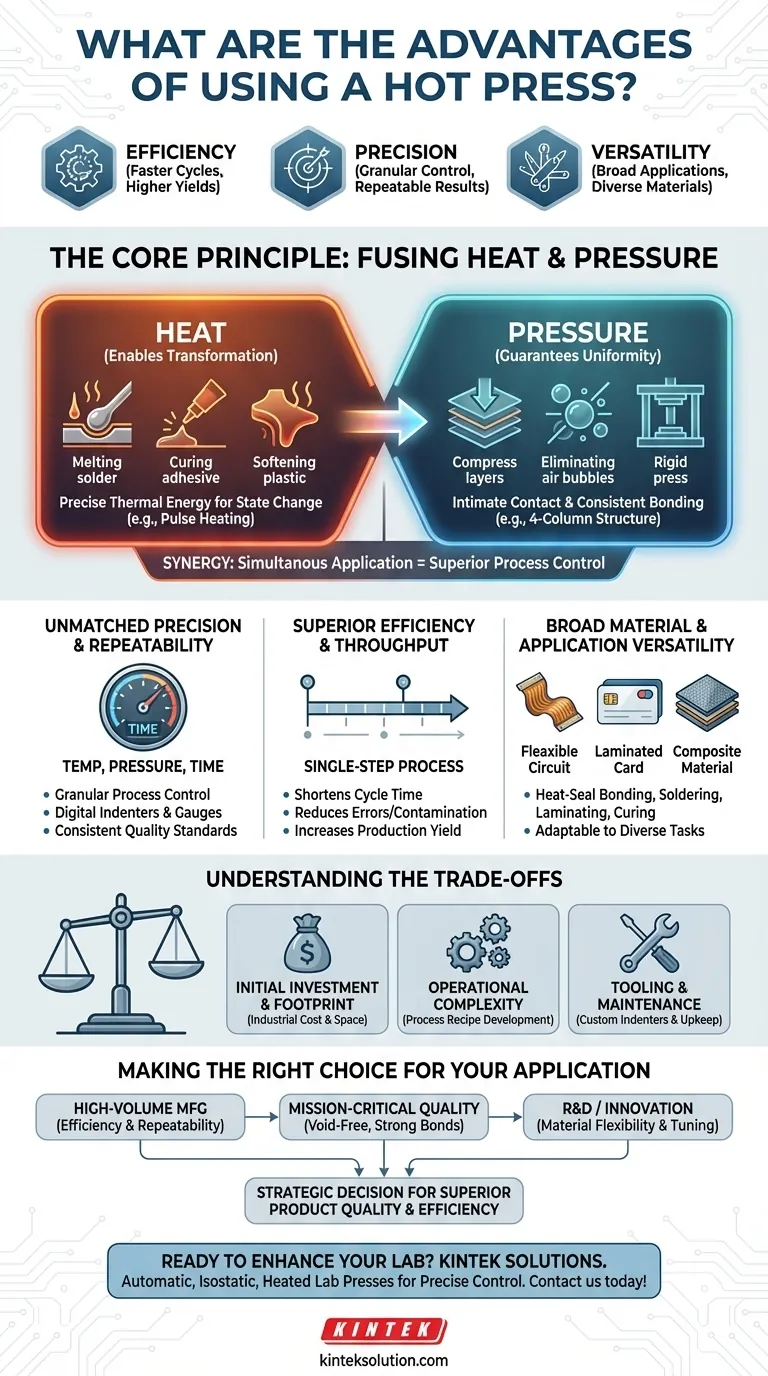
The Core Principle: Fusing Heat and Pressure
Understanding the advantages of a hot press begins with understanding why the combination of heat and pressure is so effective. Each force plays a distinct, critical role in material transformation.
How Heat Enables Transformation
Heat provides the necessary thermal energy to change a material's state. This can involve melting a solder to form an electrical and mechanical connection, curing a thermosetting adhesive, or softening thermoplastic layers for lamination.
Precise temperature control is paramount. Advanced hot presses use technologies like pulse heating and real-time temperature monitoring to follow specific heating profiles, preventing material damage while ensuring a complete reaction or phase change.
How Pressure Guarantees Uniformity
While heat enables the change, pressure ensures its quality and integrity. The force exerted by the press serves several functions.
First, it guarantees intimate contact between surfaces, squeezing out any trapped air or contaminants. This eliminates air gaps and voids that can compromise the strength and performance of a bond or solder joint.
Second, the uniform pressure, often delivered by a rigid four-column, three-plate structure, ensures that the bonding or lamination is consistent across the entire surface area. This prevents weak spots and ensures dimensional accuracy.
Unpacking the Key Advantages
The synergy of controlled heat and pressure delivers tangible benefits in a production or lab environment.
Unmatched Precision and Repeatability
Modern hot presses offer granular control over every critical process variable. Operators can precisely set the temperature, the rate of temperature increase, the amount of pressure, and the duration of the cycle.
This level of control is achieved through components like titanium indenters for even heat distribution and digital pressure gauges. The result is an exceptionally repeatable process, ensuring every part meets the exact same quality standards.
Superior Efficiency and Throughput
By performing heating and pressing in a single step, a hot press significantly shortens the overall process time compared to multi-stage methods (e.g., oven curing followed by a separate pressing stage).
This consolidation of steps not only increases throughput but also reduces the potential for errors or contamination between stages, leading to higher yields.
Broad Material and Application Versatility
The ability to fine-tune both heat and pressure makes hot presses adaptable to a vast array of tasks.
Common applications include heat-seal bonding for flexible circuits, soldering of fine-pitch components, laminating multiple layers of film or prepreg, and curing adhesives in complex assemblies. Their versatility makes them a cornerstone technology in electronics, aerospace, medical devices, and materials research.
Understanding the Trade-offs
While powerful, a hot press is a specialized piece of equipment. Objectively evaluating its fit requires understanding its inherent complexities.
Initial Investment and Footprint
These are industrial machines, and their initial acquisition cost is significantly higher than that of simpler tools like soldering irons or benchtop clamps. They also require dedicated floor space and infrastructure, such as power and potentially compressed air.
Operational Complexity
Achieving optimal results requires developing a specific process recipe for each application. This involves determining the correct temperature profile, pressure settings, and cycle time, which often requires expertise and initial trial runs. It is not a "plug-and-play" solution.
Tooling and Maintenance
The part of the press that makes contact with the workpiece, known as the indenter or thermode, is often a custom component designed for a specific part geometry. These tools represent an additional cost and require proper maintenance and eventual replacement.
Making the Right Choice for Your Application
A hot press is the definitive solution when process control is directly linked to final product quality and reliability.
- If your primary focus is high-volume manufacturing: The efficiency from single-step processing and the repeatability that reduces defect rates are the most compelling advantages.
- If your primary focus is mission-critical quality: The ability to create void-free, uniform, and strong bonds through precise control is the key benefit for applications where failure is not an option.
- If your primary focus is R&D or process development: The versatility to experiment with different materials and precisely tune process parameters makes the hot press an invaluable tool for innovation.
Ultimately, adopting a hot press is a strategic decision to prioritize process control as the foundation for achieving superior product quality and manufacturing efficiency.
Summary Table:
| Advantage | Description |
|---|---|
| Precision | Granular control over temperature, pressure, and cycle time for repeatable, high-quality results. |
| Efficiency | Single-step processing reduces time and errors, increasing throughput and yield. |
| Versatility | Adaptable to various materials and applications like heat-seal bonding, soldering, and laminating. |
Ready to enhance your lab's capabilities with a hot press? KINTEK specializes in lab press machines, including automatic lab presses, isostatic presses, and heated lab presses, designed to deliver precise control, efficiency, and versatility for your laboratory needs. Contact us today via our contact form to learn how our solutions can boost your product quality and manufacturing efficiency!
Visual Guide
Related Products
- Automatic High Temperature Heated Hydraulic Press Machine with Heated Plates for Lab
- Heated Hydraulic Press Machine with Heated Plates for Vacuum Box Laboratory Hot Press
- Automatic Heated Hydraulic Press Machine with Hot Plates for Laboratory
- Heated Hydraulic Press Machine With Heated Plates For Vacuum Box Laboratory Hot Press
- Laboratory Split Manual Heated Hydraulic Press Machine with Hot Plates
People Also Ask
- Function of a Laboratory Hydraulic Press with Heated Platens in SSE? Enhance Battery Density & Conductivity
- What are the requirements for electrode pressing with high-viscosity ionic liquids like EMIM TFSI? Optimize Performance
- How does a laboratory heated hydraulic press facilitate PBN sample prep for WAXS? Achieve Precise X-Ray Scattering
- What are the industrial applications of heated hydraulic presses? Master Heat & Force for Precision Manufacturing
- Why is a laboratory hydraulic press with heating plates required for PLA/TEC films? Achieve Precise Sample Integrity



















