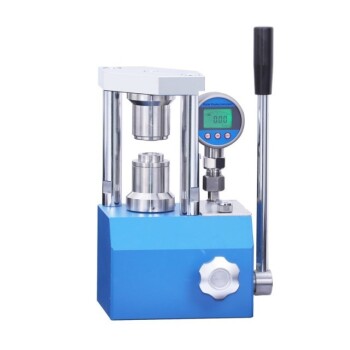
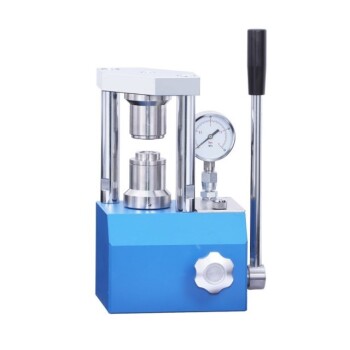
The primary advantage of large-area pouch cell testing over rigid-shell coin cells is the ability to apply direct, uniform, and active stack pressure to the battery components. While coin cells rely on a fixed, rigid casing, pouch cells allow researchers to use automated equipment to physically constrain the cell, which is critical for managing the significant volume changes that occur during lithium deposition.
Core Insight: Rigid coin cells often mask the mechanical challenges of high-energy batteries. Pouch cells solve this by allowing precise pressure application, which minimizes internal voids and forces lithium to deposit in a dense, uniform morphology—providing a much more accurate prediction of a material’s commercial viability.
Managing Volume Expansion and Deposition
The physical format of the battery cell dictates how well it handles the mechanical stresses of operation. This is particularly relevant for advanced chemistries, such as anode-free batteries.
Accommodating Significant Volume Changes
Anode-free batteries experience drastic volume fluctuations during cycling. Pouch cell formats possess a flexible architecture that accommodates this expansion while allowing for external mechanical regulation.
Inducing Dense Lithium Morphology
By applying a uniform and moderate physical constraint, you can force lithium to deposit in a dense structure rather than a porous or dendritic one. This dense deposition is essential for cycle life as it significantly reduces the formation of "dead lithium" (isolated lithium that no longer participates in the reaction).
Improving Commercial Predictive Power
Standard coin cell tests often fail to capture the mechanical realities of a full-scale battery. Pouch cell testing provides data that reflects a material's true potential in a commercial application, specifically regarding how it handles mechanical stress.
Optimizing Internal Structure and Interfaces
Beyond managing lithium growth, pressure control in pouch cells is vital for the structural integrity of the internal stack.
Eliminating Internal Voids
Using an automated laboratory press to apply constant stack pressure eliminates internal voids between layers. This removal of air gaps is critical for maintaining consistent electrical and ionic pathways throughout the cell.
Enhancing Contact Efficiency
Pressure ensures robust contact between modification layers, the separator, and the electrolyte interface. High contact efficiency is a prerequisite for achieving high areal capacities, as it ensures the active materials are fully utilized.
Ensuring Uniform Electrolyte Wetting
Precise pressure control is required during the packaging and formation stages to ensure the electrolyte uniformly wets the entire electrode surface. This is particularly critical under lean electrolyte conditions, where excess liquid is not available to compensate for dry spots.
Understanding the Trade-offs
While pouch cells offer superior data quality for high-energy applications, they introduce complexities that must be managed.
Equipment Dependency
Achieving these results requires precise pressure control equipment, such as automated laboratory presses. Unlike coin cells, which are self-contained, pouch cells rely on external hardware to maintain the necessary stack pressure.
Manufacturing Precision
The assembly process is more unforgiving. Any lack of uniformity during the packaging or formation stages—such as uneven pressure application—can lead to poor wetting or inconsistent contact, negating the benefits of the format.
Making the Right Choice for Your Goal
Choosing between coin cells and pouch cells depends on where you are in the development cycle.
- If your primary focus is rapid material screening: Stick to coin cells for their ease of assembly, but recognize that they may not accurately predict mechanical degradation or lithium plating morphology.
- If your primary focus is commercial viability or anode-free systems: You must use large-area pouch cells to apply the necessary stack pressure for dense lithium deposition and realistic volume management.
Ultimately, while coin cells test the chemistry, pouch cells test the battery.
Summary Table:
| Feature | Rigid-Shell Coin Cells | Large-Area Pouch Cells |
|---|---|---|
| Pressure Control | Passive/Fixed by Casing | Active/Uniform via Lab Press |
| Volume Management | Poor (Rigid Architecture) | Excellent (Flexible Architecture) |
| Lithium Morphology | Often Porous/Dendritic | Dense and Uniform |
| Void Elimination | Difficult to Regulate | High (Mechanical Compression) |
| Predictive Power | Initial Material Screening | High Commercial Realism |
Maximize Your Battery Research Precision with KINTEK
Don’t let rigid testing formats mask your material's true potential. KINTEK specializes in comprehensive laboratory pressing solutions designed to provide the precise, uniform stack pressure required for advanced pouch cell testing. Whether you are developing anode-free systems or high-energy-density batteries, our range of manual, automatic, heated, and glovebox-compatible models, as well as cold and warm isostatic presses, ensures your research reflects real-world commercial performance.
Ready to elevate your battery testing? Contact KINTEK today to find the perfect pressing solution for your lab!
References
- Gerard Bree, Louis F. J. Piper. LiMn<sub><i>x</i></sub>Fe<sub>1</sub><sub>−<i>X</i></sub>PO<sub>4</sub> Anodefree Batteries: A Scalable, Low Cost, Energy Dense Lithium Cell Design. DOI: 10.1002/batt.202500507
This article is also based on technical information from Kintek Solution Knowledge Base .
Related Products
- Button Battery Sealing Machine for Button Batteries
- Button Battery Sealing Press Machine for Lab
- Manual Button Battery Sealing Machine for Battery Sealing
- Lab Button Battery Tablet Press Sealing Mold
People Also Ask
- Why is a laboratory hydraulic press or battery sealing machine essential? Ensure Coin Cell Data Integrity
- What role does a laboratory press perform for CR2032 coin cell assembly? Ensure Precision in Battery Research
- Why is a high-pressure manual or automatic coin cell crimper required? Optimize Solid-State Battery Performance
- How does a high-precision lab press or coin cell crimper affect the performance of assembled lithium-metal batteries?
- How does the mechanical pressure provided by a laboratory crimper affect the performance of assembled 2032-type coin cells?