
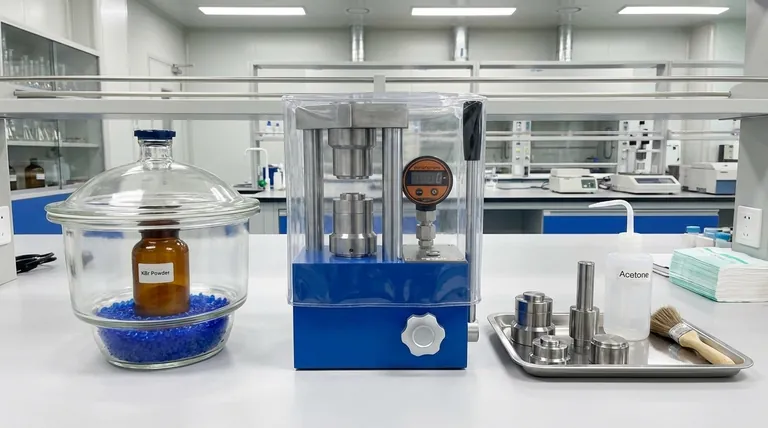
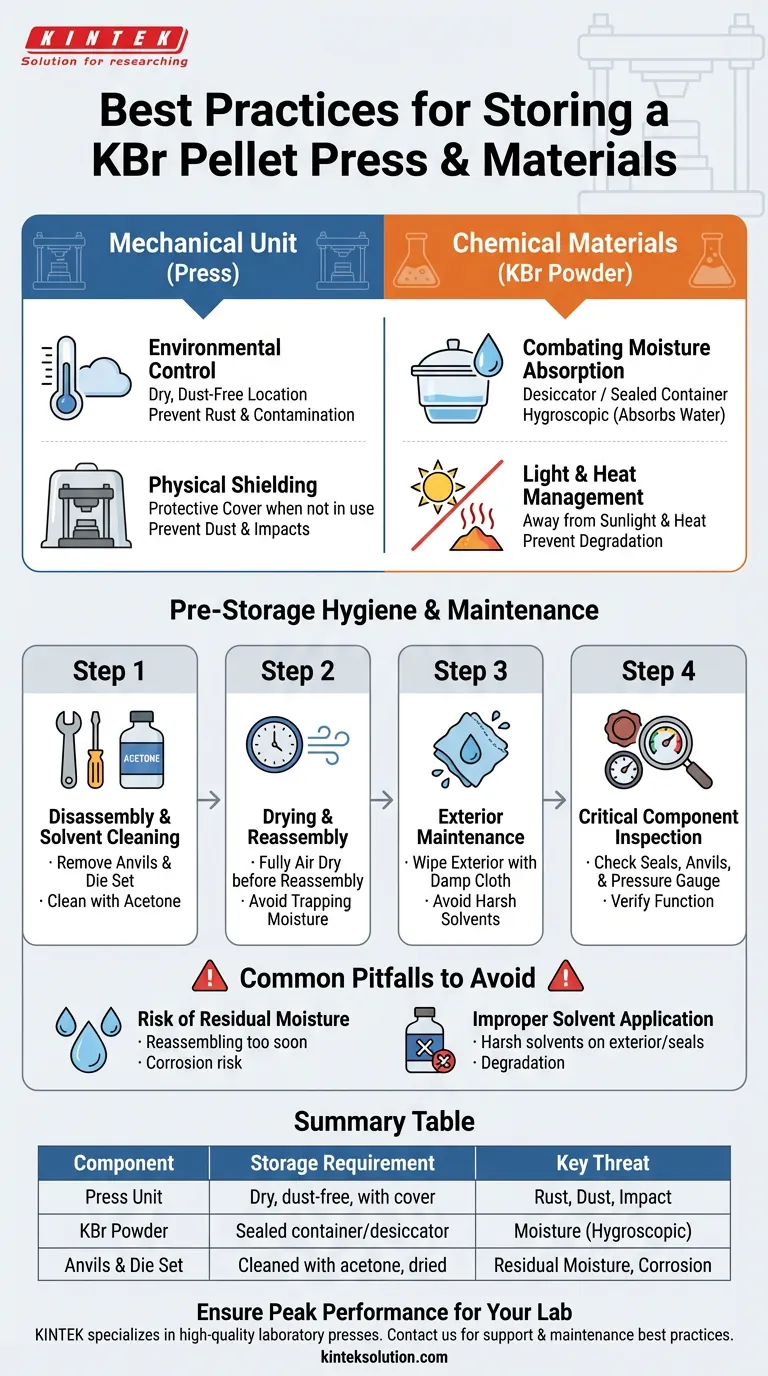
Effective storage of a KBr Pellet Press relies on strictly separating the mechanical unit from the chemical materials to prevent cross-contamination and environmental damage. The press itself requires a dry, dust-free location shielded by a protective cover, while the hygroscopic KBr powder demands isolation in a desiccator or sealed container away from light and heat sources.
Core Takeaway Moisture and dust are the primary threats to the integrity of infrared spectroscopy sample preparation. While the press requires physical protection from impact and particulate accumulation, the KBr powder must be rigorously shielded from humidity to prevent background noise in your spectral data.
Protecting the Mechanical Hardware
Environmental Control
The immediate environment for your KBr Pellet Press must be dry and free of airborne particulates. Excess moisture in the air can lead to rust on critical steel components, while dust can contaminate future samples.
Physical Shielding
Always utilize a protective cover when the press is not in operation. This shield serves a dual purpose: it prevents dust accumulation on sensitive mechanisms and provides a buffer against accidental impacts that could misalign the anvils.
Handling the Hygroscopic Materials
Combating Moisture Absorption
Potassium Bromide (KBr) is highly hygroscopic, meaning it aggressively absorbs water from the air. You must store the powder separately from the press, preferably inside a desiccator or a tightly sealed container.
Light and Heat Management
Environmental stability extends beyond humidity control. Ensure the storage container is kept away from direct sunlight and heat sources, as these can degrade the quality of the KBr or compromise the seal of the container.
Pre-Storage Hygiene and Maintenance
Disassembly and Solvent Cleaning
Before long-term storage, disassemble the press by removing the anvils and die set. Clean these metal components using a soft brush, compressed air, or a gentle stream of acetone to remove residual powder.
Exterior Maintenance
While acetone is suitable for the die set, use a simple damp cloth to wipe down the exterior of the press. Once all parts are cleaned, allow them to air dry completely before reassembling the unit correctly.
Critical Component Inspection
Periodically inspect the die set seals for signs of wear and verify that the anvils are undamaged and aligned. You should also check the pressure gauge for accuracy and monitor evacuation time during use to ensure the vacuum system is functioning correctly.
Common Pitfalls to Avoid
The Risk of Residual Moisture
A common error is reassembling the press immediately after cleaning without sufficient drying time. Trapping solvent or water inside the die set assembly can lead to corrosion or contamination of the next sample.
Improper Solvent Application
Be precise when applying cleaning agents. Acetone is effective for the metal anvils and die sets, but applying harsh solvents to the exterior housing or non-metal seals can cause degradation.
Making the Right Choice for Your Lab
To ensure the longevity of your equipment and the accuracy of your spectroscopy, apply these protocols based on your operational tempo:
- If your primary focus is long-term preservation: Prioritize a full disassembly and deep clean with acetone, ensuring the KBr is locked in a high-quality desiccator.
- If your primary focus is daily operational readiness: Keep the press covered but fully assembled for quick access, while maintaining a strict "clean-as-you-go" policy for the anvils.
A clean, dry press and moisture-free KBr are the non-negotiable foundations of accurate IR spectroscopy.
Summary Table:
| Component | Storage Requirement | Key Threat |
|---|---|---|
| Press Unit | Dry, dust-free location with protective cover | Rust, dust contamination, physical impact |
| KBr Powder | Sealed container or desiccator, away from light/heat | Moisture absorption (hygroscopic) |
| Anvils & Die Set | Cleaned with acetone, fully dried before reassembly | Residual moisture causing corrosion |
Ensure Peak Performance for Your Lab
Proper storage is key to maintaining the precision of your IR spectroscopy sample preparation. KINTEK specializes in high-quality laboratory presses, including KBr Pellet Presses, designed for durability and ease of maintenance.
Let our expertise support your lab's accuracy and efficiency. Contact KINTEK today to find the perfect press for your needs and learn more about our maintenance best practices.
Visual Guide
Related Products
- Laboratory Hydraulic Press 2T Lab Pellet Press for KBR FTIR
- XRF KBR Plastic Ring Lab Powder Pellet Pressing Mold for FTIR
- XRF KBR Steel Ring Lab Powder Pellet Pressing Mold for FTIR
- Laboratory Hydraulic Pellet Press for XRF KBR FTIR Lab Press
- Automatic Laboratory Hydraulic Press for XRF and KBR Pellet Pressing
People Also Ask
- What is the role of a laboratory pressure machine and KBr in FTIR? Master Sample Preparation for Flame Retardants
- What is the role of a laboratory hydraulic press in high-loading NCM811 cathode prep for solid-state batteries?
- What role does a laboratory hydraulic press play in reaction pellets? Optimizing Lunar Soil and Metal Fuel Density
- Why is a laboratory hydraulic press necessary for sample preparation? Precise Pelleting for Spiro Heterocyclic Analysis
- How are hydraulic presses utilized in laboratory settings? Precision Sample Prep & Material Testing Solutions



















