
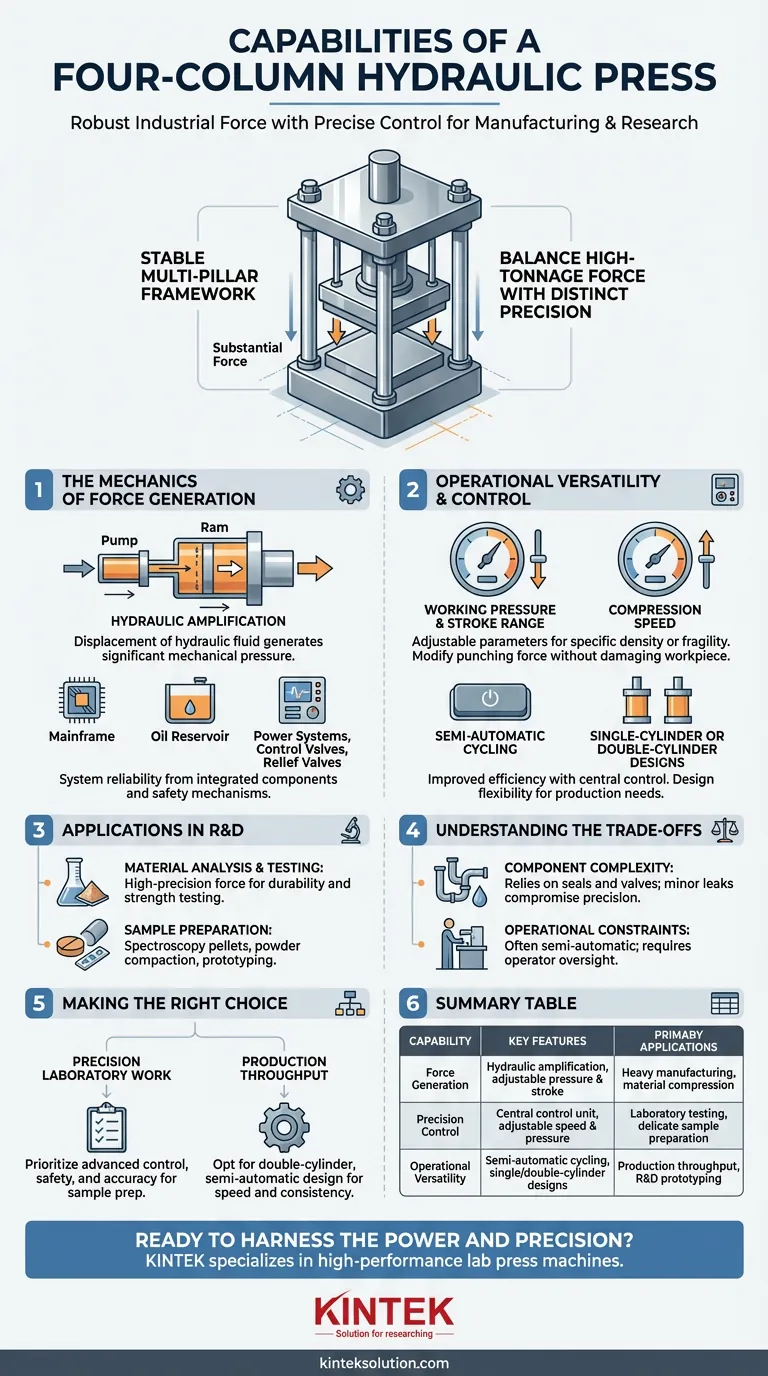
A four-column hydraulic press is a robust industrial machine designed to apply substantial, adjustable force to workpieces of varying sizes through a stable, multi-pillar framework. These systems utilize a central control unit to precisely regulate pressure, compression speed, and stroke range, making them suitable for both heavy manufacturing and delicate laboratory tasks.
The core value of a four-column hydraulic press lies in its ability to balance high-tonnage force with distinct precision. By offering adjustable parameters and a rigid structure, it allows operators to perform tasks ranging from semi-automatic manufacturing to exact material testing with minimal effort and high safety standards.
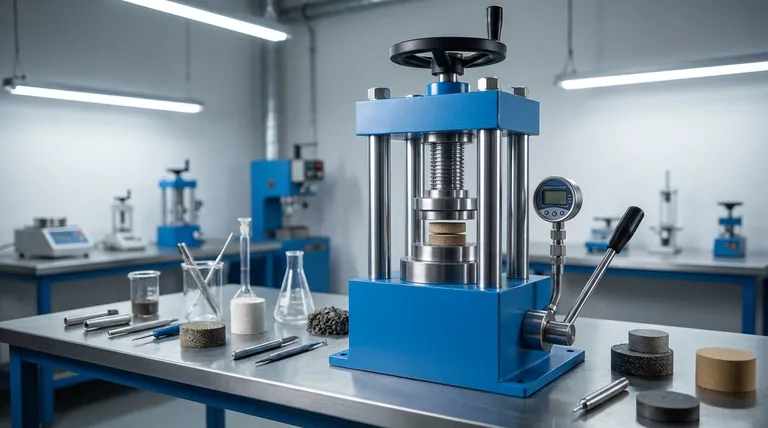
The Mechanics of Force Generation
Hydraulic Amplification
The fundamental capability of this press relies on the displacement of hydraulic fluid. A pump forces fluid from a small plunger cylinder into a larger ram cylinder.
This exchange amplifies the input effort, generating significant mechanical pressure. This force is then transmitted to an anvil, which presses directly against the workpiece to shape or compress it.
Essential Components
The system's reliability comes from the integration of a mainframe, oil reservoir, and power systems. Control valves regulate the flow and pressure, while relief valves and gauges ensure the machine operates safely without overloading.
Operational Versatility and Control
Adjustable Parameters
One of the most critical capabilities is the customization of the machine's behavior. Operators can adjust the working pressure and compression speed to suit the specific density or fragility of the material.
The punching force and stroke range can also be modified. This ensures the press delivers the exact amount of power required without damaging the workpiece or the tooling.
Automation and Design Options
To improve efficiency, these presses often feature central control systems that enable semi-automatic cycling. This reduces manual intervention during repetitive tasks.
Design flexibility is also a key feature. Depending on manufacturing needs, the unit can be configured with a single-cylinder or a double-cylinder design.
Applications in Research and Development
Material Analysis and Testing
In laboratory environments, hydraulic presses are pivotal for testing the durability and strength of various materials. They are capable of exerting large amounts of force with high precision, which is essential for accurate data collection.
Sample Preparation
These machines are standard tools for creating pellets used in spectroscopy and pharmaceutical research. They are also widely used for powder compaction in composite materials and for prototyping microfluidic devices.
Understanding the Trade-offs
Component Complexity
While these presses are generally low-maintenance, they rely on a complex network of pumps, cylinders, and fluid reservoirs. The integrity of seals and valves is critical; even minor leaks can compromise the precision required for laboratory applications.
Operational Constraints
References highlight that many systems offer semi-automatic cycling rather than fully autonomous operation. This implies that while the machine handles the heavy lifting, it still requires consistent operator oversight and interaction compared to fully automated production lines.
Making the Right Choice for Your Goal
When selecting a four-column hydraulic press, align the machine’s specific configuration with your primary objective.
- If your primary focus is precision laboratory work: Prioritize a model with advanced control valves and safety features to ensure accurate sample preparation for spectroscopy or material testing.
- If your primary focus is production throughput: Opt for a double-cylinder design with semi-automatic cycling capabilities to maximize speed and consistency across larger manufacturing runs.
The right hydraulic press transforms high-pressure physics into a manageable, precise tool for shaping your materials.
Summary Table:
| Capability | Key Features | Primary Applications |
|---|---|---|
| Force Generation | Hydraulic amplification, adjustable pressure & stroke | Heavy manufacturing, material compression |
| Precision Control | Central control unit, adjustable speed & pressure | Laboratory testing, delicate sample preparation |
| Operational Versatility | Semi-automatic cycling, single/double-cylinder designs | Production throughput, R&D prototyping |
Ready to harness the power and precision of a hydraulic press for your laboratory or production line?
KINTEK specializes in high-performance lab press machines, including automatic lab presses, isostatic presses, and heated lab presses. Our solutions are engineered to deliver the exact force, control, and reliability you need for applications like material testing, spectroscopy sample preparation, and efficient manufacturing.
Contact us today to discuss your specific requirements and discover how KINTEK's expertise can optimize your processes and results.
Visual Guide
Related Products
- Automatic High Temperature Heated Hydraulic Press Machine with Heated Plates for Lab
- Automatic Heated Hydraulic Press Machine with Heated Plates for Laboratory
- Manual Heated Hydraulic Lab Press with Integrated Hot Plates Hydraulic Press Machine
- 24T 30T 60T Heated Hydraulic Lab Press Machine with Hot Plates for Laboratory
- Heated Hydraulic Press Machine With Heated Plates For Vacuum Box Laboratory Hot Press
People Also Ask
- Function of a Laboratory Hydraulic Press with Heated Platens in SSE? Enhance Battery Density & Conductivity
- What are the requirements for electrode pressing with high-viscosity ionic liquids like EMIM TFSI? Optimize Performance
- How does a laboratory heated hydraulic press facilitate PBN sample prep for WAXS? Achieve Precise X-Ray Scattering
- What are the industrial applications of heated hydraulic presses? Master Heat & Force for Precision Manufacturing
- Why is a laboratory hydraulic press with heating plates required for PLA/TEC films? Achieve Precise Sample Integrity



















