
The application of varying pressures during the assembly of all-solid-state batteries is dictated by the disparate mechanical properties of the individual layers. High pressures (e.g., 400–500 MPa) are required to densify the cathode and solid-state electrolyte to minimize impedance, while significantly lower pressures (e.g., 50 MPa) are strictly necessary when integrating soft metallic lithium anodes to prevent internal short circuits and structural damage.
Success in solid-state battery assembly relies on a precise, multi-step compaction strategy. You must apply enough force to eliminate voids in rigid ceramic layers without exceeding the yield strength of delicate metallic components, ensuring a low-resistance interface without compromising the cell's integrity.
The Physics of Solid-Solid Interfaces
Overcoming Interface Rigidity
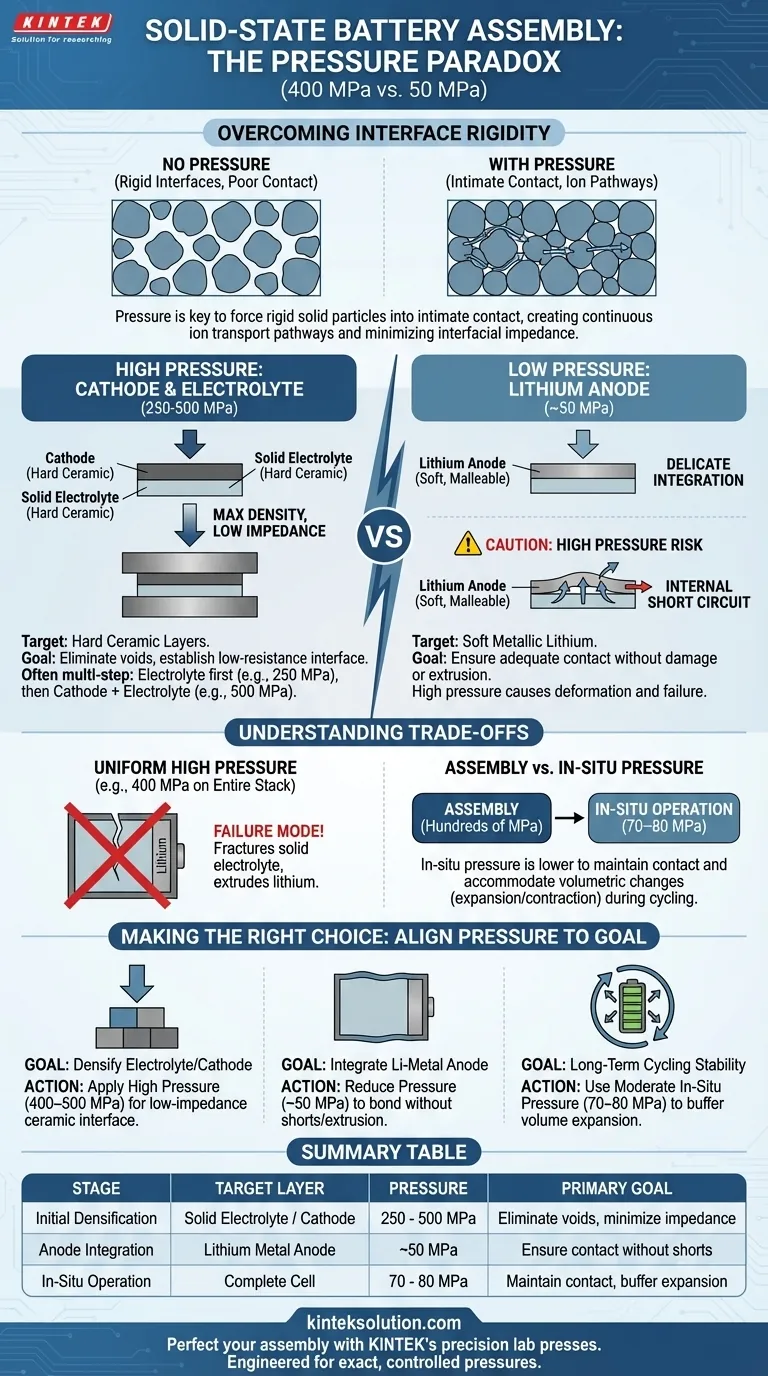
Unlike liquid electrolyte batteries, solid-state cells possess rigid solid-solid interfaces. The particles within the cathode, anode, and electrolyte do not naturally flow to create contact.
External pressure is the primary mechanism used to force these rigid particles into intimate, continuous physical contact. Without this, ions cannot transport efficiently between layers.
Minimizing Interfacial Impedance
The performance of the battery is critically dependent on the quality of these interfaces.
Insufficient contact leads to high interfacial resistance (impedance). By applying pressure, you create continuous ion transport pathways, which are fundamental for realizing the battery's electrochemical potential.
Layer-Specific Pressure Strategies
High Pressure: Cathodes and Electrolytes
The cathode and solid-state electrolyte layers are typically composed of hard, ceramic-like materials.
To achieve maximum densification and internal connectivity, these layers require high pressure, often ranging from 250 MPa to 500 MPa.
A common multi-step approach involves pressing the electrolyte layer first (e.g., at 250 MPa), then adding the cathode and pressing again at a higher pressure (e.g., 500 MPa) to bond them seamlessly.
Low Pressure: The Lithium Anode
The mechanical rules change drastically when introducing the anode, particularly if using metallic lithium.
Lithium is soft and malleable. Subjecting it to the high pressures used for the cathode would cause deformation or induce internal short circuits by forcing lithium through the electrolyte layer.
Therefore, the anode is compacted at significantly lower pressures, such as 50 MPa. This ensures adequate contact with the electrolyte without damaging the delicate cell structure.
Understanding the Trade-offs
The Risk of Uniform High Pressure
Applying a uniform high pressure (e.g., 400 MPa) to the entire stack after adding a lithium anode is a common failure mode.
This can fracture the solid electrolyte or extrude the lithium, destroying the cell before testing begins. The differential pressure approach is a mandatory safety and performance constraint.
Assembly Pressure vs. In-Situ Pressure
It is vital to distinguish between the pressure used to manufacture the cell and the pressure used to operate it.
While assembly often requires hundreds of megapascals, in-situ operational pressure is typically lower (e.g., 70–80 MPa).
This continuous, lower operational pressure maintains contact during cycling and accommodates volumetric changes (expansion/contraction) without crushing the active materials.
Making the Right Choice for Your Goal
To optimize your lab press protocols, align your pressure settings with the specific stage of assembly:
- If your primary focus is densifying the electrolyte/cathode: Apply high pressure (400–500 MPa) to eliminate voids and establish a low-impedance ceramic interface.
- If your primary focus is integrating a Lithium metal anode: Reduce pressure drastically (approx. 50 MPa) to bond the layer without inducing short circuits or material extrusion.
- If your primary focus is long-term cycling stability: Transition to a moderate, continuous pressure (70–80 MPa) effectively using an in-situ compression setup to buffer volume expansion.
Mastering these pressure differentials is the key to transforming a collection of powders and foils into a cohesive, high-performance energy storage device.
Summary Table:
| Assembly Stage | Target Layer | Recommended Pressure Range | Primary Goal |
|---|---|---|---|
| Initial Densification | Solid Electrolyte / Cathode | 250 - 500 MPa | Eliminate voids, minimize impedance |
| Anode Integration | Lithium Metal Anode | ~50 MPa | Ensure contact without short circuits |
| In-Situ Operation | Complete Cell | 70 - 80 MPa | Maintain contact during cycling, buffer expansion |
Ready to perfect your all-solid-state battery assembly?
KINTEK's precision lab press machines, including our automatic and heated lab presses, are engineered to deliver the exact, controlled pressures required for each critical layer in your research. We help battery researchers like you achieve flawless layer-by-layer compaction, from high-pressure cathode densification to delicate anode integration.
Contact our experts today to discuss how our specialized lab presses can enhance your battery development process and accelerate your path to a high-performance, reliable cell.
Visual Guide
References
- Seungwoo Lee, Ungyu Paik. Stabilized Conductive Agent/Sulfide Solid Electrolyte Interface via a Halide Solid Electrolyte Coating for All‐Solid‐State Batteries. DOI: 10.1002/cey2.70051
This article is also based on technical information from Kintek Solution Knowledge Base .
Related Products
- 24T 30T 60T Heated Hydraulic Lab Press Machine with Hot Plates for Laboratory
- Manual Heated Hydraulic Lab Press with Integrated Hot Plates Hydraulic Press Machine
- Laboratory Hydraulic Pellet Press for XRF KBR FTIR Lab Press
- Lab Infrared Press Mold for Laboratory Applications
- Laboratory Hydraulic Press Lab Pellet Press Machine for Glove Box
People Also Ask
- Function of a Laboratory Hydraulic Press with Heated Platens in SSE? Enhance Battery Density & Conductivity
- Why is a laboratory hydraulic press with heating plates required for PLA/TEC films? Achieve Precise Sample Integrity
- What role does a laboratory heated hydraulic press play in LTCC? Essential for High-Density Ceramic Lamination
- What is the primary function of a laboratory heated hydraulic press? Mastering Thermoplastic Carbon Fiber Composites
- What is the critical role of a laboratory heated hydraulic press? Mastering PVC Sample Prep for Testing



















