
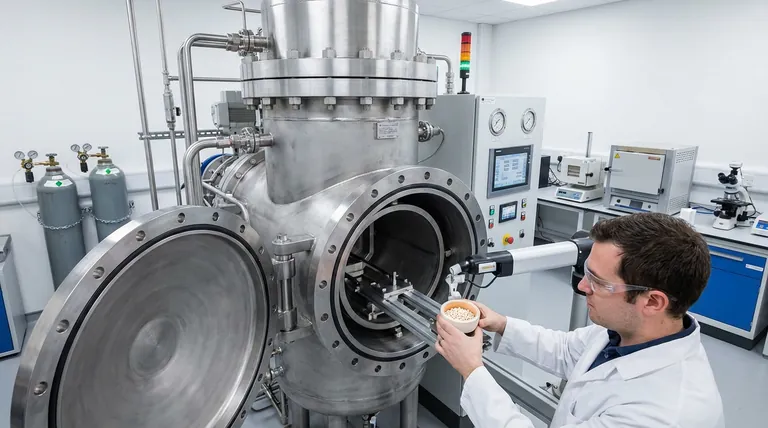
The simultaneous application of high temperature and omnidirectional pressure distinguishes Hot Isostatic Pressing (HIP) from conventional methods.
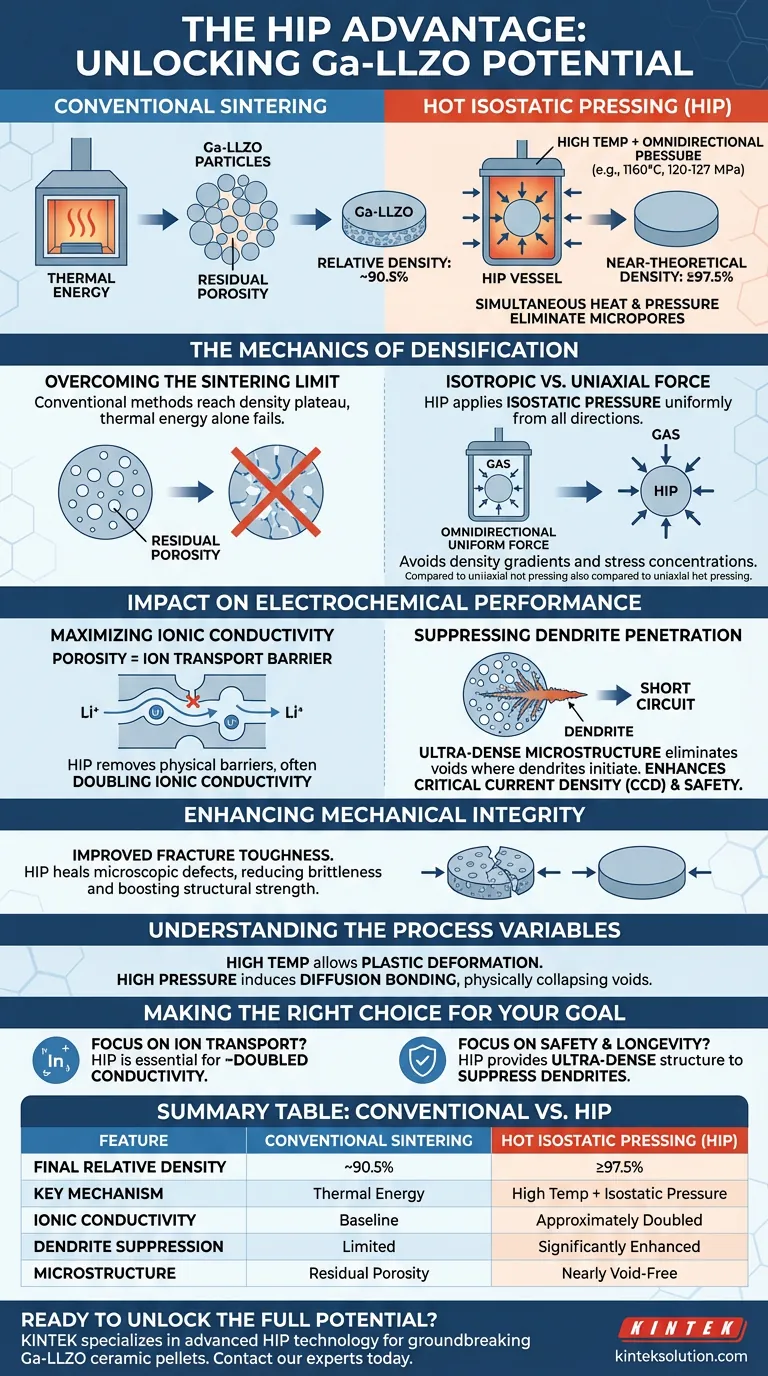
While conventional sintering relies primarily on thermal energy to bond particles, HIP introduces high isostatic gas pressure (e.g., 120–127 MPa) alongside high temperatures (e.g., 1160°C). This combination forces the closure of microscopic pores through plastic deformation and diffusion bonding, driving the relative density of Ga-LLZO pellets from typical values of ~90.5% to near-theoretical levels of 97.5% or higher.
The Core Insight Conventional sintering often leaves closed pores that act as bottlenecks for ion transport and structural weak points. By eliminating these defects through uniform pressure, HIP creates a nearly void-free microstructure that doubles ionic conductivity and significantly improves resistance to lithium dendrite penetration.
The Mechanics of Densification
Overcoming the Sintering Limit
Conventional pressureless sintering often reaches a density plateau, leaving residual porosity that thermal energy alone cannot eliminate.
HIP bypasses this limit by applying an inert gas atmosphere (such as argon) as a pressure medium. This extreme environment effectively squeezes the material, eliminating internal micropores that conventional methods fail to remove.
Isotropic vs. Uniaxial Force
Unlike hot pressing, which applies force from a single direction (uniaxial), HIP applies isostatic pressure.
This means force is applied uniformly from all directions. This omnidirectional pressure ensures consistent densification throughout the complex crystal structure of Ga-LLZO, avoiding the density gradients or stress concentrations often seen in uniaxial processing.
Impact on Electrochemical Performance
Maximizing Ionic Conductivity
Porosity is the enemy of ion transport; every pore is a dead end for a lithium ion.
By increasing relative density to nearly 100%, HIP removes these physical barriers. The result is a direct and significant enhancement in performance, often doubling the ionic conductivity compared to samples processed via conventional sintering.
Suppressing Dendrite Penetration
A critical failure mode in solid-state batteries is the growth of lithium dendrites through the electrolyte, leading to short circuits.
The ultra-dense microstructure achieved via HIP eliminates the voids and defects where dendrites typically initiate and propagate. This structural integrity is vital for enhancing the critical current density (CCD), allowing the battery to operate safely at higher power rates.
Enhancing Mechanical Integrity
Improved Fracture Toughness
Ceramic electrolytes like LLZO are inherently brittle, and pores act as stress concentrators that initiate cracks.
By healing these microscopic defects through diffusion bonding, HIP significantly boosts the material's fracture toughness. A mechanically robust pellet is essential for withstanding the physical stresses of cell assembly and operation.
Understanding the Process Variables
The Role of Plastic Deformation
At the high temperatures employed during HIP, the ceramic material softens slightly, allowing the high pressure to induce plastic deformation.
This mechanism physically collapses voids. Simultaneously, the heat promotes diffusion, bonding the grain boundaries tightly together to create a continuous, solid monolith.
Comparison to Hot Pressing
While standard hot pressing (uniaxial) also improves density, it often creates anisotropic (direction-dependent) properties.
HIP's use of gas pressure ensures that the material properties remain uniform in all axes. This is distinct from cold isostatic pressing (CIP), which is primarily used for pre-compacting green bodies or improving interface contact, rather than final densification.
Making the Right Choice for Your Goal
While conventional sintering is simpler, HIP is the definitive choice for high-performance applications where material perfection is non-negotiable.
- If your primary focus is Ion Transport: HIP is essential to remove porosity barriers, potentially doubling your total ionic conductivity.
- If your primary focus is Safety and Longevity: Use HIP to achieve the ultra-dense microstructure required to suppress lithium dendrite propagation and prevent short circuits.
Achieving near-theoretical density is not just a metric; it is the prerequisite for unlocking the full electrochemical potential of Ga-LLZO ceramics.
Summary Table:
| Feature | Conventional Sintering | Hot Isostatic Pressing (HIP) |
|---|---|---|
| Final Relative Density | ~90.5% | ≥97.5% (Near-Theoretical) |
| Key Mechanism | Thermal Energy | High Temp + Isostatic Pressure |
| Ionic Conductivity | Baseline | Approximately Doubled |
| Dendrite Suppression | Limited | Significantly Enhanced |
| Microstructure | Residual Porosity | Nearly Void-Free |
Ready to unlock the full potential of your solid-state battery materials? KINTEK specializes in advanced lab press machines, including precision Hot Isostatic Presses (HIP), designed to help researchers like you achieve the near-perfect densification required for groundbreaking Ga-LLZO ceramic pellets. Our HIP technology can help you eliminate detrimental porosity, double ionic conductivity, and build safer, more powerful batteries. Contact our experts today to discuss how our solutions can accelerate your R&D. Get in touch via our Contact Form
Visual Guide
Related Products
- Warm Isostatic Press for Solid State Battery Research Warm Isostatic Press
- Manual Cold Isostatic Pressing CIP Machine Pellet Press
- Automatic Laboratory Hydraulic Press for XRF and KBR Pellet Pressing
- Automatic Laboratory Hydraulic Press Lab Pellet Press Machine
- Manual Laboratory Hydraulic Press Lab Pellet Press
People Also Ask
- Why must composite cathodes be sealed in vacuum lamination bags for WIP? Ensure Battery Stability and Density
- How do sacrificial volume materials (SVM) maintain microchannels in isostatic pressing? Ensure Structural Integrity
- What is the function of elastic molds in warm isostatic pressing? Achieve Uniform Density in Composite Particles
- What are the advantages of using a Warm Isostatic Press (WIP) for batteries? Achieve Superior Interface Contact
- How does Warm Isostatic Pressing differ from traditional pressing methods? Unlock Uniform Density for Complex Parts



















