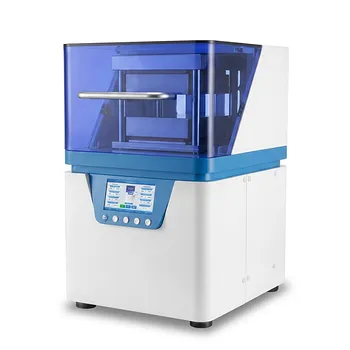
The primary difference between automatic and manual hydraulic presses lies in the trade-off between consistency and cost. Automatic presses utilize electric motors to deliver programmable, autonomous force for high-throughput environments, while manual presses rely on physical hand-lever operation, offering a cost-effective solution for infrequent use.
Core Takeaway While manual presses are affordable and effective for occasional tasks, they introduce human variability into sample preparation. Automatic presses eliminate this variable, justifying their higher cost by ensuring absolute repeatability and workflow efficiency in busy laboratories.
Operational Mechanics and Workflow
The Driver of Force
Manual hydraulic presses operate via a hand-operated lever. This lever physically drives a piston within a cylinder filled with hydraulic oil to generate force.
Automatic hydraulic presses replace physical effort with an electric motor. This motor drives the pump and utilizes electric switches to control the relief valve, automating the pressure application.
Autonomy vs. Attention
Automatic units operate autonomously once programmed. A technician can initiate a cycle and attend to other tasks, significantly improving workflow efficiency in high-throughput labs.
Manual units require hands-on involvement throughout the entire pressing cycle. The operator must physically pump the lever to achieve and maintain the desired pressure, making multitasking impossible.
Precision and Data Integrity
Eliminating Human Error
In laboratory settings, particularly for spectroscopy (FTIR) or XRF analysis, consistency is critical.
With a manual press, the pressure applied can vary slightly based on the operator's physical technique. This variance can lead to inconsistencies between samples, potentially affecting analytical results.
Automatic presses remove the "human element." They provide high accuracy and repeatability by ensuring the exact same pressure is applied for the exact same duration across every single use.
Control and Customization
Despite their simpler mechanism, manual presses still offer a high level of customization. Operators can make real-time adjustments based on tactile feedback, though this requires skill.
Automatic presses rely on pre-set parameters. This digital precision minimizes sample damage by strictly adhering to adjustable pressure settings, but it distances the operator from the "feel" of the process.
Understanding the Trade-offs
The Cost of Convenience
Manual presses are the clear choice for budget-conscious laboratories. They are significantly more affordable and cost-effective for facilities that only need to press samples infrequently.
Automatic presses represent a larger capital investment. However, for labs processing high volumes of samples, the return on investment comes through labor savings and reduced error rates.
Physical Demands and Ergonomics
Manual presses are labor-intensive. Generating significant force requires physical exertion, which can lead to operator fatigue during repeated use.
Automatic presses require zero physical exertion to generate force. This makes them safer and more sustainable for technicians performing repetitive tasks daily.
Footprint and Portability
Manual presses offer versatility in size. They range from full-size benchtop units to handheld models, making them ideal for field work or laboratories with extremely limited counter space.
Automatic presses generally require a dedicated benchtop space and a power source, limiting their portability compared to handheld manual options.
Making the Right Choice for Your Goal
To select the correct equipment, you must prioritize your laboratory's specific operational needs.
- If your primary focus is high-throughput consistency: Choose an automatic press to eliminate operator variability and free up technician time for other tasks.
- If your primary focus is budget optimization: Choose a manual press, as it offers a cost-effective solution for low-volume or infrequent sampling needs.
- If your primary focus is field work or limited space: Choose a handheld manual press, which provides portability that motorized units cannot match.
Ultimately, the choice depends on whether your lab values the low cost of manual operation or the rigorous reproducibility of automation.
Summary Table:
| Feature | Manual Hydraulic Press | Automatic Hydraulic Press |
|---|---|---|
| Operation | Hand-lever physical pumping | Motor-driven autonomous cycle |
| Consistency | Operator-dependent (variable) | Programmable (high repeatability) |
| Throughput | Low (labor-intensive) | High (multitasking capable) |
| Portability | High (benchtop or handheld) | Low (requires power source) |
| Best For | Budget-conscious, infrequent use | High-volume, precision analytics |
Elevate Your Lab Productivity with KINTEK
Precision and consistency are the cornerstones of reliable research. KINTEK specializes in comprehensive laboratory pressing solutions tailored to your specific workflow. Whether you need the cost-effective flexibility of our manual units or the programmable accuracy of our automatic, heated, and multifunctional models, we provide the tools to ensure superior sample integrity.
Our extensive range includes:
- Automatic & Manual Presses for FTIR and XRF preparation.
- Heated & Glovebox-Compatible Models for advanced material synthesis.
- Isostatic Presses (Cold & Warm) for high-density battery research.
Don't let manual variability compromise your data. Contact KINTEK today to find your perfect pressing solution and see how our expertise can streamline your laboratory operations.
Related Products
- Automatic Hydraulic Hot Press with Large Plate and Precision Temperature Control for Advanced Material Sample Preparation and Industrial Research
- Automatic Hydraulic Heat Press Machine with Multi Stage Programmable Control and Integrated Water Cooling Plate Size 180x180mm
- Automatic High Temperature Heated Hydraulic Press Machine with Heated Plates for Lab
- Automatic Heated Hydraulic Lab Press with Programmable Touch Screen Controls and Precision Temperature Regulation
- Manual Heated Hydraulic Lab Press with Integrated Hot Plates Hydraulic Press Machine
People Also Ask
- What are the specific features and applications of hydraulic hot press machines? Precision Solutions for Modern Labs
- How does an automatic hydraulic press operate? Achieve Precision and Consistency in Lab Pelleting
- What are the advantages and common applications of an automatic hydraulic press? Elevate Your Lab's Precision
- What is the technical significance of setting a precise dwell time? Achieve Peak Material Density and Stability
- When is an automatic hydraulic press more suitable than a manual press? Scale Your Lab with Precision & Speed