
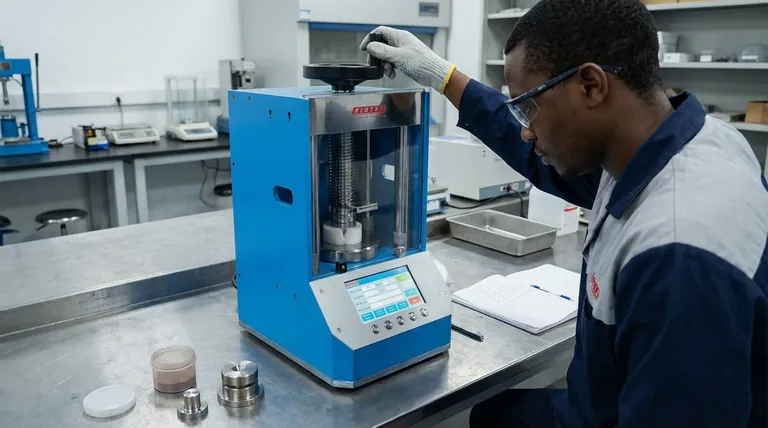
Operating a hydraulic pellet press safely requires a distinct combination of personal protective equipment (PPE), equipment stability, and controlled force application. The immediate priority is to wear safety glasses and gloves, ensure the unit is securely mounted to a stable workbench, and utilize integrated safety guards to shield against potential component failure.
Core Insight: True safety in hydraulic pressing extends beyond wearing goggles; it depends on the operator's ability to accurately interpret load limits. You must distinguish between internal hydraulic pressure and the actual force applied to the die to prevent catastrophic equipment failure.
Securing the Environment and Operator
Personal Protective Equipment (PPE)
You must wear appropriate safety glasses and protective gloves at all times. Hydraulic systems store immense potential energy, and in the event of a die fracture or seal failure, debris can be ejected at high velocities.
Workbench Stability
Ensure the press is placed on a stable, level workbench capable of supporting its weight. The unit must be secure to prevent tipping, shifting, or accidental movement during the manual pumping process.
Utilizing Safety Guards
Never operate the press without the safety guards in place. These barriers are designed to contain shrapnel if a die crushes under excessive load or if the workpiece fails.
Controlling the Pressing Cycle
Gradual Force Application
To begin, close the hydraulic valve to seal the system. operate the hand lever gradually to build pressure; sudden jerking motions can shock the system and damage the sample.
Monitoring the Gauge
Keep your eyes fixed on the force gauge continuously while pumping. Stop immediately once you reach the target load; do not rely solely on the system's mechanical limits to stop you.
Safe Decompression
When the operation is complete, slowly release the pressure by opening the valve or lever gently. Rapid decompression can cause the pressed pellet to crack or "laminate" due to expanding air trapped inside.
Distinguishing Pressure from Force
The Conversion Criticality
A common danger is misinterpreting the gauge reading. Some gauges display internal hydraulic pressure (e.g., psi or bar) rather than the actual force applied to the sample (e.g., tons or Newtons).
Calculating True Load
If your gauge reads pressure, you must convert this value to force using the effective surface area of the internal ram (found in the manual). Failing to do this calculation can lead to unknowingly applying force that exceeds the die's rating.
Common Pitfalls to Avoid
Over-reliance on Relief Valves
While presses are equipped with pressure relief valves, do not use them as your primary method of load control. Habitually hitting the relief valve stresses the hydraulic seals and reduces the lifespan of the press.
Improper Die Removal
Never attempt to remove the die while the system is under load. You must fully neutralize the pressure and retract the lead screw (upper wheel) before unlocking the die assembly.
Making the Right Choice for Your Goal
Safety procedures should be adapted based on your specific operational priorities.
- If your primary focus is Equipment Longevity: Operate the press well below its maximum rated capacity to reduce wear on seals and minimize the risk of hydraulic leaks.
- If your primary focus is Sample Consistency: Record the specific force value (not just gauge pressure) used for each pellet to ensure reproducibility across different batches.
Ultimately, the safest operator is one who understands that the gauge is a precision instrument, not just a progress bar.
Summary Table:
| Safety Precaution | Key Action | Why It Matters |
|---|---|---|
| Personal Protective Equipment (PPE) | Wear safety glasses and gloves. | Protects from high-velocity debris in case of failure. |
| Workbench & Guards | Secure press to a stable bench; always use safety guards. | Prevents tipping and contains potential shrapnel. |
| Force Application | Apply pressure gradually; monitor the gauge continuously. | Prevents system shock and sample damage from over-pressing. |
| Pressure vs. Force | Convert gauge pressure to actual force on the die. | Critical to avoid exceeding die capacity and causing failure. |
| Decompression | Release pressure slowly after pressing. | Prevents pellet cracking from rapid air expansion. |
Operate Your Lab Press with Confidence and Precision
Following these safety protocols is essential for protecting your team and your samples. For laboratories that demand reliability and repeatability, the right equipment is just as important as the right procedures.
KINTEK specializes in lab press machines (including automatic, isostatic, and heated lab presses), serving the precise needs of research and quality control laboratories. Our presses are engineered for safety, durability, and accurate force control, helping you achieve consistent results batch after batch.
Ready to enhance your lab's safety and efficiency? Contact our experts today to find the perfect hydraulic press for your application and ensure your pressing operations are built on a foundation of safety.
Visual Guide

Related Products
- Laboratory Hydraulic Pellet Press for XRF KBR FTIR Lab Press
- Automatic Laboratory Hydraulic Press Lab Pellet Press Machine
- Laboratory Hydraulic Press Lab Pellet Press Machine for Glove Box
- Manual Laboratory Hydraulic Pellet Press Lab Hydraulic Press
- Automatic Laboratory Hydraulic Press for XRF and KBR Pellet Pressing
People Also Ask
- Laboratory Pellet Press for Solar PV Recycling: Ensuring High-Precision Material Analysis and Purity
- Why is a professional laboratory pellet press required for XRF of silica sand? Achieve +/- 0.10% Precision
- Why is high consistency in holding pressure from a laboratory pellet press required when preparing multi-component alloy specimens?
- Why Use a Laboratory Pellet Press for PXRD Anode Material Prep? Standardize Samples for Precise Analysis
- What are the different types of pellet-making tools available for labs? Choose the Right Press for Your Sample



















