Hot-pressing addresses the single greatest hurdle in solid-state battery engineering: overcoming the natural rigidity of ceramic electrolytes to ensure efficient ion flow. By simultaneously applying heat and pressure, this process dramatically reduces interface impedance, creates a mechanically stable solid-solid boundary, and drives the densification necessary for high-rate performance.
The fundamental advantage of hot-pressing lies in its ability to soften materials and force plastic deformation at the microscopic level. While cold pressing leaves voids between rigid particles, hot-pressing closes these gaps to form a unified, highly conductive pathway, effectively turning a powder compact into a dense, high-performance electrochemical system.
Overcoming the Interface Challenge
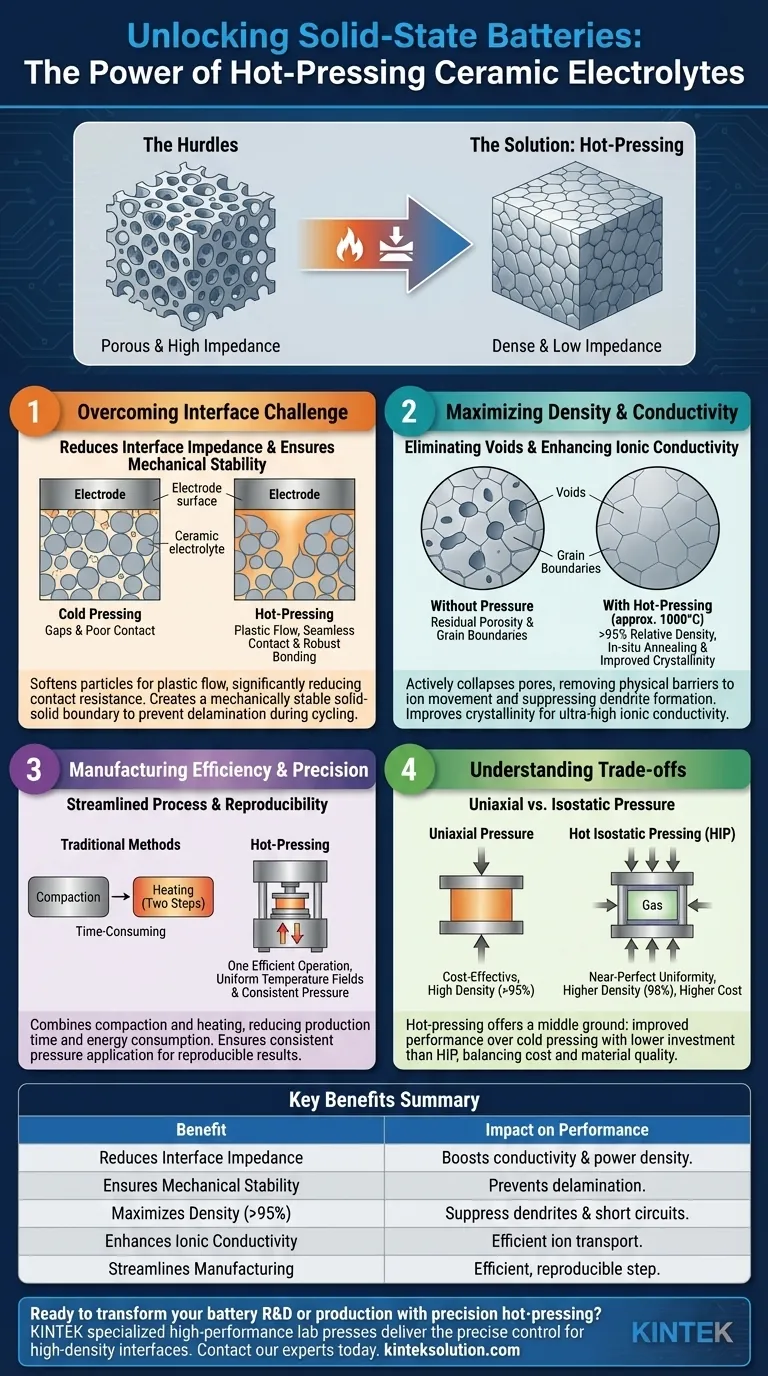
The primary struggle with ceramic electrolytes—such as Perovskites or Garnet-type materials—is their hardness. Without the "wetting" ability of liquid electrolytes, establishing contact between the electrolyte and electrode is difficult. Hot-pressing provides the solution.
Reducing Interface Impedance
For a solid-state battery to function, lithium ions must move seamlessly from the electrode into the electrolyte. Gaps or loose contact points create high resistance.
Hot-pressing softens the material particles, promoting plastic flow. This allows the electrolyte to conform perfectly to the electrode surface, significantly reducing the contact resistance that typically bottlenecks performance.
Ensuring Mechanical Stability
Mere physical contact is often insufficient; the components must remain bonded during operation.
The simultaneous application of heat and pressure fosters a mechanically stable solid-solid interface. This robust bonding prevents the delamination that can occur during battery cycling, ensuring consistent performance over time.
Maximizing Density and Conductivity
The microstructure of the ceramic pellet dictates its electrochemical properties. A porous material is a poor conductor.
Eliminating Voids and Pores
Sintering without pressure often leaves residual porosity. Hot-pressing, specifically uniaxial pressure at temperatures around 1000°C, actively collapses these internal pores.
This technique allows for relative densities exceeding 95%. By eliminating voids, you remove physical barriers to ion movement and suppress the formation of lithium dendrites, which thrive in porous structures.
Enhancing Ionic Conductivity
High density translates directly to performance. The process minimizes grain boundaries—the "seams" between particles where resistance is highest.
Furthermore, hot-pressing acts as an in-situ annealing treatment. This improves the crystallinity of the material, leading to ultra-high ionic conductivity (e.g., 1.7×10⁻² S cm⁻¹ in sulfide systems) that is difficult to achieve through cold pressing alone.
Manufacturing Efficiency and Precision
Beyond material performance, hot-pressing offers distinct operational advantages for scaling production.
Streamlined Process Efficiency
Traditional methods might require separate steps for compaction and heating. Hot-pressing combines these into a single operation.
This consolidation reduces overall production time and increases throughput. It is also energy-efficient, as the design limits longitudinal heat flow, concentrating energy exactly where it is needed—on the workpiece.
Precision and Reproducibility
Consistency is critical for quality control. Modern hot-pressing equipment can be integrated with IT systems to manage the densification process precisely.
This ensures uniform temperature fields and consistent pressure application. The result is minimal variation between batches, providing the reproducible data necessary for validating battery designs.
Understanding the Trade-offs
While hot-pressing is superior to cold pressing for ceramics, it is important to understand its context relative to other advanced methods like Hot Isostatic Pressing (HIP).
Uniaxial vs. Isostatic Pressure
Standard hot-pressing typically applies uniaxial pressure (force from one direction). While this is cost-effective and creates high density (>95%), it may not achieve the near-perfect uniform density of HIP.
HIP applies gas pressure from all directions, often achieving relative densities of 98% and creating transparent ceramics. However, HIP involves significantly higher equipment investment and complexity.
Equipment Investment
Hot-pressing represents a middle ground. It requires a lower initial investment than isostatic pressing systems but is more complex and expensive than simple cold-pressing rigs. You are trading capital cost for significantly improved material performance.
Making the Right Choice for Your Project
The decision to utilize hot-pressing depends on the specific stage of your development and your performance targets.
- If your primary focus is research and validation: Use hot-pressing to ensure optimal physical contact, guaranteeing that your electrochemical data reflects the material's true potential rather than assembly defects.
- If your primary focus is cost-effective manufacturing: Leverage hot-pressing to reduce cycle times and energy consumption while maintaining the high density required for commercial viability.
- If your primary focus is suppressing dendrites: Prioritize the densification capabilities of hot-pressing (or HIP) to eliminate the pores that allow dendrites to propagate and short-circuit the cell.
By unifying thermal and mechanical energy, hot-pressing transforms brittle ceramics into robust, high-conductivity components, bridging the gap between theoretical material properties and real-world battery performance.
Summary Table:
| Key Benefit | Impact on Solid-State Battery Performance |
|---|---|
| Reduces Interface Impedance | Enables seamless ion flow, boosting conductivity and power density. |
| Ensures Mechanical Stability | Creates robust solid-solid interfaces, preventing delamination during cycling. |
| Maximizes Density (>95%) | Eliminates pores to suppress lithium dendrite growth and short circuits. |
| Enhances Ionic Conductivity | Improves crystallinity and minimizes grain boundaries for efficient ion transport. |
| Streamlines Manufacturing | Combines heating and pressing into one efficient, reproducible step. |
Ready to transform your solid-state battery R&D or production with precision hot-pressing?
KINTEK specializes in high-performance lab press machines, including automatic lab presses, isostatic presses, and heated lab presses designed specifically for advanced materials development. Our equipment delivers the precise temperature control and uniform pressure required to achieve the high-density, low-impedance interfaces detailed in this article.
Let us help you bridge the gap between theoretical material properties and real-world battery performance. Contact our experts today to discuss how a KINTEK hot-pressing solution can accelerate your project.
Visual Guide
Related Products
- Warm Isostatic Press for Solid State Battery Research Warm Isostatic Press
- Laboratory Hydraulic Press Lab Pellet Press Button Battery Press
- Lab Infrared Press Mold for Laboratory Applications
- Automatic High Temperature Heated Hydraulic Press Machine with Heated Plates for Lab
- Laboratory Manual Heated Hydraulic Press Machine with Hot Plates
People Also Ask
- Why must composite cathodes be sealed in vacuum lamination bags for WIP? Ensure Battery Stability and Density
- What is the function of elastic molds in warm isostatic pressing? Achieve Uniform Density in Composite Particles
- How do sacrificial volume materials (SVM) maintain microchannels in isostatic pressing? Ensure Structural Integrity
- How does Warm Isostatic Pressing differ from traditional pressing methods? Unlock Uniform Density for Complex Parts
- What is the process involved in warm isostatic pressing? Mastering Uniform Density with WIP Technology