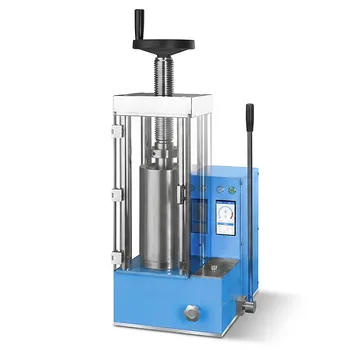
The hydraulic system of a rubber laboratory press is defined by a high-capacity cylinder capable of delivering approximately 25 tons of closure force. This system is typically augmented by a hydraulic balance device, engineered to facilitate stable and rapid machine movement during the molding process.
The efficacy of the press relies not just on raw power, but on the hydraulic balance device. This component ensures the stability and even distribution of pressure required to mold rubber without defects, distinguishing a precision instrument from a simple crushing machine.
The Mechanics of Force Generation
The Role of the Hydraulic Cylinder
The core component of the system is the hydraulic cylinder. It is responsible for applying sufficient pressure to the rubber sample to ensure proper molding.
Preventing Material Defects
By exerting adequate clamping force, the cylinder compacts the material to prevent common rubber processing issues. This pressure specifically mitigates the formation of air bubbles, prevents overflow, and ensures there are no dry spots (lack of glue) in the final sample.
Pascal’s Law in Application
The system operates on the principles of Pascal’s law, utilizing a confined fluid—typically oil—to transmit power. This mechanism ensures that pressure is applied evenly and consistently across the entire surface area of the sample, guaranteeing uniform compression.
Stability and Precision Control
The Hydraulic Balance Device
While the cylinder provides force, the hydraulic balance device provides control. This feature is critical for maintaining stability during the press's operation.
Rapid Movement Capability
According to primary technical specifications, the balance device also contributes to rapid machine movement. This allows for efficient cycle times without sacrificing the stability required for accurate testing.
Closure Force Capacity
A standard rubber laboratory press is engineered to handle significant loads. The system is typically rated for a closure force of around 25 tons, providing the high pressure necessary for demanding rubber compounding applications.
Operational Considerations and Trade-offs
Assessing Laboratory Constraints
When selecting a hydraulic system, you must account for the physical footprint and energy requirements. High-tonnage presses require significant laboratory space and substantial energy inputs to generate the required 25 tons of force.
Balancing Force with Application
More force is not always better; the system must be matched to the specific application. An oversized hydraulic system may be inefficient for smaller samples, while an undersized system will fail to prevent air bubbles or proper compaction.
Selecting the Right System for Your Lab
To ensure you select a press that delivers accurate and successful results, you must align the hydraulic features with your specific testing goals.
- If your primary focus is sample consistency: Prioritize a unit with a robust hydraulic balance device to ensure even pressure distribution and stable movement.
- If your primary focus is defect prevention: Ensure the clamping force (typically 25 tons) is sufficient to compress your specific rubber compound and eliminate air bubbles.
- If your primary focus is workflow efficiency: Look for a system designed for rapid movement to reduce dwelling time and increase testing throughput.
The ideal hydraulic system strikes a precise balance between raw closure force and stable, controlled movement.
Summary Table:
| Feature | Function | Benefit |
|---|---|---|
| Hydraulic Cylinder | Delivers ~25 tons of closure force | Prevents air bubbles and dry spots |
| Balance Device | Facilitates stable and rapid movement | Enhances machine stability and efficiency |
| Pascal’s Law Application | Uniform fluid pressure transmission | Ensures consistent compression across samples |
| High Clamping Force | Compaction of rubber compounds | Eliminates overflow and material defects |
Optimize Your Rubber Research with KINTEK
Ready to achieve flawless material consistency? KINTEK specializes in comprehensive laboratory pressing solutions tailored for precision. Whether you need manual, automatic, heated, or glovebox-compatible models, our equipment—including advanced cold and warm isostatic presses—is engineered to meet the rigorous demands of battery research and rubber compounding.
Maximize your lab's efficiency today. Contact us now to find the perfect hydraulic press for your application!
Related Products
- Assemble Square Lab Press Mold for Laboratory Use
- Lab Round Bidirectional Press Mold
- Special Shape Lab Press Mold for Laboratory Applications
- Lab Infrared Press Mold for Laboratory Applications
- Lab Heat Press Special Mold
People Also Ask
- What is the purpose of incorporating cartridge heaters into a lab press mold for MLCC block compression? Optimize Results
- Why is a high-performance laboratory molding press critical for in-situ electrolyte formation? Unlock Battery Success
- How does the geometry of laboratory molds influence mycelium-based composites? Optimize Density and Strength
- What challenges are associated with recycling textiles, and how do laboratory presses help? Overcome Recycling Hurdles with Precision Tools
- What are the common applications for laboratory presses? Expert Guide to Sample Prep, R&D, and Quality Control