
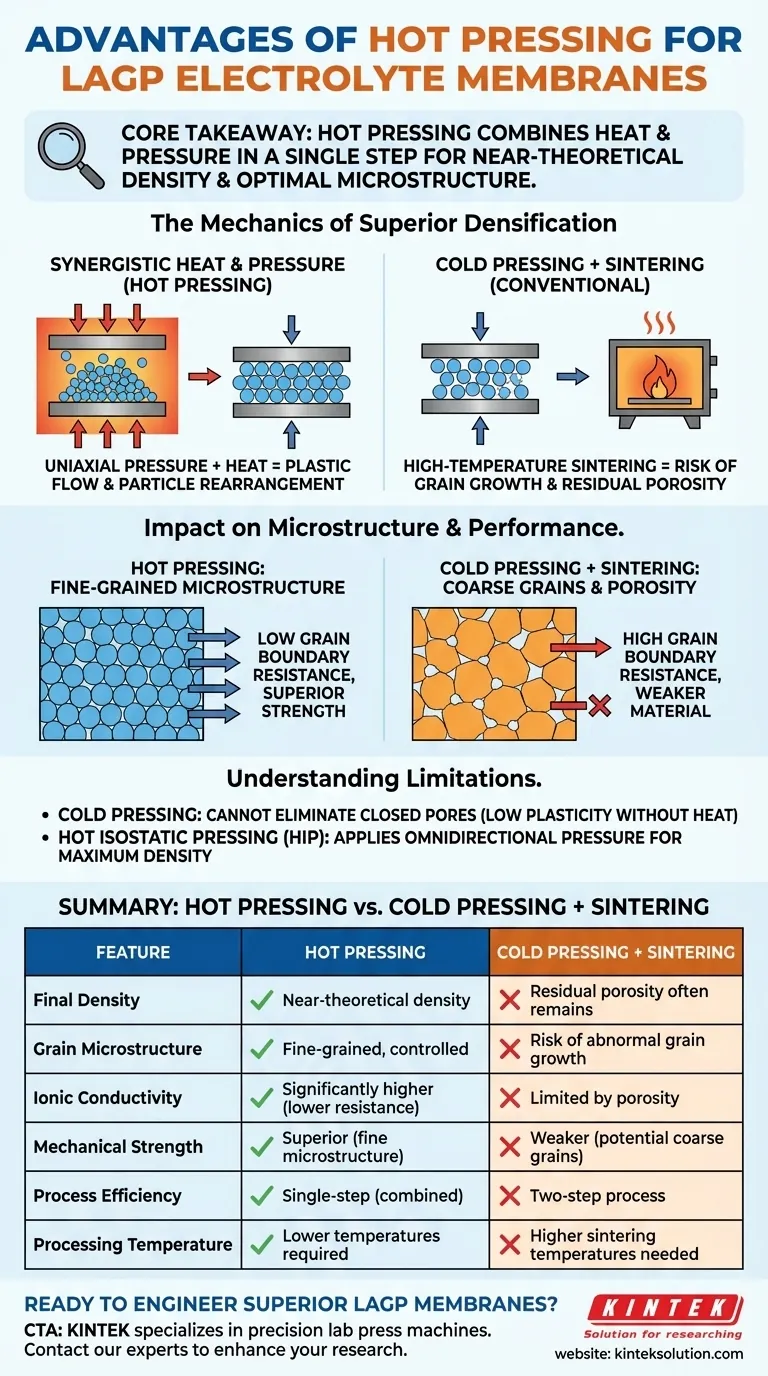
Hot pressing offers a distinct manufacturing advantage by integrating thermal treatment and mechanical compression into a single, synergistic step. By applying uniaxial pressure at elevated temperatures, this process induces plastic flow in the LAGP material, achieving near-theoretical density and optimal microstructure that cold pressing followed by separate sintering cannot match.
Core Takeaway Conventional cold pressing often leaves residual porosity and requires high-temperature sintering that risks grain growth. Hot pressing solves this by using simultaneous heat and pressure to fully densify the membrane at lower temperatures, preserving a fine-grained microstructure and significantly lowering grain boundary resistance.
The Mechanics of Superior Densification
Synergistic Heat and Pressure
The fundamental flaw of cold pressing is its inability to remove all voids between particles. Hot pressing applies uniaxial pressure directly to the powder while heated, creating a synergistic effect.
This combination enhances particle rearrangement and promotes plastic flow, allowing the material to fill microscopic gaps that mechanical force alone cannot resolve.
Achieving Density at Lower Temperatures
In conventional processing, achieving full density requires sintering at very high temperatures, which can degrade the material.
Hot pressing allows LAGP membranes to achieve full densification at significantly lower temperatures and in shorter timeframes. This efficiency is driven by inter-particle creep and diffusion, which are activated by the pressure-heat combination.
Impact on Microstructure and Performance
Suppression of Abnormal Grain Growth
A critical downside of high-temperature sintering (post-cold press) is the tendency for grains to grow uncontrollably, weakening the material.
Hot pressing effectively suppresses abnormal grain growth. By densifying at lower thermal loads, it maintains a fine-grained microstructure, which directly correlates to superior mechanical strength and improved resistance to dendrite penetration.
Reduction of Grain Boundary Resistance
Porosity acts as a barrier to ion transport. Cold-pressed compacts often retain microscopic pores that impede performance.
Hot pressing eliminates these residual pores and ensures intimate physical contact between grains. This significantly reduces grain boundary resistance, often increasing ionic conductivity by orders of magnitude compared to porous, cold-pressed samples.
Understanding the Limitations of Cold Pressing
The Persistence of Closed Pores
While cold pressing (as noted in fabrication contexts for composites) can reduce voids and establish initial contact, it often fails to eliminate closed pores.
References indicate that without the simultaneous application of heat, the material lacks the plasticity required to close these internal defects. This leaves a "ceiling" on the density and conductivity achievable via cold pressing alone.
The Role of Isostatic Pressure (HIP)
It is worth noting that for maximum theoretical density, Hot Isostatic Pressing (HIP) represents an evolution of standard hot pressing.
Where uniaxial hot pressing applies force in one direction, HIP applies uniform gas pressure (omnidirectional) at high temperatures. This is particularly effective for eliminating the final traces of closed porosity that might survive standard uniaxial hot pressing.
Making the Right Choice for Your Goal
Depending on the specific requirements of your LAGP electrolyte application, the advantages of hot pressing manifest differently.
- If your primary focus is Ionic Conductivity: Hot pressing is essential to eliminate residual porosity and minimize grain boundary resistance, creating unobstructed ion transport channels.
- If your primary focus is Mechanical Integrity: The suppression of abnormal grain growth during hot pressing yields a fine microstructure that significantly boosts the membrane's fracture strength.
- If your primary focus is Process Efficiency: Combining the pressing and sintering steps reduces overall processing time and lowers the maximum temperature required to reach full density.
Hot pressing transforms the fabrication of LAGP membranes from a simple compaction task into a microstructure engineering process, delivering a denser, stronger, and more conductive electrolyte.
Summary Table:
| Feature | Hot Pressing | Conventional Cold Pressing + Sintering |
|---|---|---|
| Final Density | Near-theoretical density | Residual porosity often remains |
| Grain Microstructure | Fine-grained, controlled | Risk of abnormal grain growth |
| Ionic Conductivity | Significantly higher (lower grain boundary resistance) | Limited by porosity |
| Mechanical Strength | Superior (fine microstructure) | Weaker (potential for coarse grains) |
| Process Efficiency | Single-step (combined pressing & sintering) | Two-step process (pressing then sintering) |
| Processing Temperature | Lower temperatures required | Higher sintering temperatures needed |
Ready to engineer superior LAGP electrolyte membranes in your lab?
KINTEK specializes in precision lab press machines, including automatic lab presses and heated lab presses designed for advanced materials processing like hot pressing. Our equipment helps you achieve the critical combination of heat and pressure needed for full densification, fine microstructures, and optimal ionic conductivity.
Let us help you enhance your research and development. Contact our experts today to discuss your specific application requirements and find the ideal press solution for your laboratory.
Visual Guide
References
- Jingrui Kang, Lei Liu. Recent Advances in NASICON‐Type Electrolytes for Solid‐State Metal Batteries. DOI: 10.1002/cey2.70031
This article is also based on technical information from Kintek Solution Knowledge Base .
Related Products
- Automatic High Temperature Heated Hydraulic Press Machine with Heated Plates for Lab
- Heated Hydraulic Press Machine with Heated Plates for Vacuum Box Laboratory Hot Press
- Automatic Heated Hydraulic Press Machine with Hot Plates for Laboratory
- Heated Hydraulic Press Machine With Heated Plates For Vacuum Box Laboratory Hot Press
- Laboratory Split Manual Heated Hydraulic Press Machine with Hot Plates
People Also Ask
- Function of a Laboratory Hydraulic Press with Heated Platens in SSE? Enhance Battery Density & Conductivity
- How does a laboratory heated hydraulic press facilitate PBN sample prep for WAXS? Achieve Precise X-Ray Scattering
- What are the requirements for electrode pressing with high-viscosity ionic liquids like EMIM TFSI? Optimize Performance
- What are the industrial applications of heated hydraulic presses? Master Heat & Force for Precision Manufacturing
- Why is a laboratory hydraulic press with heating plates required for PLA/TEC films? Achieve Precise Sample Integrity



















