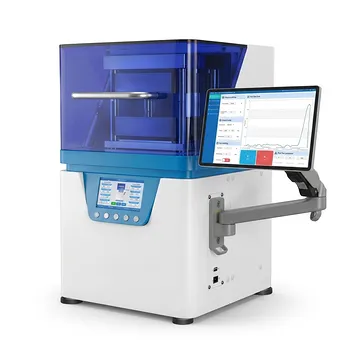
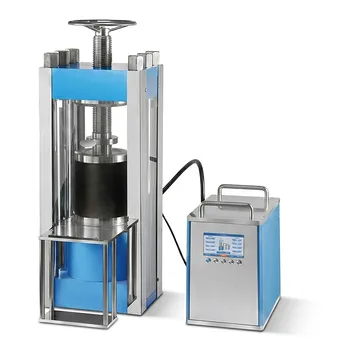
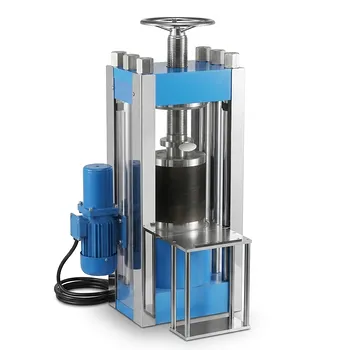
Laboratory hot presses are versatile instruments designed to apply precise heat and pressure to materials for shaping, curing, and densification. Their primary application areas include the processing of polymers and composites, the fabrication of electronic and energy components, powder metallurgy sintering, and the preparation of standardized samples for analytical testing.
The laboratory hot press is more than just a molding tool; it is a critical platform for studying material behavior under stress and temperature. Whether for R&D, lean manufacturing, or quality control, its function is to facilitate phase transitions and chemical reactions in a controlled environment.
Material Fabrication and Processing
Polymer Compression Molding
The most common application for hot presses is the compression molding of thermoplastics and the curing of thermosetting resins.
This process transforms raw plastic pellets or powders into solid shapes. It is also the standard method for rubber vulcanization and creating thin film laminates for testing.
Composite Structure Development
In the field of composite materials, hot presses are essential for curing fiber-reinforced composites.
They allow researchers to fabricate robust sandwich structures by bonding different layers together. The pressure ensures distinct layers adhere correctly while eliminating voids that could weaken the material.
Electronics and Energy Applications
Electronic Component Laminating
The electronics industry relies on hot presses for laminating multilayer printed circuit boards (PCBs).
Precision is vital here to ensure electrical connectivity and structural integrity between layers. Presses are also used for curing chip encapsulation materials, protecting delicate microelectronics from the environment.
New Energy Materials
As energy research expands, hot presses play a pivotal role in developing fuel cell membrane electrode assemblies (MEAs).
They are also used to treat and compress various battery components. This helps optimize the density and contact between active materials, which is crucial for energy efficiency.
Sintering and Densification
Powder Metallurgy and Ceramics
For hard materials, hot presses are used for hot-press sintering.
This involves compacting ceramic or metal powders while applying heat. The goal is to significantly improve density and reduce porosity, creating a solid, durable component from granular raw materials.
Pharmaceutical Compacting
While often associated with cold pressing, heated applications also exist in pharmaceuticals for pill making and compaction studies.
This process ensures that granular materials are compressed into precise forms with uniform density, which is critical for dosage consistency.
Research and Analytical Support
Standard Sample Preparation
To ensure accurate data, researchers use hot presses to create standardized samples for mechanical and microstructural analysis.
This includes pressing thin polymer films for IR transmission sampling or preparing briquettes for spectroscopy. Consistent sample thickness and density are non-negotiable for valid test results.
Adhesive and Biomaterial Research
Hot presses are used to study adhesive curing behavior and test bonding strength under specific thermal conditions.
In the medical field, they are utilized for molding and processing biocompatible materials, allowing for the development of implants and medical devices.
Operational Considerations and Constraints
Production Volume Limitations
While hot presses are ideal for R&D, short production runs, and lean manufacturing, they are generally not suited for high-volume mass production.
They excel in flexibility and precision rather than speed. For large-scale output, continuous processing equipment is usually required.
Parameter Sensitivity
The success of any hot press application depends entirely on temperature and pressure uniformity.
If the platens do not heat evenly or if pressure is applied distinctively across the surface, the material will suffer from warping, incomplete curing, or density gradients.
Making the Right Choice for Your Goal
Selecting the right process parameters depends heavily on your specific material science objectives.
- If your primary focus is Polymer R&D: Prioritize a press with precise thermal ramping to accurately study curing kinetics and thermoplastic flow.
- If your primary focus is Electronics or Energy: Ensure your equipment allows for high-precision lamination to prevent delamination in multi-layer stacks.
- If your primary focus is Analytical Sampling: Focus on repeatability and pressure control to generate identical samples for spectroscopy or mechanical testing.
Successful material processing requires balancing thermal energy with mechanical force to achieve the desired microstructural properties.
Summary Table:
| Application Category | Key Processes | Common Materials |
|---|---|---|
| Material Fabrication | Compression molding, vulcanization, laminating | Polymers, composites, resins, rubber |
| Electronics & Energy | PCB lamination, MEA fabrication, chip encapsulation | Microelectronics, fuel cells, battery components |
| Sintering & Densification | Hot-press sintering, compacting | Ceramics, metal powders, pharmaceuticals |
| Analytical Research | Sample preparation, IR spectroscopy briquettes | Thin films, biomaterials, adhesives |
Elevate Your Material Research with KINTEK
At KINTEK, we specialize in providing comprehensive laboratory pressing solutions tailored to your specific R&D needs. Whether you are advancing battery research, developing complex composites, or preparing standardized analytical samples, our diverse range of equipment—including manual, automatic, heated, and glovebox-compatible models—ensures precision and repeatability.
Our value to you:
- Precision Control: Achieve uniform temperature and pressure for high-quality results.
- Versatility: From cold and warm isostatic presses to multifunctional heated models.
- Expert Support: Specialized solutions for both lean manufacturing and advanced scientific discovery.
Ready to optimize your lab’s efficiency? Contact us today to find the perfect press for your application!
Related Products
- 24T 30T 60T Heated Hydraulic Lab Press Machine with Hot Plates for Laboratory
- Laboratory Split Manual Heated Hydraulic Press Machine with Hot Plates
- Heated Hydraulic Press Machine with Heated Plates for Vacuum Box Laboratory Hot Press
- Automatic Heated Hydraulic Press Machine with Hot Plates for Laboratory
- Automatic Large Format Laboratory Heated Hydraulic Press 400x400mm Plate Capacity
People Also Ask
- Function of a Laboratory Hydraulic Press with Heated Platens in SSE? Enhance Battery Density & Conductivity
- Why is a laboratory hydraulic press with heating plates required for PLA/TEC films? Achieve Precise Sample Integrity
- What role does a laboratory heated hydraulic press play in LTCC? Essential for High-Density Ceramic Lamination
- Why is a laboratory heated hydraulic press required? Ensure Precise Vulcanization for NBR/EPDM Nanocomposites
- Why is a laboratory heated hydraulic press utilized during the lamination stage of NASICON green tapes?