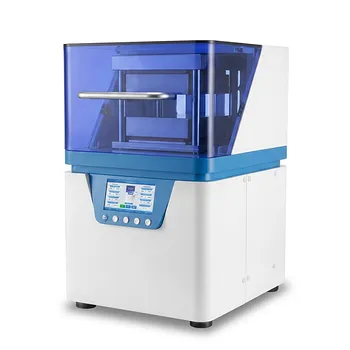
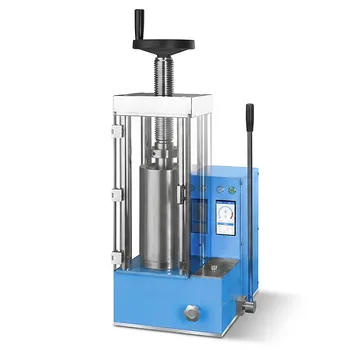
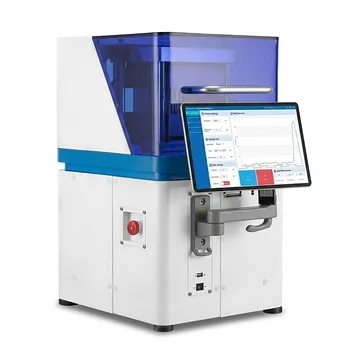
Benchtop presses are engineered to streamline laboratory workflows by combining accessibility with a minimal physical footprint. These units are characterized by their user-friendly design, straightforward controls, and the ability to handle a versatile range of sample materials without requiring the dedicated floor space of larger industrial machines.
By condensing essential pressing capabilities into a compact format, benchtop presses allow laboratories to maintain high productivity and sample diversity even within distinct spatial constraints.
Prioritizing Accessibility and Usability
Intuitive Control Interfaces
The primary appeal of a benchtop press lies in its simplicity. These units are designed with user-friendly controls that reduce the learning curve for operators.
Streamlined Operation
Because they are positioned directly on the workbench, they offer immediate accessibility. This encourages frequent use and seamless integration into daily experimental routines without complex setup procedures.
Maximizing Efficiency in Limited Environments
Space-Efficient Architecture
Labs often struggle with overcrowding. The compact design of these presses is their most defining physical characteristic, allowing them to fit easily on standard work surfaces.
Ideal for Restricted Rooms
For facilities where floor space is at a premium, benchtop models provide a solution that does not displace other critical infrastructure.
Versatility and Construction Quality
Diverse Sample Handling
Despite their size, these presses maintain significant versatility. They are capable of processing a wide variety of sample materials, making them suitable for multiple applications within a single lab.
Operational Variety
Benchtop units are often available in different mechanical configurations. Common variations include hydraulic and screw-driven models, allowing users to select the mechanism that best fits their specific precision needs.
Durability and Lifespan
These units are typically constructed from high-quality materials. This robust build quality ensures a long service life and consistent performance, even under regular usage.
Understanding the Trade-offs
While benchtop presses are excellent for accessibility and space saving, it is critical to understand their limitations compared to floor-standing units.
Pressure Capabilities
Due to their compact size, these presses typically generate lower maximum pressure than larger, industrial-grade alternatives. They are designed for standard lab tasks rather than extreme high-pressure applications.
Sample Capacity
The smaller physical footprint inevitably leads to smaller capacity constraints. If your workflow requires processing very large amounts of material simultaneously, a benchtop unit may become a bottleneck.
Making the Right Choice for Your Goal
To determine if a benchtop press is the correct tool for your laboratory, weigh your spatial constraints against your force requirements.
- If your primary focus is Space Optimization: The compact, tabletop design is the ideal solution for crowded labs needing reliable performance without losing floor space.
- If your primary focus is Ease of Use: The simple controls and accessible design make this the best choice for multi-user environments or educational settings.
- If your primary focus is High-Volume Production: Be aware that the limited capacity and pressure range may require a larger, floor-standing unit.
By aligning the press’s capabilities with your specific sample requirements, you ensure a durable investment that enhances your lab's efficiency.
Summary Table:
| Feature | Key Characteristic | Main Benefit |
|---|---|---|
| Design | Compact, space-saving footprint | Fits standard workbenches; saves floor space |
| Operation | Intuitive control interfaces | Reduces learning curve; immediate accessibility |
| Versatility | Hydraulic or screw-driven models | Handles diverse materials for multiple applications |
| Durability | High-quality robust construction | Ensures long service life and consistent performance |
| Suitability | Optimized for standard lab tasks | Ideal for restricted rooms and educational settings |
Elevate Your Material Research with KINTEK
At KINTEK, we specialize in comprehensive laboratory pressing solutions tailored to your unique research needs. Whether you require manual, automatic, heated, multifunctional, or glovebox-compatible models, our diverse range of benchtop and isostatic presses ensures precision and durability for battery research and beyond.
Ready to optimize your workspace without compromising on power? Contact us today to find the perfect press for your lab. Our experts are here to help you select the ideal equipment to drive your innovation forward.
Related Products
- Automatic Hydraulic Heat Press Machine with Multi Stage Programmable Control and Integrated Water Cooling Plate Size 180x180mm
- Automatic Hydraulic Hot Press with Large Plate and Precision Temperature Control for Advanced Material Sample Preparation and Industrial Research
- Automatic High Temperature Heated Hydraulic Press Machine with Heated Plates for Lab
- Automatic Heated Hydraulic Press Machine with Heated Plates for Laboratory
- Laboratory Hydraulic Pellet Press for XRF KBR FTIR Lab Press
People Also Ask
- How does a laboratory hydraulic heat press facilitate the molding of cellulose composite specimens? Precision Molding
- How is a hydraulic heat press used for sample preparation? Achieve Uniform, Void-Free Samples for Lab Analysis
- What is the role of a hydraulic heat press in material testing? Unlock Superior Data for Research & QC
- What is a hydraulic heat press? Discover Precision Material Bonding and Sample Preparation
- What are the industrial applications of a hydraulic heat press? Powering Lamination, Bonding, and R&D Efficiency