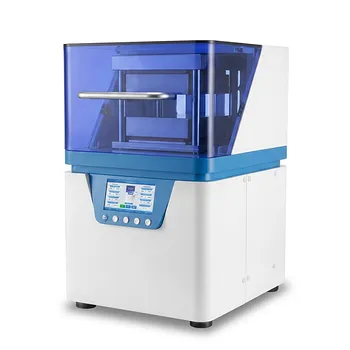
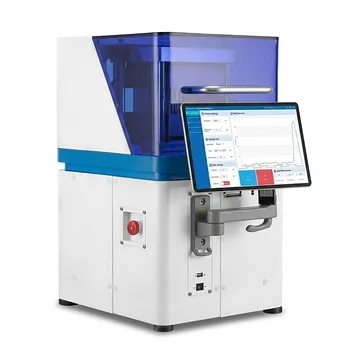
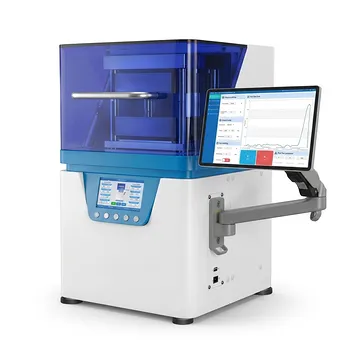
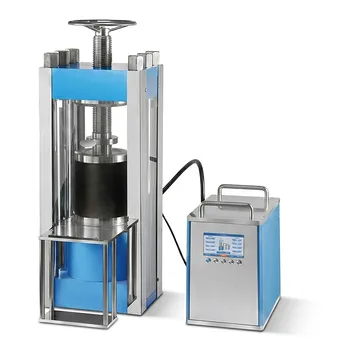
Hot presses are critical thermal processing instruments used to apply simultaneous heat and pressure for material transformation. The main applications across industrial and laboratory settings are defined by four core functions: lamination to bond composites, molding to shape plastics and ceramics, curing to set adhesives and coatings, and compacting to densify powders for metallurgy and pharmaceutical use.
By applying controlled heat and pressure simultaneously, hot presses do more than just shape materials; they fundamentally alter material properties—enhancing density, ensuring structural integrity, and preparing precise samples for analytical testing.
Core Functional Applications
The utility of a hot press is best understood by the physical changes it induces in materials. Whether in a heavy industrial plant or a research laboratory, the equipment is generally employed to achieve one of the following four outcomes.
Lamination and Bonding
Lamination is the process of uniting different distinct layers into a single, cohesive structure.
Hot presses use heat to activate bonding agents or melt interface layers, while pressure ensures complete contact without voids.
This is essential for creating multilayer composites and advanced material structures where layer adhesion determines the final strength of the product.
Precision Molding
Molding involves shaping pliable materials into specific, permanent forms.
This is a standard application for processing plastics, rubber, and ceramics.
By controlling the temperature profile, the press ensures the material flows into the mold cavity correctly before solidifying, resulting in precise geometries and minimal waste.
Material Curing
Curing refers to the chemical process of toughening or hardening a polymer material.
Hot presses promote the proper curing of adhesives, composites, and coatings.
The application of heat accelerates the chemical reaction (cross-linking), while pressure maintains the shape and integrity of the component, significantly enhancing its final mechanical properties.
Compacting and Densification
Compacting focuses on reducing porosity to increase density.
This is critical in powder metallurgy, ceramics, and pharmaceuticals, where granular materials must be fused into solid forms.
High pressure eliminates air gaps between particles, while heat assists in the sintering or binding process, resulting in a denser, stronger final product.
Specialized Laboratory Contexts
While the functions above apply generally, laboratories utilize hot presses for distinct, high-precision tasks involving Research and Development (R&D) and Quality Control.
Sample Preparation for Spectroscopy
In analytical chemistry, hot presses are indispensable for preparing samples for spectroscopic analysis.
They are used to create compressed pellets, such as pressing a KBr matrix for infrared (IR) spectroscopy or briquetting inorganic samples for X-ray fluorescence (XRF).
This ensures the sample is uniform and optical-quality, which is vital for accurate data collection.
R&D and Small-Batch Manufacturing
Laboratories often use these presses for short production runs or "lean manufacturing" to test new concepts without interrupting mass production lines.
They facilitate the development of new materials by allowing researchers to manipulate variables (temperature, tonnage, dwell time) on a small scale.
Common R&D tasks include cell manufacturing, tissue pressing, and testing the flow and durability of new polymer formulations.
Critical Operational Trade-offs
When selecting or operating a hot press, understanding the limitations is as important as understanding the capabilities.
Precision vs. Throughput
Laboratory presses are designed for high precision and control, often handling small sample sizes or single items.
They are generally not suited for high-volume mass production, which requires faster cycle times and automated feeding systems found in larger industrial hydraulic presses.
Temperature Uniformity vs. Complexity
Achieving perfectly uniform temperature across the platens is critical for processes like lamination and curing.
Uneven heating can lead to warping, delamination, or incomplete curing.
However, achieving high uniformity often requires more expensive equipment with complex heating zones and control systems.
Determining the Fit for Your Application
To maximize the value of a hot press, align the equipment's capabilities with your specific output goals.
- If your primary focus is Materials Analysis: Prioritize a press capable of high-pressure compaction to create uniform pellets for spectroscopy (IR, XRF) or calorimetry.
- If your primary focus is Product Development: Look for a press that offers precise control over temperature and pressure ramps to simulate lamination and molding processes on a small scale.
- If your primary focus is Materials Engineering: Ensure the press can deliver the necessary force to compact powders and reduce porosity in ceramics or metallurgy samples.
Ultimately, the effective use of a hot press depends on balancing the need for geometric shaping with the requirement for chemical or physical property enhancement.
Summary Table:
| Application Category | Core Function | Primary Industries/Materials |
|---|---|---|
| Lamination & Bonding | Uniting layers into cohesive structures | Multilayer composites, Advanced materials |
| Precision Molding | Shaping pliable materials into geometries | Plastics, Rubber, Ceramics |
| Material Curing | Hardening polymers/adhesives via heat | Coatings, Composites, Adhesives |
| Compacting | Densifying powders & reducing porosity | Powder metallurgy, Pharmaceuticals |
| Sample Preparation | Creating pellets for analytical testing | Spectroscopy (FTIR, XRF), Chemistry |
Elevate Your Lab's Precision with KINTEK
Ready to transform your material processing? KINTEK specializes in comprehensive laboratory pressing solutions, offering a versatile range of equipment including manual, automatic, heated, multifunctional, and glovebox-compatible models. Whether you are conducting battery research or developing new ceramics, our cold and warm isostatic presses provide the uniformity and control required for high-stakes R&D.
Maximize your research potential today. Contact our experts at KINTEK to find the perfect pressing solution tailored to your specific application and material requirements.
Related Products
- Automatic Hydraulic Hot Press with Large Plate and Precision Temperature Control for Advanced Material Sample Preparation and Industrial Research
- Automatic High Temperature Heated Hydraulic Press Machine with Heated Plates for Lab
- Heated Hydraulic Press Machine with Heated Plates for Vacuum Box Laboratory Hot Press
- Automatic Heated Hydraulic Press Machine with Hot Plates for Laboratory
- Heated Hydraulic Press Machine With Heated Plates For Vacuum Box Laboratory Hot Press
People Also Ask
- What are the specific features and applications of hydraulic hot press machines? Precision Solutions for Modern Labs
- How does an automatic hydraulic press operate? Achieve Precision and Consistency in Lab Pelleting
- What are the advantages and common applications of an automatic hydraulic press? Elevate Your Lab's Precision
- What is the technical significance of setting a precise dwell time? Achieve Peak Material Density and Stability
- When is an automatic hydraulic press more suitable than a manual press? Scale Your Lab with Precision & Speed