
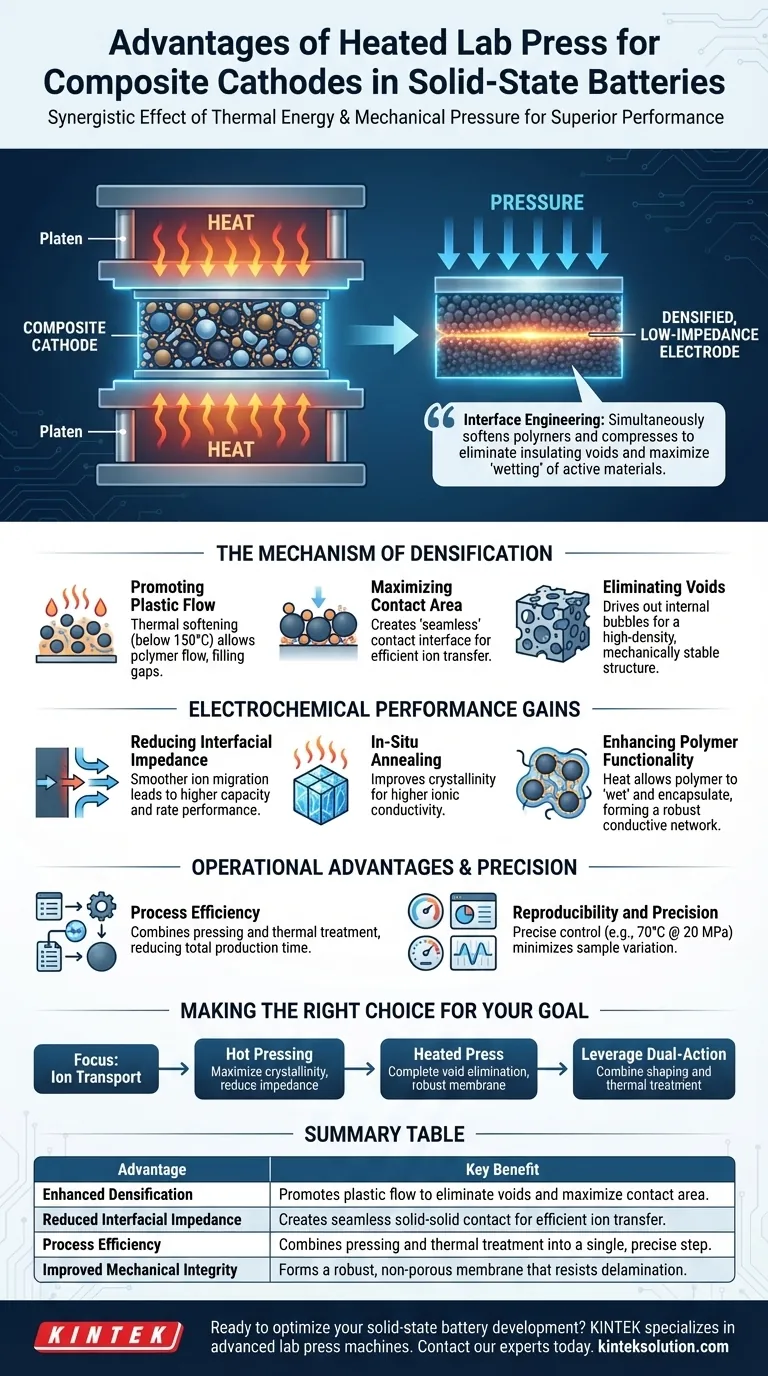
The primary advantage of using a heated lab press for composite cathodes is the synergistic effect of thermal energy and mechanical pressure, which creates a denser, lower-impedance electrode than pressure alone can achieve. While cold pressing establishes basic mechanical strength, adding heat allows for the deformation and plastic flow of electrolyte particles, resulting in superior solid-solid contact.
The core value of hot-pressing lies in interface engineering. By simultaneously softening polymer components and compressing the structure, you eliminate insulating voids and maximize the "wetting" of active materials, directly addressing the high interfacial impedance that limits solid-state battery performance.
The Mechanism of Densification
Promoting Plastic Flow
Materials used in solid-state batteries, particularly those with low bulk modulus, benefit significantly from thermal softening. Applying gentle heat (e.g., below 150°C) reduces the viscosity of polymer binders and solid electrolytes. This allows the material to flow plastically under pressure, filling gaps that rigid, cold particles would otherwise bridge over.
Maximizing Contact Area
Standard compression often leaves microscopic gaps between the active material and the electrolyte. By softening the electrolyte particles, the press forces them to conform to the surface of the active material. This creates a "seamless" contact interface, which is critical for efficient ion transfer.
Eliminating Voids
The combination of heat and pressure transforms a loose, porous powder mixture into a continuous, uniform whole. This dual action effectively drives out internal bubbles and inter-particle voids. The result is a mechanically stable structure with high density, which is a prerequisite for reliable battery operation.
Electrochemical Performance Gains
Reducing Interfacial Impedance
The most critical barrier in solid-state batteries is the resistance at the solid-solid interface. By ensuring intimate contact through hot pressing, you significantly reduce this impedance. A well-densified cathode allows for smoother ion migration, which directly translates to higher capacity and better rate performance.
In-Situ Annealing
The hot-pressing procedure functions as a simultaneous annealing treatment. For certain electrolytes, this thermal exposure improves crystallinity. Enhanced crystallinity within the composite electrode can lead to higher ionic conductivity, boosting the overall efficiency of the cell.
Enhancing Polymer Functionality
In cathodes using polymer components like PEO, heat is essential for encapsulation. The elevated temperature allows the polymer to "wet" and encapsulate the active material particles. This forms a robust conductive network that connects the electrode both ionically and physically.
Operational Advantages and Precision
Process Efficiency
A heated press combines multiple fabrication steps into one. Instead of pressing a pellet and then annealing it in a separate oven, hot pressing achieves densification and thermal treatment simultaneously. This reduces total production time and increases throughput.
Reproducibility and Precision
Advanced heated presses offer precise control over both temperature and pressure parameters (e.g., maintaining exactly 70°C at 20 MPa). This precision minimizes variation between samples, ensuring that results are consistent—a vital factor when scaling from material discovery to high-quality manufacturing.
Making the Right Choice for Your Goal
While cold pressing offers basic consolidation, hot pressing is the definitive choice for optimizing electrochemical performance.
- If your primary focus is Ion Transport: Prioritize hot pressing to maximize crystallinity and reduce interfacial impedance through the annealing effect.
- If your primary focus is Mechanical Integrity: Use the heated press to ensure complete void elimination, creating a robust, non-porous membrane that resists delamination.
- If your primary focus is Manufacturing Speed: Leverage the dual-action efficiency of the press to combine shaping and thermal treatment into a single workflow.
Hot pressing is not merely a forming step; it is a critical conditioning process that defines the ultimate microstructure and efficiency of your solid-state cell.
Summary Table:
| Advantage | Key Benefit |
|---|---|
| Enhanced Densification | Promotes plastic flow to eliminate voids and maximize contact area. |
| Reduced Interfacial Impedance | Creates seamless solid-solid contact for efficient ion transfer. |
| Process Efficiency | Combines pressing and thermal treatment into a single, precise step. |
| Improved Mechanical Integrity | Forms a robust, non-porous membrane that resists delamination. |
Ready to optimize your solid-state battery development with precision hot-pressing? KINTEK specializes in advanced lab press machines, including automatic, isostatic, and heated lab presses, designed to meet the exacting demands of laboratory research. Our equipment provides the precise control over temperature and pressure you need to achieve superior electrode densification, reduce interfacial impedance, and accelerate your path from material discovery to high-quality manufacturing. Contact our experts today to discuss how a KINTEK heated lab press can bring critical advantages to your battery development workflow.
Visual Guide
References
- Jon A. Newnham, Wolfgang G. Zeier. Progress and Challenges in Li <i>M</i> OCl <sub>4</sub> and Na <i>M</i> OCl <sub>4</sub> ( <i>M</i> = Nb, Ta) Oxyhalide Solid Electrolytes for Solid‐State Batteries. DOI: 10.1002/aenm.202504067
This article is also based on technical information from Kintek Solution Knowledge Base .
Related Products
- 24T 30T 60T Heated Hydraulic Lab Press Machine with Hot Plates for Laboratory
- Manual Heated Hydraulic Lab Press with Integrated Hot Plates Hydraulic Press Machine
- Automatic High Temperature Heated Hydraulic Press Machine with Heated Plates for Lab
- Automatic Heated Hydraulic Press Machine with Hot Plates for Laboratory
- Heated Hydraulic Press Machine with Heated Plates for Vacuum Box Laboratory Hot Press
People Also Ask
- Function of a Laboratory Hydraulic Press with Heated Platens in SSE? Enhance Battery Density & Conductivity
- Why is a laboratory hydraulic press with heating plates required for PLA/TEC films? Achieve Precise Sample Integrity
- What role does a laboratory heated hydraulic press play in LTCC? Essential for High-Density Ceramic Lamination
- Why reduce load when applying composite strengthening tabs? Protect Specimen Integrity and Data Accuracy
- Why is a laboratory heated hydraulic press utilized during the lamination stage of NASICON green tapes?



















