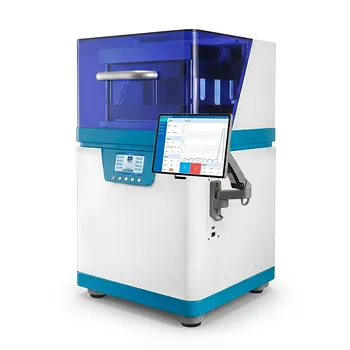
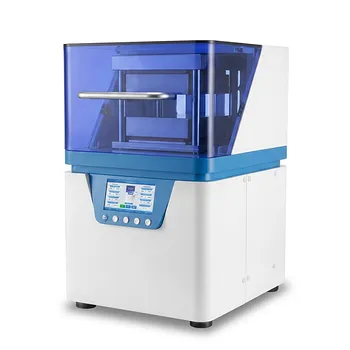
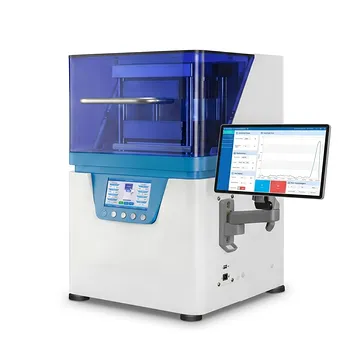
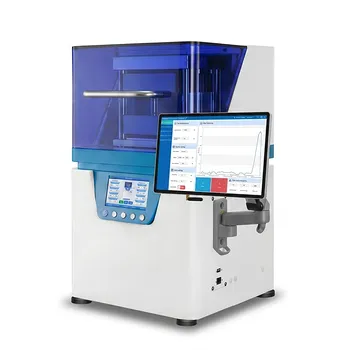
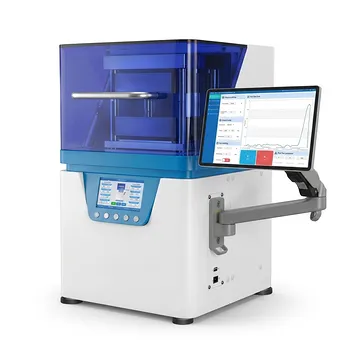
Hydraulic presses act as the critical standard for force application in modern laboratory environments. Their primary advantages lie in their ability to deliver high, consistent pressure within a compact footprint, allowing researchers to create homogenous samples with minimal physical effort and high reproducibility.
While raw power is a key feature, the definitive value of a laboratory hydraulic press is its ability to standardize sample preparation. By removing manual variability, these tools ensure that analytical results—particularly in spectroscopy and material testing—remain accurate and comparable across different experiments.
Enhancing Sample Quality and Precision
Achieving Sample Homogeneity
The most significant advantage of using a hydraulic press is the ability to create perfectly uniform samples. In analytical techniques like XRF or FTIR spectroscopy, the consistency of the sample pellet directly influences the accuracy of the reading.
Precision Force Control
Unlike manual alternatives, hydraulic systems allow for the application of consistent, repeatable pressure. This ensures that every sample is subjected to the exact same conditions, minimizing data errors caused by structural inconsistencies.
High-Quality Output
The stability provided by these presses results in high-quality samples that are free from the defects often caused by uneven manual force. This is particularly vital in pharmaceutical and polymer testing, where sample integrity is paramount.
Operational Efficiency and Design
Maximizing Force with Minimal Effort
Hydraulic presses are designed to generate immense force—often up to several tons—with relatively low input power. This allows laboratory personnel to perform heavy-duty compression tasks without significant physical exertion or fatigue.
Compact Laboratory Footprint
Space is often a premium resource in research environments. Hydraulic presses, particularly manual and benchtop models, are prized for their compact design, delivering high-tonnage capabilities without occupying large amounts of bench space.
Cost-Effectiveness
For many undergraduate chemistry labs and industrial testing facilities, these presses represent a cost-effective solution. They offer professional-grade force generation and durability without the extreme expense associated with larger, automated industrial machinery.
Versatility in Application
Broad Material Compatibility
These tools are not limited to a single discipline; they are highly versatile workhorses. They effectively handle a wide range of materials, including ceramics, metals, polymers, and complex pharmaceutical compounds.
Adaptability for Specialized Testing
Beyond simple crushing, hydraulic presses—especially hydraulic hot press machines—are essential for specialized tasks. They are widely used for tension testing, composite molding, and creating laminates where temperature and pressure must be controlled simultaneously.
Understanding the Trade-offs
Maintenance Requirements
While generally durable, hydraulic systems rely on fluids and seals that require regular inspection. Neglecting maintenance on hydraulic oil levels or seals can lead to pressure losses or fluid leaks over time.
Cost vs. Automation
While basic models are cost-effective, advanced units with fully automated programmable controls can be expensive. Laboratories must balance the need for high-throughput automation against the lower cost of manual or semi-automatic models.
Making the Right Choice for Your Goal
To maximize the value of a hydraulic press, align the machine's capabilities with your specific research objectives:
- If your primary focus is Analytical Spectroscopy (FTIR/XRF): Prioritize a press with extreme precision and stability to ensure the creation of perfectly homogenous, defect-free pellets.
- If your primary focus is Polymer or Composite Research: Look for a hydraulic hot press that offers integrated heating elements to study material behavior under simultaneous heat and pressure.
- If your primary focus is Undergraduate Education: Select a manual, compact model that balances durability and safety with a cost-effective price point.
The right hydraulic press transforms the variable of force into a constant, ensuring that your data reflects the material's properties rather than the preparation method.
Summary Table:
| Advantage | Key Benefit | Ideal Application |
|---|---|---|
| Sample Homogeneity | Eliminates voids and defects for accurate readings | FTIR & XRF Spectroscopy |
| Precision Control | Repeatable, consistent force application | Material Testing & R&D |
| Compact Design | High tonnage with a small footprint | Benchtop Lab Operations |
| High Efficiency | Generates tons of force with minimal manual effort | Pharmaceutical & Polymers |
| Versatility | Supports heating, cooling, and various materials | Battery & Composite Research |
Elevate Your Research with KINTEK Pressing Solutions
Don't let sample variability compromise your analytical results. KINTEK specializes in comprehensive laboratory pressing solutions designed to turn force into a reliable constant. Whether you are conducting cutting-edge battery research, pharmaceutical testing, or material science, our diverse range of equipment—including manual, automatic, heated, multifunctional, and glovebox-compatible models, as well as cold and warm isostatic presses—provides the precision your lab demands.
Ready to standardize your sample preparation? Contact us today to find the perfect high-performance press for your specific application and discover the KINTEK advantage in durability and precision.
Related Products
- Automatic Hydraulic Hot Press with Large Plate and Precision Temperature Control for Advanced Material Sample Preparation and Industrial Research
- Automatic Hydraulic Heat Press Machine with Multi Stage Programmable Control and Integrated Water Cooling Plate Size 180x180mm
- Automatic High Temperature Heated Hydraulic Press Machine with Heated Plates for Lab
- Automatic Heated Hydraulic Lab Press with Programmable Touch Screen Controls and Precision Temperature Regulation
- Manual Heated Hydraulic Lab Press with Integrated Hot Plates Hydraulic Press Machine
People Also Ask
- What are the specific features and applications of hydraulic hot press machines? Precision Solutions for Modern Labs
- How does an automatic hydraulic press operate? Achieve Precision and Consistency in Lab Pelleting
- What are the advantages and common applications of an automatic hydraulic press? Elevate Your Lab's Precision
- What is the technical significance of setting a precise dwell time? Achieve Peak Material Density and Stability
- When is an automatic hydraulic press more suitable than a manual press? Scale Your Lab with Precision & Speed