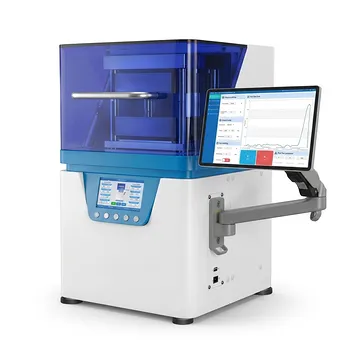
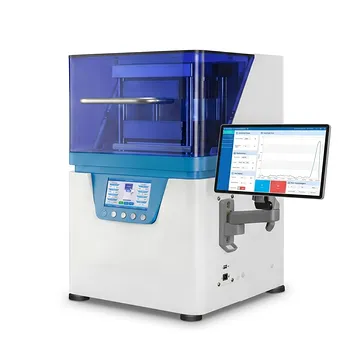
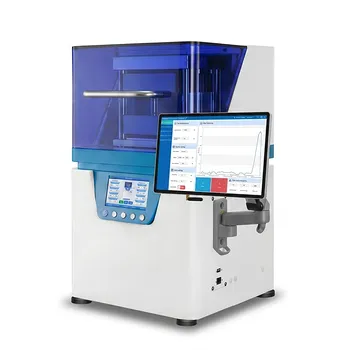
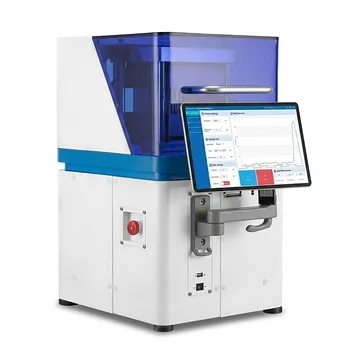
Laboratory hydraulic presses are critical instruments designed for material characterization and precise sample preparation. Their primary applications are testing the strength and durability of materials, investigating the behavior of substances under high pressure, and compressing powders into pellets for analytical techniques such as FTIR and XRF spectroscopy.
The laboratory hydraulic press bridges the gap between raw material and actionable data. By applying controlled force on a small scale, it ensures that samples are uniform for analysis and that materials are rigorously stress-tested before full-scale deployment.
Sample Preparation for Spectroscopy
For many laboratories, the hydraulic press is the standard tool for preparing samples for chemical analysis. The quality of the analysis depends entirely on the consistency of the sample preparation.
Creating Pellets for Analysis
Techniques like FTIR (Fourier Transform Infrared Spectroscopy) and XRF (X-Ray Fluorescence) require samples to be solid, flat, and transparent to the analyzing beam.
A hydraulic press compresses powdered samples—often mixed with a matrix like potassium bromide (KBr)—into thin, uniform discs or "pellets."
Ensuring Homogeneity
Loose powders often yield inconsistent results due to air gaps or uneven particle distribution.
By applying high pressure, the press eliminates air pockets and forces particles into close contact. This creates a homogenous sample that yields reproducible, accurate spectroscopic data.
Material Characterization and Testing
Beyond preparation, the press is used as a testing environment to understand how new materials perform under stress.
Testing Strength and Durability
Researchers use these presses to evaluate the mechanical limits of a material.
By subjecting a sample to increasing loads, laboratories can determine the material's yield strength and durability limits. This mimics the forces the material would encounter in real-world industrial applications.
Investigating High-Pressure Effects
Certain substances change their phase or chemical properties when subjected to extreme pressure.
A laboratory press allows scientists to investigate these pressure-induced effects in a controlled, safe environment. This is essential for fundamental physics research and materials science.
Advanced Research and Development
Modern research utilizes the versatility of hydraulic presses for prototyping and creating complex composite materials.
Pharmaceutical R&D
In drug development, presses are used to test powder compaction properties.
Researchers use this data to determine how well a drug formulation can be compressed into tablet form while maintaining its efficacy and structural integrity.
High-Entropy Alloys (HEA)
In advanced metallurgy, presses are vital during the pretreatment stages of developing high-entropy alloys.
Precursor powders are compressed into "green bodies" of specific densities. Precise pressure control ensures powder particles are in close contact, which is critical for promoting uniformity during subsequent solid-state reactions.
Prototyping Microfluidic Devices
The press allows for the rapid prototyping of microfluidic channels and devices.
By embossing patterns into polymers under pressure, researchers can create precise micro-channels used in lab-on-a-chip technologies.
Understanding the Limitations
While versatile, laboratory hydraulic presses are specialized tools with specific operational boundaries.
Scale Constraints
These units are smaller, precision-focused versions of industrial presses.
They are designed for testing small sample coupons or preparing gram-scale pellets. They are not suitable for testing large structural components or full-scale manufacturing parts.
Throughput vs. Precision
Laboratory presses prioritize control and accuracy over speed.
They generally operate on a manual or semi-automatic cycle ideal for research batches. They are not designed for the high-speed, continuous throughput required in mass production environments.
Making the Right Choice for Your Application
When integrating a hydraulic press into your laboratory, align the equipment capabilities with your primary research outputs.
- If your primary focus is Spectroscopic Analysis (FTIR/XRF): Prioritize a press compatible with standard die sets that delivers consistent, moderate force to create clear, transparent pellets.
- If your primary focus is Material Science and Alloys: Ensure the press offers high-tonnage capacity and precise pressure control to achieve the specific densities required for green body fabrication.
- If your primary focus is Prototyping or R&D: Look for a versatile unit with adjustable daylight (vertical space) to accommodate different molds and experimental setups.
Select the press that delivers the precise force control required to turn your raw materials into reliable scientific evidence.
Summary Table:
| Application Category | Primary Use Case | Key Benefit |
|---|---|---|
| Spectroscopy (FTIR/XRF) | Creating KBr or powder pellets | Ensures sample homogeneity and data accuracy |
| Material Science | Testing strength and durability | Determines yield limits and mechanical properties |
| Advanced R&D | High-Entropy Alloy (HEA) pretreatment | Achieves precise green body density for reactions |
| Pharmaceuticals | Powder compaction testing | Evaluates tablet integrity and formulation efficacy |
| Prototyping | Microfluidic device embossing | Enables rapid fabrication of lab-on-a-chip channels |
Elevate Your Research Precision with KINTEK
Don't let inconsistent sample preparation compromise your analytical results. KINTEK specializes in comprehensive laboratory pressing solutions tailored for precision-driven environments. Whether you are conducting cutting-edge battery research, developing new pharmaceuticals, or performing routine XRF analysis, our equipment delivers the controlled force you need.
Our Range Includes:
- Manual & Automatic Models: For everything from low-volume pellets to high-throughput testing.
- Heated & Multifunctional Presses: Perfect for complex material characterization.
- Glovebox-Compatible & Isostatic Presses: Specialized solutions for sensitive battery and metallurgy research.
Ready to transform your raw materials into actionable scientific data? Contact KINTEK today to find the perfect pressing solution for your lab!
Related Products
- Laboratory Hydraulic Press Lab Pellet Press Machine for Glove Box
- Laboratory Hydraulic Press 2T Lab Pellet Press for KBR FTIR
- 24T 30T 60T Heated Hydraulic Lab Press Machine with Hot Plates for Laboratory
- Laboratory Hydraulic Press Lab Pellet Press Button Battery Press
- Laboratory Hydraulic Pellet Press for XRF KBR FTIR Lab Press
People Also Ask
- How does a laboratory hydraulic press contribute to the preparation of Li3-3xScxSb samples? Optimize Ionic Conductivity
- What is the function of a laboratory hydraulic press in FT-IR of curcumin-coated MWCNTs? Achieve Optical Clarity.
- Why is a laboratory hydraulic press required for compression molding boron-siloxane? Solve High-Loading Density Challenges
- What role does a laboratory hydraulic press play in the preparation of piezoelectric ceramic discs for DC-PG? | KINTEK
- What role does a laboratory hydraulic press play in reaction pellets? Optimizing Lunar Soil and Metal Fuel Density